 Retro Replay Retro Gaming History, Reviews & Emulation


Retro Replay Review
Gameplay
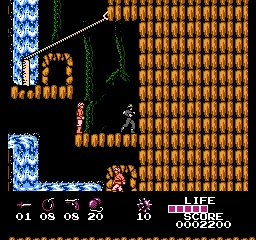
The grappling hook is what makes Arumana no Kiseki worth your attention. Kaito does not simply run through six side-scrolling stages tossing knives at everything in his path. He has to repeatedly hook upward toward ledges and work through spaces that rise far above the ground. That climbing focus gives the game a more exploratory feel than a standard left-to-right action platformer, especially when a waterfall or a narrow vertical shaft becomes the route forward.
You start with throwing knives, then gradually uncover bombs, pistols, bolas, mines, and crystals that clear the screen. That is a satisfying spread for a game of this size. Finding a new weapon feels useful because the stages are filled with enemies and traps, not because the game is merely handing out collectibles. Hidden health-extending necklaces and fedora-shaped extra lives also give diligent searching real value.
The catch is that the same tight level layouts that make the hook interesting can make every mistake sting. Narrow passages packed with traps leave little room to relax, and vertical progress asks you to stay alert rather than blindly rush ahead. If you like mastering a short action game through careful movement, item hunting, and persistence, that tension is part of the fun. If you want a breezy Indiana Jones-style romp, its old-school severity may wear on you.
Graphics
The gameplay screens are bold, chunky, and sometimes downright loud. Bright blue waterfalls cut through black caves and gold-brown rock walls, while temple exteriors use flat blue skies, gray stone, and huge dark green blocks. The contrast makes the climbable spaces easy to pick out, even when the color choices can look harsh.
Kaito is a very small figure against the towering ruins, which helps sell the height of the stages but limits character detail. Orange-clad enemies, skeletal stone decorations, brick corridors, purple trap hazards, and dangling ropes give each area a lively arcade look. The ancient ruins are more colorful than atmospheric, but the waterfalls and vertical shafts are memorable sights.

Story
The setup is clean and appropriately pulpy: the legendary red jewel known as the Arumana has been stolen, and an entire village has been turned to stone. Kaito heads out to retrieve it and put things right.
It is a thin excuse to send a fedora-wearing adventurer into ruins full of danger, but it is a good one. The premise immediately tells you why you are raiding old structures, scaling dangerous walls, and scavenging weapons from the environment.
Do not come to Arumana no Kiseki expecting a character-driven adventure. Its story is a brisk treasure-hunt frame, and the game is stronger for keeping the focus on the next hazardous climb rather than slowing down for a lot of explanation.

Overall Experience
Arumana no Kiseki earns its place among memorable NES action games because it builds its identity around movement, not just combat. The grappling hook turns the ruins into climbing problems, and that simple change makes the search for the Arumana feel more adventurous than the premise alone suggests.
The weapon pickups and secrets add welcome texture, but the game asks for patience. Expect traps, confined routes, and moments where advancing depends on recognizing how to use the hook instead of simply reacting with a weapon. That can be frustrating in the moment, yet it also gives successful progress a satisfying, earned feeling.
Give it a chance if you enjoy compact 8-bit action games with vertical level design and a little treasure-hunting curiosity. It is not a relaxed weekend stroll, but its unusual traversal idea, colorful ruins, and focused adventure-movie energy make the payoff worthwhile for a gamer ready to meet it on its own terms.


Reviews
There are no reviews yet.