 Retro Replay Retro Gaming History, Reviews & Emulation
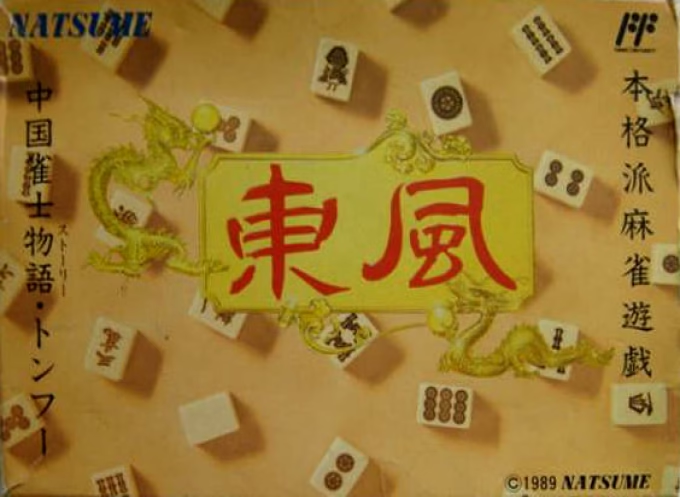
Game Overview
Gameplay
The first few hands of Tonpū are wonderfully blunt. You are staring at your tiles, tracking what the opponent throws away, and trying to build a legal winning hand before they do. There is no confusion about whether this is a matching-pair diversion. It expects you to play Japanese riichi mahjong, including the familiar draw-and-discard rhythm and calls for chi, pon, kan, riichi, tsumo, and ron.
What starts to click is the defensive side of a head-to-head table. Because the opponent’s tiles stay hidden while their discards remain in view, every throw can become a clue or a warning. A safe-looking discard can still hurt, and calling tiles to speed up your hand means revealing more of your intentions. The default East-only tonpū format helps, since you get a sharp contest without settling in for a long session. You can also choose an East/South game when you want more room for the match to develop.
Its oddest wrinkle is Tenjin Tsumo, triggered with Up + A. The manual ties it to a Ki percentage that represents your chance of drawing the winning tile. That is a memorable little bit of risk management, but it is not a substitute for understanding your hand. Frustration sets in if you come in cold on riichi rules, because Tonpū is much more interested in making you learn the table than easing you through it. For a useful point of comparison, 4 Nin Uchi Mahjong covers the broader four-player version of the game, while Tonpū makes its own tighter one-on-one case.
Graphics
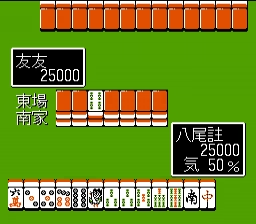
The active table is stripped down to a flat green field, orange-backed concealed opponent tiles, and white face tiles outlined in thin white borders. Red, black, and green characters sit beside circle patterns, with discards gathered in the middle. The contrast makes it easy to separate tile types at a glance, though the tiny markings demand close attention. There is almost no scenery to break up the board, so you spend the whole match looking at mahjong tiles rather than a lively China-themed backdrop.
Story
Tonpū uses a tournament journey as its reason to keep dealing. The protagonist advances through a series of mahjong opponents, which is enough to give wins a little more weight than an isolated exhibition match.
That light framing suits the game because the real drama is in the hand you are trying to finish. You are not here for elaborate scenes between rounds. You are here to beat the next person across the table and move on.
The China setting adds flavor, but it does not overpower the mahjong. This is a progression hook rather than a sweeping narrative, and that honesty works in its favor. Anyone hoping for a dense story-driven adventure will find little to hold onto; anyone who likes a practical reason to keep playing will get it.
Overall Experience
Tonpū is lean, serious Famicom mahjong. Its best moments come when the board narrows to a decision you can feel in your hands: push toward riichi, call a tile to accelerate, or discard cautiously because the opponent’s visible pile is telling a story. The payoff is worthwhile if you already enjoy the mental tug-of-war behind riichi mahjong.
Its limitations are equally plain. The board is visually bare, the tile text is small, and the game does not soften the rules for newcomers. A new player may spend more time deciphering the situation than enjoying its tournament climb.
Still, the focused format has charm. Tonpū does not drown its central contest in extra clutter, and the Tenjin Tsumo gamble gives its old-school table a distinctive flash of nerve. If you want to check the original control and rule notes before sitting down, the original Tonpu instruction booklet scans are worth a look. Give this one a chance if you want compact, competitive mahjong and do not mind earning your comfort with the rules.



Reviews
There are no reviews yet.