 Retro Replay Retro Gaming History, Reviews & Emulation


Retro Replay Review
Gameplay
Your first session starts with a simple but amusing choice: pick three historical rivals and take your seat at a four-player mahjong table. The novelty of facing Caesar alongside Zhuge Liang or Cleopatra does not change the fundamentals, but it is a much better framing device than playing a set of faceless computer opponents. Once the tiles are in play, Mahjong Taikai asks you to settle into the patient rhythm of reading your hand, weighing discards, and reacting to what the other seats reveal.
That pace will either be the game’s strength or its wall. Mahjong is inherently turn-based and thoughtful, and Mahjong Taikai does not disguise that with action-game distractions. If you already enjoy tile games where a single discard can reshape the table, the match-by-match tension has room to grow. If you only know mahjong as a matching puzzle, be ready for a more demanding game built around a full four-player ruleset.
The adjustable rules are the feature that gives the game more staying power than a basic single-ruleset version. Regional differences can matter a great deal in mahjong, so the chance to tailor the rules lets experienced players chase the variant they prefer rather than accept one fixed house style. It also means you should spend a little time deciding what sort of game you want before judging the computer competition.
Ranking progress supplies a clear long-term target, and the grand tournament opening after you advance far enough is a sensible reward for learning the game’s cadence. That structure makes Mahjong Taikai more compelling when you commit to it over several sessions. It is less welcoming when you want a fast, consequence-free round; the payoff comes from improving your results and earning your place, not from instant fireworks.

Graphics
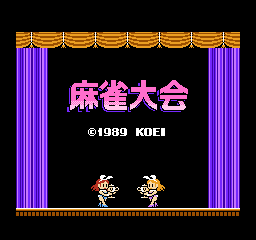
On NES, Mahjong Taikai uses fixed screens centered on the tile table and its information. The view keeps attention on the pieces and the four-player match rather than trying to turn mahjong into a flashy spectacle. The historical-opponent concept gives the game a memorable roster even within that restrained format.

Story
There is no sweeping historical campaign here; the story is the playful idea of gathering famous people from different eras around one mahjong table. Julius Caesar, Genghis Khan, Oda Nobunaga, Napoleon, Zhuge Liang, Cleopatra, and Yang Guifei make for an agreeably absurd lineup, and that is the point. The game treats history as a backdrop for competition rather than asking you to take it seriously.
Your own arc is built through the rankings. You begin by choosing opposition, keep testing yourself in ordinary four-player games, and work toward the grand tournament. That gives the matches a sense of forward motion even though the subject is fundamentally a repeated tabletop contest.
Do not come expecting historical drama from the famous names. Their value is in making the opponents feel more distinct in your imagination and giving the climb a bit of character. For a mahjong game, that light thematic touch is enough: it makes another table worth sitting down at without getting in the way of the rules.
Overall Experience
Mahjong Taikai is a sturdy pick for someone who wants traditional four-player mahjong with more personality than a bare rules implementation. The roster is charming, the rule options respect the depth of the game, and the ranking path gives you a reason to care about more than a single good hand. It understands that mahjong can carry a long game when the rules and stakes are allowed to breathe.
The tradeoff is accessibility. The same deliberate pace and rule complexity that reward a committed mahjong fan can make the opening feel dry if you are not already curious about how the game works. Give it a chance if you want to learn or revisit serious tile play; skip it if the historical faces are the only part that interests you.
For its era and platform, the tournament unlock is a worthwhile carrot, not a substitute for the core game. If the decisions around every discard start to click, climbing the rankings against this bizarre hall of fame becomes genuinely satisfying. Mahjong Taikai earns its place as a focused, niche strategy game rather than a broad crowd-pleaser.


Reviews
There are no reviews yet.