 Retro Replay Retro Gaming History, Reviews & Emulation
Retro Replay Review
Gameplay
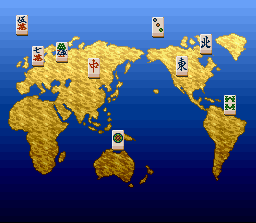
The first thing Mahjong Taikai II does right is put you in the grand tournament. Instead of treating mahjong as a disconnected run of hands, it asks you to survive groups of four and climb through elimination rounds. That structure gives a match real tension: you are not just chasing a satisfying win, but trying to protect a tournament run.
That may sound like a modest change, but it is the kind of addition that can make a sequel feel much more purposeful. A ladder is easier to care about than a plain sequence of opponents, and the upward progression gives you a clear reason to come back after a rough result. If you enjoy mahjong most when every round has consequences, this is the strongest argument for Mah jong Taikai II.
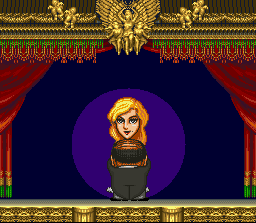
The character creation is rudimentary, limited to choosing your character’s gender and portrait, but it is still a welcome touch. It lets the tournament feel a little more like your own campaign rather than an exhibition you are watching from outside. Do not come expecting a deep role-playing layer; think of it as a small personal stamp on a game built around the matches.
Graphics
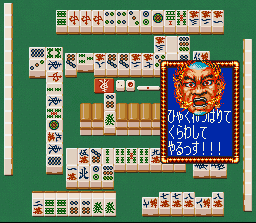
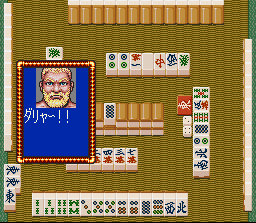
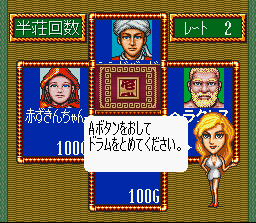
The most concrete visual change is in the portraits surrounding the tournament. Your own selected portrait sits alongside a broader lineup of recognizable historical, literary, artistic, and fictional faces, from Mozart and Sei Shōnagon to Sherlock Holmes and Sinbad. That is a more playful sight than another roster dominated by military rulers.
Story
There is no sweeping narrative pushing Mahjong Taikai II along. The tournament itself is the framework: enter, survive the groups, and advance through elimination rounds.
Its personality comes from whom you face. Replacing figures such as Caesar and Napoleon with writers, artists, prophets, and fictional adventurers makes the contest feel less like a historical pageant and more like a deliberately eclectic gathering.
That choice is charming precisely because it does not need a complicated plot attached to it. Seeing Nostradamus, Mozart, Sherlock Holmes, and Sinbad in the same competitive orbit gives the game a light, slightly silly flavor between hands.
Overall Experience
Mahjong Taikai II sounds like a sequel that understands where the extra value belongs: around the table, not away from it. The tournament mode gives solo play a firmer shape, and the new opponent selection keeps that climb from feeling overly formal.
You should give it a chance if you already enjoy mahjong and want a structured route through a series of increasingly consequential matches. The appeal is not novelty for novelty’s sake; it is the simple satisfaction of earning your way through a bracket.
Its additions are modest, and that is also its limitation. The portrait choice is a nice garnish rather than a major system, while the unusual cast mainly adds atmosphere. Still, the tournament progression is a meaningful payoff: for a mahjong fan, it turns a familiar game into a campaign worth seeing through.


Reviews
There are no reviews yet.