 Retro Replay Retro Gaming History, Reviews & Emulation
Retro Replay Review
Gameplay
The first hour is likely to be spent doing something Mahjong Taikai III handles sensibly: learning how not to drown in mahjong’s rules. Practice is not glamorous, but it matters here. Traditional four-way mahjong asks you to recognize useful tile patterns, weigh risk against opportunity, and stay alert to what three other hands might be building. A game with a dedicated place to study before the serious matches is far more inviting than one that throws you straight into a tournament table.
Once the basics begin to click, the structure gives each match more weight. Free matches let you spend time at the table without the larger stakes, while the Millennium League gives you an eventual target rather than leaving you to play isolated rounds forever. Five stages of matches per season is a solid framework for a tile game: you need consistency, not merely one fortunate hand, to feel as though you have earned progress.
Frustration will still be part of the deal, because mahjong can punish a shaky grasp of its rules and reward patience far more than impulse. This is not a strategy game that rushes you toward constant novelty. Its strength is the slow improvement from confused beginner to someone who can sit down, read a hand with more confidence, and care about the next league stage. If that learning curve sounds satisfying instead of exhausting, the payoff is real.
Graphics
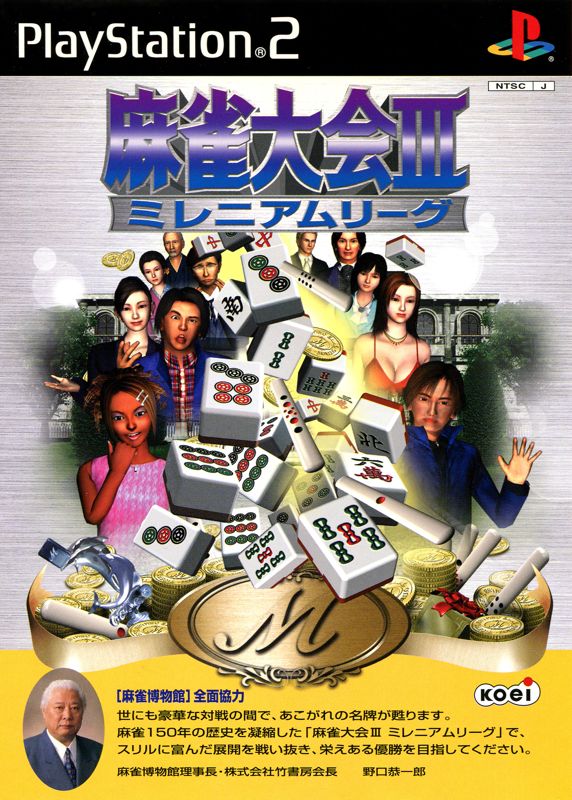
The key on-screen distinction is the opponent roster: this entry uses original contemporary characters from around the world instead of the famous historical figures associated with other Mahjong Taikai games. That gives the tables a more modern cast, even as the focus remains firmly on the tiles and opponents across from you.
Story
You are framed as a new member of a famous mahjong society, which is a clean excuse to begin in practice and work your way upward. It is a better fit for the game than forcing a large dramatic plot around a series of four-player tile matches.
The Millennium League supplies the main sense of advancement. Joining it after learning the ropes turns the game from a collection of matches into a seasonal ambition, with five stages standing between you and a stronger run.
The contemporary international opponent group is the notable change in tone. Rather than leaning on recognizable figures from history, Mahjong Taikai III puts original characters at the table. It is a small narrative shift, but one that suits a turn-of-the-millennium league setting.
Overall Experience
Mahjong Taikai III: Millennium League is most compelling when you treat it as a game to settle into rather than conquer in a weekend. Its practice, free-play, and league path form a sensible arc for traditional mahjong, and the league gives your growing competence somewhere concrete to go.
It will not convert anyone who dislikes the deliberate calculations and occasional cruelty of four-player mahjong. You have to enjoy learning a dense ruleset, accepting bad breaks, and coming back sharper for the next match. But the game respects that commitment by offering both a place to learn and a proper competitive destination.
For a fan of classic tile games, this is an easy recommendation; for a curious newcomer, it is a credible starting point if you are willing to put in the practice time. The contemporary cast does not redefine the series, yet the seasonal Millennium League gives this installment a worthwhile hook beyond a simple set of exhibition tables.


Reviews
There are no reviews yet.