 Retro Replay Retro Replay gaming reviews, news, emulation, geek stuff and more!
Retro Replay Review
Gameplay
The first hour asks you to meet Hyaku Monogatari on its own terms. Rather than sending you into a haunted house to explore or putting survival demands on you, it seats you down for story after story, as if you have joined the old nighttime parlour game that inspired it. Each tale advances the larger ritual: one more unsettling account, one more step toward the darkness at the end of a hundred candles.
That makes this a very particular kind of adventure. Most of the stories are brief and largely non-interactive, so the pleasure is in reading on, absorbing the details, and letting the sound effects and images sharpen the mood. If you need every game to hand you a problem to solve, the linearity can start to feel like a wall. Hyaku Monogatari is closer to a horror collection you pace through than an adventure you master.
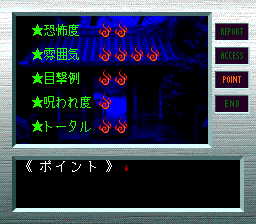
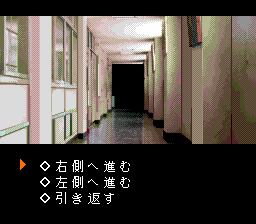
The occasional choice is important precisely because it is rare. Some episodes let you choose a location to visit or decide how to respond, and those decisions can alter a conclusion. The recurring Tokyo-area episode, built around visits to locations and reviews of criminal cases and ghost stories, gives the anthology a thread to return to. Do not expect those branches to transform the whole game, but they break up the passive stretches and give you a reason to pay closer attention when a story finally puts a decision in your hands.
Graphics
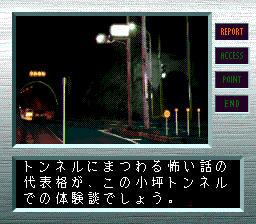
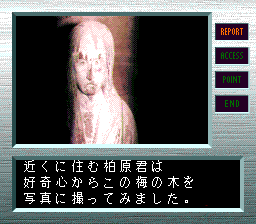
Hyaku Monogatari uses digitized photographs rather than animated horror set pieces. That suits the material: the images give the stories a blunt, documentary-like texture, especially alongside the text and sound effects. It is a restrained look, built for staring at a still image and imagining what it means rather than watching action unfold.
Story
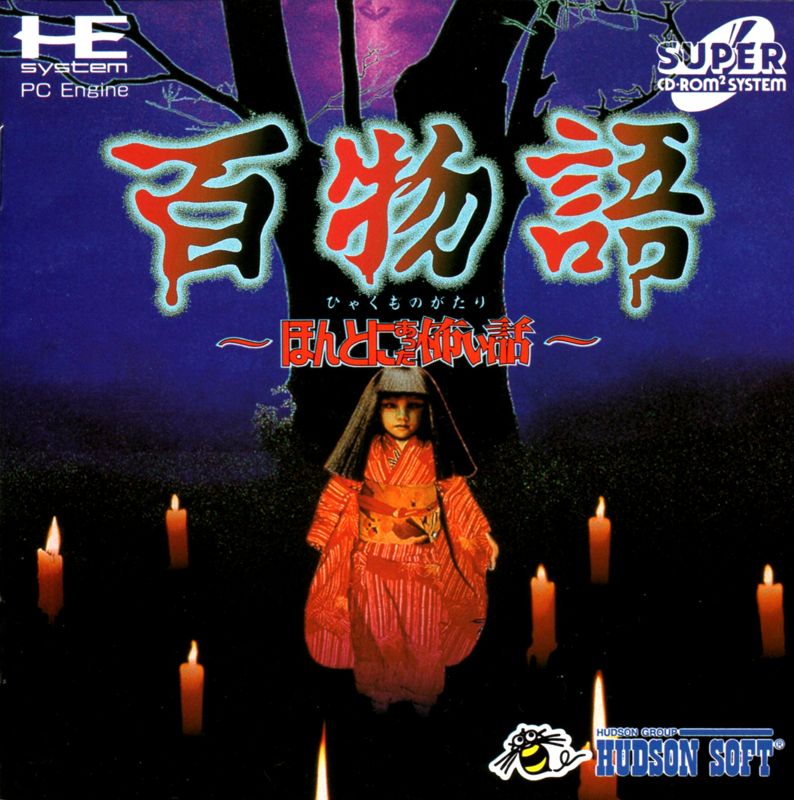
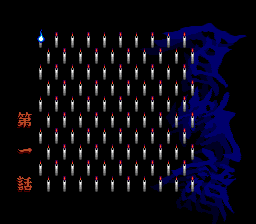
The central idea is excellent. Hyaku Monogatari Kaidankai was a Japanese gathering in which people told ghost stories while extinguishing one hundred candles, leaving the room dark after the final tale. Hudson Soft turns that ritual into the frame for an anthology of “true scary stories,” and the format gives even tiny entries a sense of momentum. You are not just reading an isolated ghost story; you are moving deeper into a long night of them.
The stories’ brevity is both the hook and the limitation. A short account can land like a nasty rumor someone tells you at the wrong time of night, then vanish before it wears out its welcome. On the other hand, the format leaves little room for characters or situations to build beyond their immediate sting. The game works best when you accept that a quick shiver is the intended payoff, not a deeply developed horror narrative.
The Tokyo thread adds some welcome connective tissue. Visiting locations tied to criminal cases and ghost stories gives the collection a recurring real-world angle, which is a smart fit for a game built around supposedly genuine accounts. It will not replace a single sweeping plot, but it makes the hundred-story structure feel less like a completely random stack of tales.
Overall Experience
Hyaku Monogatari is easy to admire and harder to broadly recommend. Its commitment to the source ritual is unusually pure: a hundred stories, a slow march through dread, and only occasional moments where you steer the outcome. That restraint is exactly why it can be effective. Play it alone, late, and in small batches, and its repetition becomes part of the spell rather than a demand for endurance.
Frustration sets in if you arrive wanting the usual visual-novel balance of frequent choices and branching routes, or the usual adventure-game rhythm of investigation and payoff. Here, interaction is the exception. The game asks you to be an audience member first, with the sporadic decisions functioning as a bonus rather than its foundation.
For horror fans with patience for text-heavy anthologies, though, there is real charm in this odd 1995 experiment. The hundred-candle concept gives the collection a memorable shape, and the mix of short tales, photos, and sound effects has a pleasingly old-fashioned campfire-story pull. It is not a must-play for every TurboGrafx CD owner, but it is a distinctive choice if you want horror that feels more like participating in a ritual than clearing a game.


Reviews
There are no reviews yet.