 Retro Replay Retro Gaming History, Reviews & Emulation
Retro Replay Review
Gameplay
The first stretch asks you to slow down and meet Shin Onigashima on its own terms. This is a text-heavy command adventure, not a quick reflex game, so progress comes from selecting context-sensitive actions and paying attention to what the current scene is telling you. The central hook is the ability to switch between Donbe and Hikari. That simple choice gives the adventure more texture than a standard menu of Examine and Talk commands, because deciding who should act is part of working through the tale.
What starts to click is the game’s storybook logic. Donbe and Hikari are not interchangeable heroes, and changing characters turns a basic command menu into a small puzzle about perspective. When you hit on the appropriate action or child, the picture changes and the story moves forward. It is a pleasingly direct feedback loop for an adventure of this era.
Frustration can set in if you expect the game to communicate everything through visuals or if you cannot comfortably read Japanese. Its progress depends heavily on the text, and the command structure has the familiar old-adventure risk of making you pause over what response the scene expects. Still, the character-switching wrinkle keeps it from feeling like a completely passive folktale. Give it a chance if you enjoy deliberate, language-driven adventures and can meet it with patience.
Graphics
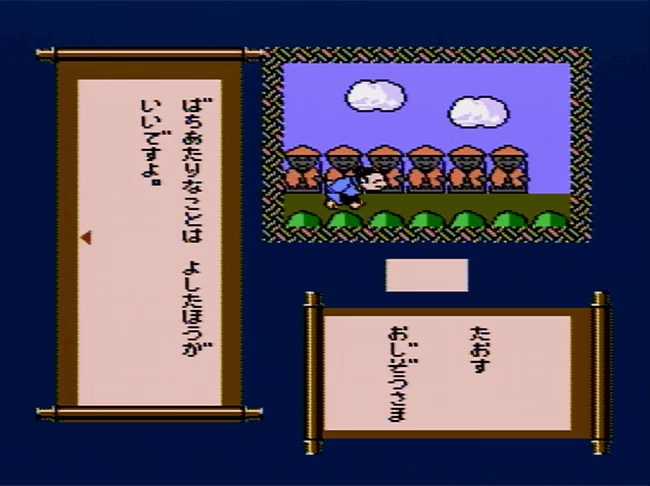
The gameplay appears in a small rectangular picture area, with big-headed cartoon sprites and bold, clearly separated colors. One outdoor scene has a blue-clad Donbe walking past six straw-hatted stone Jizo figures, backed by pale clouds, a lavender sky, and low green shrubs. It is simple, but the scene has the cozy, handmade charm you want from a Japanese folktale.
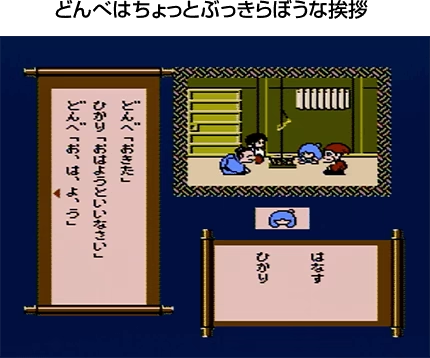
Indoor scenes are equally spare: small figures kneel on light tatami in a dark olive-brown room, with green steps and a barred window breaking up the background. The limited space means these images feel more like little illustrated story panels than places to explore, yet the characters remain easy to pick out and the colors give each scene some personality.
Story
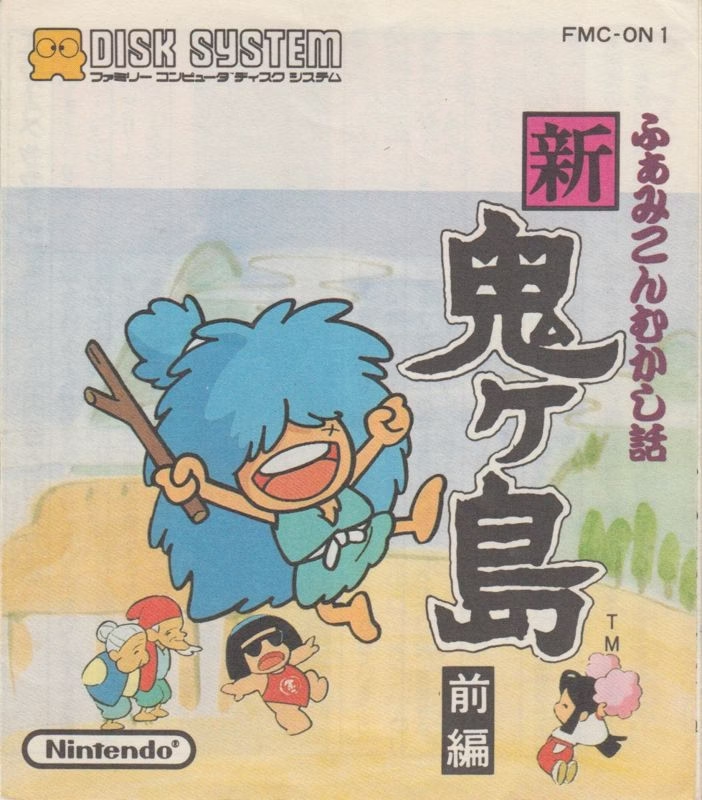
This is where Shin Onigashima has its strongest pull. An elderly childless couple adopts Donbe and Hikari, only for a dragon to bring oni who steal the couple’s souls. The children’s decision to save them gives the adventure an immediate emotional purpose without needing a complicated setup.
The game draws from Japanese folktales including Momotaro, Kintaro, and the bamboo cutter story, while making its two young leads the center of the journey. Donbe’s bowl birth and Hikari’s bamboo birth are wonderfully strange details, and they set the right tone: this is a fairy tale where familiar ingredients are deliberately remixed rather than treated as museum pieces.
The two-disk structure also makes the original release feel like a serial. Disk 2 follows only after Disk 1 is completed, with the swap performed while the Famicom Disk System remains powered on. For more on the original release and its command-adventure format, Nintendo’s official Shin Onigashima history is a useful companion. If the story intrigues you and you want its later Super Famicom adaptation, see Heisei Shin Onigashima: Zenpen, which is a separate version rather than this Disk System original.
Overall Experience
Shin Onigashima is easy to admire because it takes an old-school command adventure and gives it a genuinely specific voice. The rescue quest is warm, eerie, and playful in equal measure, while the Donbe and Hikari switch gives the player a modest but meaningful role in how scenes unfold. It feels less like a test of dexterity and more like being invited into an interactive picture-book mystery.
Its age is apparent in the small scene windows and the stop-and-think rhythm of command selection. The Japanese-language text is the decisive barrier for many modern players, and there is no getting around how much of the experience lives in those words. A player without the language ability will lose far more than plot details, since the commands and their context are the game.
For the right gamer, though, the payoff is real. This is worth seeking out if you value early Nintendo curiosities, Japanese folktales, and adventures that ask for observation rather than fast inputs. It is not a broad recommendation for someone looking for instant action, but its gentle oddness and two-child puzzle structure make it much more than a historical footnote.


Reviews
There are no reviews yet.