 Retro Replay Retro Gaming History, Reviews & Emulation

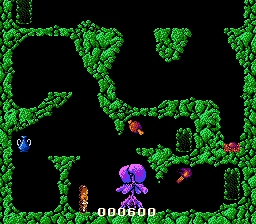
Retro Replay Review
Gameplay
Fire Rock is at its best when you spot a ledge far above, climb a wall toward it, and realize that the meat you just collected has finally given you the jump needed to reach it. That is a wonderfully odd progression idea for an action platformer. Instead of handing you a conventional movement upgrade, the game makes your current jumping ability part of the route-planning puzzle.
Each stage asks you to clear four bosses and locate four key items before the exit opens, so wandering is never entirely aimless. You are constantly balancing immediate danger against a larger question: is this door, cavern, or vertical passage actually taking you toward a missing item? The throwing torches give you a simple means of attack, and upgrading them into Fire Rock adds a satisfying sense that your lone fighter is becoming more capable as the labyrinth grows nastier.
The structure is also where frustration can set in. These are maze-like stages, not clean left-to-right runs, and needing every required boss and key means you cannot casually stumble into the finish. If you enjoy mapping spaces in your head, testing vertical routes, and working toward a locked exit, Fire Rock has a sturdy pull. If you want platforming momentum without much backtracking or searching, its demands may wear thin.
Graphics
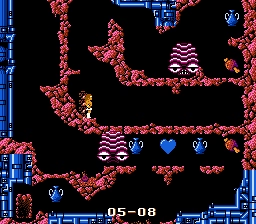
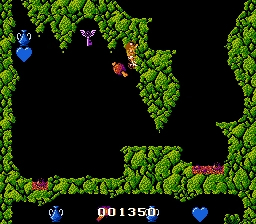
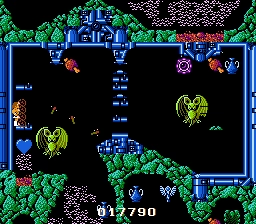
The underground stages have a strong, chunky Famicom look. Blue mechanical walls and doors frame black caverns in the early areas, while later screens fill with bright green rock, tangled vines, and leafy growth. The contrast makes the climbable terrain and openings stand out clearly, even when the screen is crowded with bats and projectiles.
Enemy art is pleasantly strange: blue bat-like creatures, green winged foes, and bulbous pink bosses look suitably at home in the caves. The orange-clad hero is small but easy to pick out against the dark backgrounds, and the oversized organic rock formations give the levels more character than plain corridors would have.
Story
There is a direct, pulpy urgency to Fire Rock’s setup. An invading force arrives hidden inside a falling ray of light, establishes itself beneath the ruins of an ancient human civilization, and then launches its attack on Earth. You head underground alone because someone has to reach the heart of the base.
That premise works because it gives the caverns a purpose beyond being a generic platforming backdrop. Mechanical chambers, monster-filled passages, and later overgrown spaces all fit the idea of an alien stronghold buried in a lost human world. It is a familiar save-the-world mission, but one with enough weirdness to suit the game.
Do not come expecting a story-heavy adventure. The narrative is a clean excuse for the descent and the boss battles, not the main reward. Still, the lone-warrior setup lands well: you are not assembling a party or negotiating with allies, just forcing a path deeper into something that has already taken root beneath Earth.
Overall Experience
Fire Rock has the sort of rough-edged imagination that can make an obscure 8-bit action game worth revisiting. Climb-any-wall movement is useful on its own, but pairing it with jump height that grows through collected meat turns the whole game into a vertical exploration puzzle. That is the idea you will remember after the individual screens blur together.
It asks for patience. Progress depends on thorough exploration, and the requirement to defeat bosses and gather keys makes each stage feel more like a contained expedition than a quick arcade sprint. The payoff is strongest when you enjoy learning a hostile space well enough to turn its dead ends and high ledges into a route.
Give Fire Rock a chance if you like demanding 8-bit platformers with unusual progression systems and a little maze-solving mixed into their action. Its combat setup is uncomplicated, but its stages are not. That tension gives it a personality that many more straightforward contemporaries lack, even if its insistence on searching every corner will test your tolerance for old-school persistence.


Reviews
There are no reviews yet.