 Retro Replay Retro Gaming History, Reviews & Emulation

Retro Replay Review
Gameplay
The first few hands can feel like being dropped into a card room where everyone else already knows the etiquette. You draw, discard, assemble groups, and try to complete a proper mahjong hand against the computer, but the game does not spend much time easing you through the rules. If you already know Japanese mahjong, that directness is refreshing. If you do not, expect to learn with the rules open beside you rather than through the game itself.
Beginner difficulty is the best entry point because it blocks illegal actions with a simple warning. That safety net lets you concentrate on the more interesting question: which tile can you afford to throw away? Once you can read your hand and see potential groups quickly, the compact format starts to click. Every discard becomes a small declaration of intent, and every point swing gives the next hand a reason to matter.
Intermediate and advanced are much less forgiving. Invalid winning declarations carry penalties, so careless button presses have consequences, and advanced gives you roughly twelve seconds for calls and discards before the game acts for you. That timer creates real tension, though it can also be irritating when you need a moment to parse dense tile markings. This version rewards fluency rather than patiently building it.
Matches run through East 1, East 2, South 1, and South 2, with the higher score taking the hanchan and the first side to three match wins taking the contest. That structure gives the computer matches more shape than isolated hands would have. It is a lean, focused conversion, best for someone who wants to practice fundamental decision-making rather than a broad simulation full of distractions. Nintendo’s original Mahjong rules and release information is worth a look before diving in.
Graphics
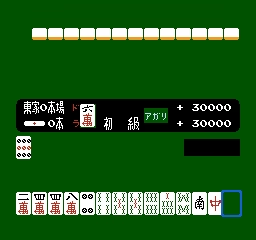
The game board is a dark, flat green table with ivory tiles edged in pale yellow. Your hand sits along the bottom, the computer’s face-down tiles make a neat row across the top, and discards fill the space between. Black and red characters, green bamboo, and colored dot patterns give the tiles their needed distinctions, although the tiny symbols can blur together at native resolution. There are no people or rooms to break up the table view, just the tiles and the decisions they demand.
Story
There is no scripted story here, and that suits the subject. Mahjong does not need a campaign to create drama when a single discard can alter the rest of a hand.
The closest thing to a narrative is the score line across a hanchan. A bad early result can make later hands feel like a recovery effort, while a lead invites cautious choices that may or may not hold up.
That makes its tension personal rather than theatrical. You remember the hand you misread or the risky discard that worked, not a cast of characters or a plot twist.
Overall Experience
Mahjong is a stern little game, even on beginner. It gets to the table immediately and expects you to meet it halfway with at least some rules knowledge. That lack of instruction is the biggest obstacle, especially for anyone arriving from tile-matching solitaire games and expecting a similarly intuitive puzzle.
For a player who knows the basics, its stripped-down nature becomes a strength. The computer opponent, escalating difficulty, match scoring, and advanced time pressure concentrate the experience on reading a hand and making a choice before the opportunity disappears. There is very little padding between you and the core contest.
The payoff is worth it if you want an old-school way to test Japanese mahjong fundamentals against a computer. It is not a welcoming first lesson, and the tiny tile faces make the fastest difficulty more demanding than it needs to be. Still, once you understand what a good hand is asking of you, this is a surprisingly tense and disciplined tabletop conversion.


Reviews
There are no reviews yet.