 Retro Replay Retro Gaming History, Reviews & Emulation



Retro Replay Review
Gameplay
The first few screens make Galious look straightforward: move through side-scrolling rooms, climb ladders, and put a sword to anything hostile. Then the game starts asking you to read each room more carefully. Ghosts are simple targets, but bouncing balls require deliberate sword swings, and creatures that become rocks after a hit turn combat into an obstacle-management problem. That small twist gives the action more texture than a routine slash-and-go platformer.
The redesigned dungeon structure is the biggest reason to try this NES version. Instead of ten smaller dungeons, you get five larger ones with new layouts. That should suit you if you like getting familiar with a place over time, building a mental map of its paths, ladders, walls, and hazards rather than racing through a string of brief stages. The scrolling also lets connected spaces feel more continuous as you move through them.
There is a stern, old-school edge to the design. Narrow passages, mobile threats, and tricky route features can turn a room into a problem you have to solve before you can make progress. A one-sided door is a good example: it is not merely scenery, but a rule you need to recognize and use. Frustration can set in if you want constant forward momentum, yet the payoff comes from learning how each dungeon’s pieces interact and making a route work.
Button-based spell inputs are a smart practical change from the MSX original’s typed incantations. They keep you on the controller and reduce the friction between realizing you need a spell and actually using it. Along with the larger character sprite, it makes this version feel deliberately adapted to the NES rather than simply transferred over.
Graphics
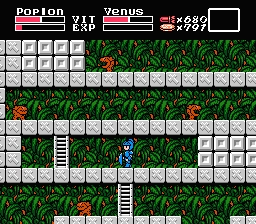
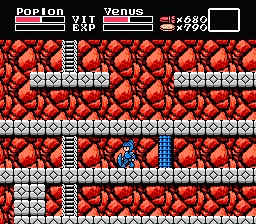
Galious has bold, chunky NES dungeon art that is easy to parse at a glance. Gray blockwork forms crisp platforms and ladders, dense green foliage fills one set of ruins, and another area surrounds you with jagged red rock walls. The blue-and-white ghost sprite stands out clearly against those warm cavern colors, while the player character remains visible amid the busy terrain.
The rooms can look repetitive when the same stone tiles and rock patterns stretch across the screen, but the strong color changes between areas help. Its best images are the compact hazard rooms, where pale blocks, dark green brick, small orange bouncing balls create a lively little maze.

Story
This version retains the MSX game’s story, so the shift to five larger dungeons is a structural revision rather than a new tale. The important difference is in how you travel through the adventure, not in a rewritten narrative.
Fantasy imagery carries the mood: hostile ghosts, strange creatures, stone corridors, overgrown ruins, and volcanic-looking caverns give the journey a classic monster-filled atmosphere. It is a familiar setup, but it fits a game centered on dangerous exploration and dungeon problem-solving.
If you already know the MSX release, you can come in expecting the same narrative framework with substantially altered dungeon spaces. If you do not, Galious still works because its moment-to-moment challenges communicate the stakes: every new room is a place to survive, understand, and push beyond.
Overall Experience
Majō Densetsu II: Daimashikyō Galious is rewarding when you enjoy games that ask for attention instead of handing out easy progress. It has the compact, sometimes punishing rhythm of an early Konami action game, but its enemy behaviors and larger dungeons give it more to chew on than a simple arcade-style platformer.
The NES changes are meaningful. Larger redesigned dungeons encourage deeper exploration, scrolling smooths out the sense of place, and button-operated spells remove a cumbersome barrier from the MSX design. It is not a casual pick for someone who wants a breezy fantasy romp, but it is a strong choice if the prospect of mastering dense, hostile dungeon spaces sounds satisfying.
Give it a chance for the deliberate exploration and the pleasure of gradually decoding its rooms. The rough patches are part of the bargain, especially when hazards and restrictive paths slow you down, but Galious earns its reputation as a distinctive early action-adventure rather than just a historical curiosity.


Reviews
There are no reviews yet.