 Retro Replay Retro Gaming History, Reviews & Emulation
Retro Replay Review
Gameplay
The first hour puts you in the mindset of a detective who cannot afford to be polite to everyone. Akihito Kashihata has only three workdays inside PowerSoft’s office, from 10 AM until 6 PM, and every action costs three minutes. Moving rooms, speaking with someone, using an item, or examining a detail all eat into the day. It is a wonderfully severe rule because it makes the mundane act of choosing your next question feel loaded.
What starts to click is that this is not a game you should brute-force. You do not have enough time to drain every conversation topic from every person you meet. Instead, you follow promising threads, remember who mentioned what, and decide whether a location is worth another visit. Time-limited events add real tension, since missing one can mean losing a clue forever. That can be frustrating when a hunch turns out to be wrong, but it also gives the investigation a rare sense of consequence.
There is a useful contrast here with Portopia Renzoku Satsujin Jiken: both sit comfortably in the Japanese murder-investigation adventure tradition, but Satsui no Kaisō is far harsher about forcing priorities. Come prepared to take notes, track leads, and accept that a first run may be more about learning the shape of the case than cleanly conquering it.
Graphics
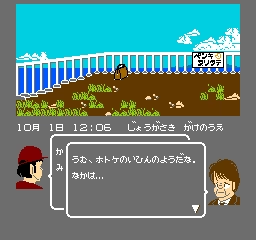
The outdoor scenes use flat, sparse Famicom pixel art: a broad cyan sky behind a white seaside railing, distant white rocky forms, and brown ground dotted with pale stones and small green tufts. It is not a detailed view, but the setting is immediately legible.
Large character portraits do more of the expressive work than the small on-location figures. A dark-haired man in a red cap and a brown-haired man with a pale collar are easy to distinguish, and their faces give conversations more presence than the simple scenery does.
Story
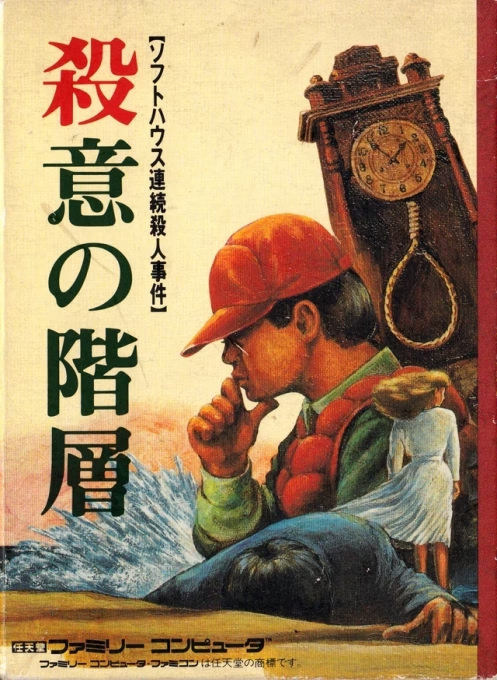
The hook is strong and efficient. Masato Nishikawa, programmer of the newly successful Super Marx Brothers for the Fairy Computer, apparently jumps from a cliff just as his career peaks. His friend Akihito refuses to accept the easy explanation and heads to Masato’s workplace, PowerSoft, to investigate.
That premise earns the game its urgency. A suspicious death at a game company gives the case a specific, memorable setting, while Akihito’s personal disbelief supplies a credible reason to keep digging. The mystery is not treated as a sightseeing tour through suspects. It is a case with deadlines, limited access, and evidence that must be gathered before the trail goes cold.
Most importantly, reaching the credits is not the same as truly closing the case. You can finish without fully solving it, while the true ending requires both identifying the culprit and collecting enough material to build a case. That distinction makes the narrative payoff feel earned, and it gives failure a more interesting shape than a simple dead end.
Overall Experience
Satsui no Kaisō is a demanding detective game because it trusts you to make bad calls, miss appointments, and move forward anyway. Its strict calendar can feel unforgiving, especially if you are used to exhausting every menu option, but the pressure transforms investigation into decision-making rather than routine cleanup.
The payoff is worth the friction if you like mysteries that ask for attention outside the screen. Keep notes, mark leads that sound urgent, and do not spend an entire day chasing weak conversational threads. The game rewards a focused mind far more than a completionist impulse.
Give it a chance if you want a Famicom adventure that makes limited time part of the mystery rather than a cosmetic constraint. It is a tougher, narrower experience than many genre peers, but its three-day structure and evidence-based true ending give its case a satisfying bite.


Reviews
There are no reviews yet.