 Retro Replay Retro Gaming History, Reviews & Emulation


Retro Replay Review
Gameplay
Super Chinese 3 has the restless energy of a game that refuses to settle into one lane. You travel the world from an overhead view, enter towns, buy upgrades, gather clues, and stumble into random monster encounters. That basic loop is familiar, but the fights turn it into something much less conventional: ordinary battles become side-scrolling action sequences where you punch, leap with a somersault, and grab power-ups while trying to empty the enemy’s hit points.
That action is direct enough to understand immediately, and the upgrade path gives it some welcome purpose. Sen earned from victories can go toward ability boosts, weapons, projectiles, throwing stars, martial arts techniques, and other special powers. Instead of merely enduring encounters on the way to the next town, you have a reason to fight through them and see how a stronger set of options changes the next scrap.
Bosses take a sharp turn into turn-based combat. You select commands, items, and learned skills, then the enemy responds in its own turn. It is an unusual split, and not every gamer will enjoy being asked to switch from real-time brawling to command selection at the biggest encounters. Still, it makes bosses feel distinct and asks more from you than simply repeating the same attacks used against regular enemies.
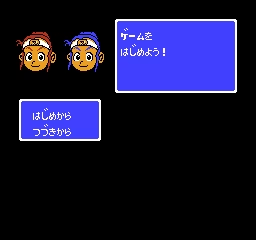
Two-player co-op gives the game its best reason to return. One person controls Jack and the other Ryu, and their shared experience keeps the partnership from becoming lopsided. Solo players control Jack, with Ryu able to join later, which is a smart accommodation for an adventure that is clearly more fun when you can trade blows with a friend. Random encounters can make the road feel stop-and-go, but the changing battle formats prevent the grind from becoming completely monotonous.

Graphics
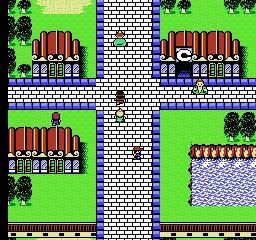
The overhead towns and world map are bright, clean NES pixel art. Green grass, light-blue water, gray brick paths, red-roofed buildings, trees, bridges, and rocky island edges are drawn in bold blocks of color, making each location easy to read at a glance. The world map has a pleasant storybook quality, even if its tiny character sprites are necessarily simple.
Battle screens are rougher and more cramped. The sandy arena, stone walls, dense flowers, and repeated block platforms give the action a lively color palette, while the small cat-ninja enemies are easy to pick out against the ground. It is not elaborate artwork, but it is cheerful and clear in the way a good NES adventure should be.
Story
The setup is wonderfully straightforward: aliens invade Chinaland, seize the emperor, and leave his son to find Jack and Ryu for help. It gives the adventure an immediate rescue mission without asking you to untangle a complicated fantasy history before you can start exploring.
The towns matter because their inhabitants supply clues and information, turning each stop into more than a shopping break. You are pushing toward the emperor’s rescue, but the route is shaped by the local guidance you pick up along the way. That suits the game’s compact action RPG structure well.
Jack and Ryu are defined more by their role as resident ninja masters than by deep characterization. That is not a flaw if you want a clean arcade-adventure premise, but it does mean the story functions mainly as momentum for the traveling, fighting, and upgrading. The alien takeover is colorful motivation rather than the kind of narrative that will carry the game by itself.
Overall Experience
Super Chinese 3 is a charmingly odd NES action RPG, and its willingness to combine exploration, scrolling brawls, upgrades, and turn-based boss battles is its strongest asset. You may need a little time to adjust to its changing rhythm, but that same unpredictability keeps the trip from feeling like a routine walk through towns and random encounters.
Its limitations are also rooted in that design. Random fights can interrupt exploration, and the shift in boss rules may feel less like a natural escalation than a separate game briefly taking over. If you want one polished combat system carried through the whole adventure, this can be frustrating.
Give it a chance if you enjoy energetic 8-bit experiments and can bring along a second player. The shared progression system makes co-op feel practical rather than tacked on, and the campaign’s mix of action and RPG rewards gives it more staying power than a simple beat-’em-up. It is not a smooth fit for every taste, but it is easy to respect how much it tries to do.


Reviews
There are no reviews yet.