 Retro Replay Retro Gaming History, Reviews & Emulation



Retro Replay Review
Gameplay
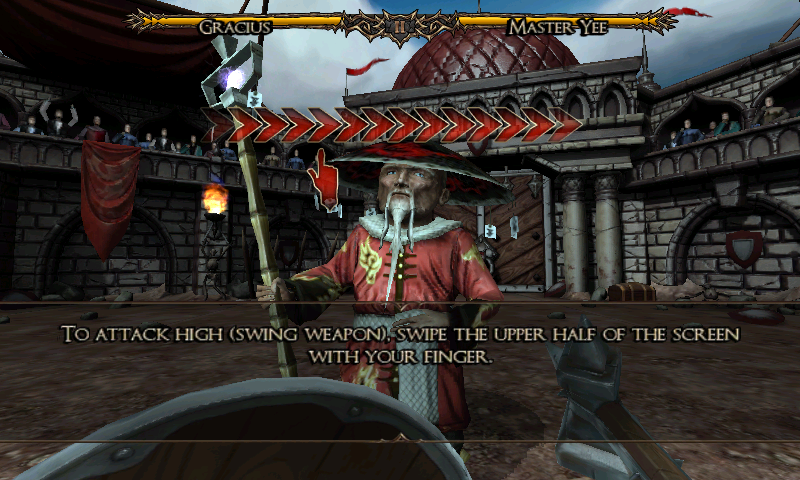
Rage of the Gladiator is at its best when you are one hit away from losing a round, staring down a monster whose rhythm you only half understand, and deciding whether to commit to an attack or wait for the safer counter. It borrows the pattern-learning tension of Punch-Out, but the first-person view puts you directly behind the prince’s shield. You cannot circle an opponent or create space; survival comes from reading their motions, dodging at the right moment, jumping over the right attack, or raising your shield against many energy attacks.
That simplicity is deceptive. Each battle is a single-opponent test, and the early fights teach the basic language clearly enough: watch, react, punish. Soon, though, victory depends less on raw reflexes than on remembering what an opponent can do and resisting the urge to swing at the wrong opening. The three difficulty tiers are not merely stat bumps. Familiar enemies gain new attacks and patterns, forcing you to revise habits that carried you through earlier circuits. That is where the game becomes much more than a tribute.
There is meaningful room to shape your approach between bouts. Wins earn money and skill points, which can improve attack, defense, and magic, unlock combo attacks, or strengthen perks such as critical-hit odds and magic buildup. Money also goes toward gear, health, magic items, and more skill points. The three-part magic meter adds another layer of timing because each segment can hold an assigned magic or combo attack. It is not a complicated role-playing system, but it gives repeat attempts a sense of progress.
Replaying is part of the deal, not a side activity. Battles award one to three stars based on how cleanly you finish their three-round structure, and a no-round-loss win pays better. Potions can restore health or build magic during a fight, but they do not replace learning the opponent. If you enjoy practicing a tough encounter until its tricks finally become second nature, that loop is intensely satisfying. If repeated losses make you impatient, the requirement to defeat each foe before advancing may wear thin.

Graphics
The first-person arena framing keeps the opponent front and center, which suits a game built around watching for attacks. The roster has a pleasingly broad fantasy spread: an Orc-like fighter, a Minotaur, a Beholder, human-like combatants, and an East Asian-styled tutor all bring distinct looks and fighting styles to the bouts.

Story
You play a deposed prince in Avalance, accused of murdering his father, the king, and forced to fight for freedom and retribution in a Roman-style arena. It is a sturdy excuse to send you through a procession of monsters and madmen, but it has more personal stakes than the standard faceless tournament climb.
The story arrives through cutscenes and first-person narration, with each completed difficulty moving the plot onward. That structure makes the higher circuits feel like chapters rather than simply remixed challenge modes, even as the real drama remains inside the arena.
Do not come expecting the narrative to eclipse the combat. The prince’s accusation and his fight to clear his name give the game direction, while the varied opponents supply the immediate flavor. It is enough context to make another hard-won win feel like forward motion.
Overall Experience
Rage of the Gladiator understands why the best Punch-Out-style fights endure: a loss can look unfair for a few seconds, then reveal itself as a lesson. Once an enemy’s feints, energy attacks, and punishable gaps start to click, you feel smarter rather than merely stronger. The first-person perspective makes that discovery loop especially immediate.
The progression systems help, but they never let you ignore the central demand for timing and recognition. Expect to replay fights for cash, skill points, and better star ratings, especially if you want to build out combos and perks. That grind has a purpose because the upgrades feed back into a combat system that still asks you to execute.
This is an easy recommendation for anyone who enjoys deliberate boss encounters, score improvement, and games that reward practice over panic. It is a harder sell if you want free movement, broad exploration, or a fighting game driven by long command lists. For the right kind of stubborn competitor, though, its focused arena duels deliver a sharp payoff. For game history and release details, see Rage of the Gladiator’s reference page.


Reviews
There are no reviews yet.