 Retro Replay Retro Gaming History, Reviews & Emulation
Retro Replay Review
Gameplay
The first few minutes make the central trick plain: this is Zelda action built for more than one hero. In multiplayer, the game’s energy comes from sharing the work of moving through a top-down fantasy adventure and handling its puzzle elements together. That makes it a much snappier proposition than a long, solitary quest; you can jump in, solve a few problems, and feel like the session had a beginning and an end.
The Anniversary Edition’s most important addition is its solo mode. You control one Link directly while the other is AI-controlled, and you can switch which one you command. That is a simple change with a big practical payoff. Instead of requiring a second player to access the game’s core idea, you are asked to think in pairs: take direct control of the Link needed at the moment, then hand the other role back to the AI.
That adjustment does not erase the game’s multiplayer roots. Solo play asks you to manage both sides of an experience originally built around multiple people, so it will not replace the easy back-and-forth of playing alongside a friend. Still, switching between Links gives the edition a purpose of its own. It is the version to try if you have always been curious about Four Swords but rarely have a partner ready for a handheld session.
If the format clicks, you may also want to see how the idea developed in The Legend of Zelda: Four Swords Adventures. Anniversary Edition feels more compact, but its two-Link hook is strong enough to make the series’ larger co-op ambitions easy to understand.

Graphics
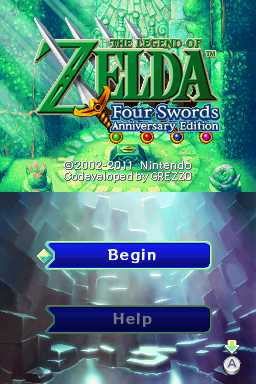
The game uses a top-down view that suits its action and puzzle focus, with two Links sharing the screen in solo mode or multiplayer. Its fantasy imagery is immediately familiar Zelda territory: small heroes seen from above, built for quick movement through an adventure rather than dramatic close-up detail.
Story
This is not the Zelda game to pick for a sweeping, character-heavy tale. Four Swords puts its premise in the service of play: there are multiple Links, and the fun comes from what that changes about the adventure.
In multiplayer, that shared premise gives each session a naturally social flavor. You are not just guiding one hero through a fantasy world; you are dealing with an adventure designed around more than one person being involved.
Solo mode shifts that same idea inward. Swapping between the player-controlled and AI-controlled Links turns the game’s partnership theme into a practical part of your own decision-making, which is a more interesting narrative angle than simply playing through a standard one-hero Zelda setup.
Overall Experience
Four Swords – Anniversary Edition is a thoughtful reworking of a multiplayer component that could easily have stayed inaccessible whenever you were alone. The added solo option makes the game far easier to recommend, because it respects the original two-Link concept instead of flattening it into an ordinary single-player mode.
Bring a friend if you can, because multiplayer remains the most natural fit for an adventure built around multiple heroes. The communal problem-solving is the reason to return, especially if you enjoy Zelda at its most immediate and session-friendly.
But you do not need to wait for company anymore. The ability to trade control between the two Links gives solo players a genuine route in, and that alone makes this anniversary release more than a novelty. It is a focused, enjoyable slice of Zelda rather than an all-consuming epic, and its 8/10 reflects how well that focused idea still works.


Reviews
There are no reviews yet.