 Retro Replay Retro Gaming History, Reviews & Emulation
Retro Replay Review
Gameplay
The first few minutes are easy to grasp: rotate the frame left, right, or all the way around, let gravity do the work, and remove fruits by bringing matching kinds together. That single change—moving the board instead of individually placing pieces—gives Super Fruitfall a slightly different rhythm from the usual tile matcher. You are not merely spotting a match; you are trying to predict where an entire pile will settle after the turn.
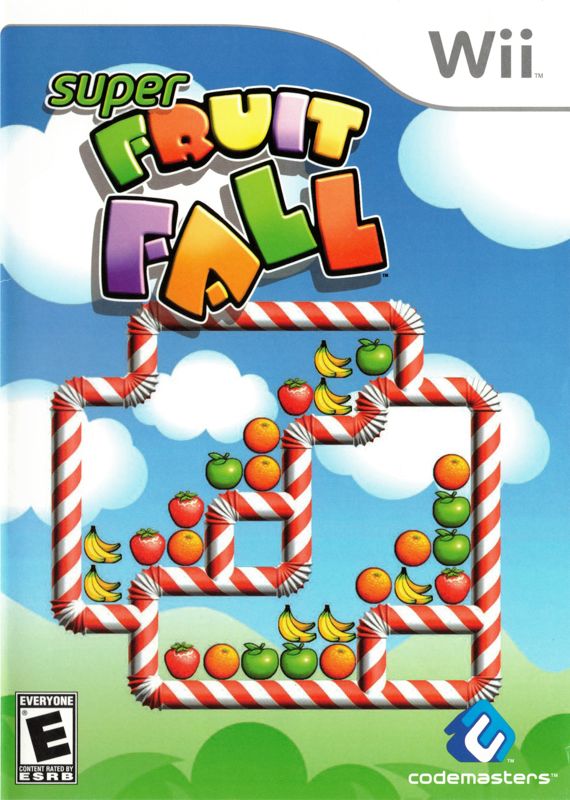
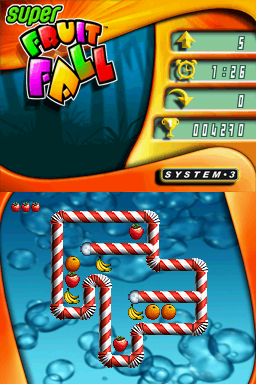
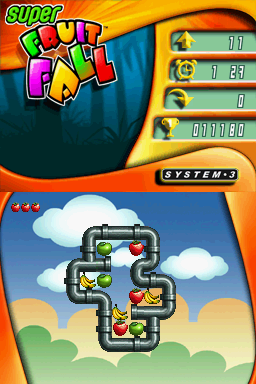
Level shapes are where the idea earns its keep. A regular square lets you learn the basics, while tube-like and irregular frames make the same simple rotation controls more demanding. Open spaces and internal forms can leave fruit stranded in inconvenient pockets, so a move that creates one match may also bury another color where it is harder to reach. When a plan works, watching several fruits fall into a useful arrangement has a tidy, mechanical satisfaction.
Frustration arrives when the board shape makes outcomes difficult to judge before you commit. Because the fruit all drops after every rotation, a promising setup can quickly turn into a more tangled one. That is part of the puzzle, but it also means the game leans heavily on patience and repeated attempts rather than on a broad set of changing ideas. If you enjoy working out spatial consequences from a small rule set, there is enough here to keep you engaged; if you need constant new twists, the core loop may wear thin.
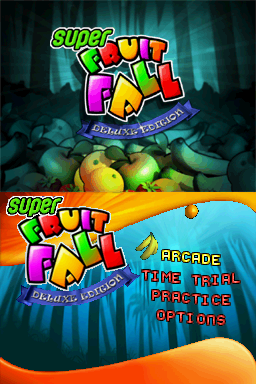
The modes suit different moods. Training removes the clock and is the right place to learn how particular shapes behave. Time Challenge turns each individual level into a speed run, while Arcade asks you to keep solving under a broader time limit. Split-screen multiplayer is the liveliest variation, since both players can race through the same straightforward objective without needing to learn a complicated competitive ruleset.
Graphics
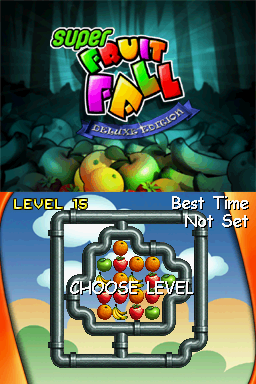
The game is built around side-view puzzle boards filled with fruit inside clearly defined frames. Squares, tubes, and other level shapes give the boards their most noticeable visual variation, while the falling fruit makes the result of each rotation easy to watch.
Story
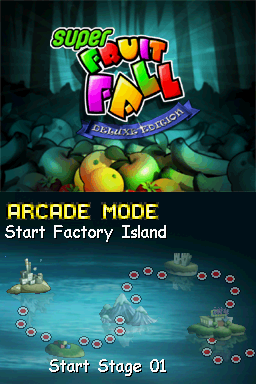
Super Fruitfall does not lean on plot to pull you forward. Its structure is the sequence of 50 boards: clear every fruit, move on, and face a new shape.
That makes the game feel direct and old-fashioned in a useful way. You are not waiting for story beats to justify the next level; the reason to continue is simply that the next frame may demand a better solution than the last one.
The trade-off is that progression has little emotional lift beyond puzzle completion. If you want a game with characters or a developing narrative, this will feel bare. If you are happy to let the board itself be the entire focus, the stripped-down approach stays out of the way.
Overall Experience
Super Fruitfall is a competent puzzle game built around one good physical idea. Rotating a container of fruit sounds almost too slight to carry a full game, yet the changing frames do create genuine moments of planning, surprise, and recovery. It is at its best in short sessions, when you can appreciate a clever clear without dwelling on how familiar the basic process remains.
Training is the recommended starting point: use it to understand how fruits settle in each shape before putting yourself under a clock. From there, Time Challenge offers a clean test of efficiency, and Arcade adds pressure when you want less room to deliberate. Two-player split-screen is worth trying if you have someone nearby who enjoys simple head-to-head puzzle competition.
The payoff is real but limited. Clearing a stubborn board feels good, especially after you finally see the rotation that frees a trapped cluster, but the game does not build far beyond that central pleasure. Give it a chance if you like compact, gravity-driven tile puzzles and can enjoy mastering variations on a single mechanic. Skip it if you want a rich campaign or a puzzle game that keeps reinventing itself.


Reviews
There are no reviews yet.