 Retro Replay Retro Gaming History, Reviews & Emulation

Retro Replay Review
Gameplay
The first hour of Yakuman DS is likely to be spent getting comfortable with the fact that Mario is not here to turn Mahjong into a lightweight minigame. The character theme lowers the barrier a little, yet the focus stays squarely on making hands, judging your options, and adapting to the rules at the table. If you already enjoy Mahjong, that directness is a strength: you can get straight into matches without a lot of detours.
Free Mode is where the game earns its keep for repeat sessions. Being able to select CPU opponents and set your own rules means you can shape a match around the kind of table you want rather than simply accept a fixed format. It is the mode to use when you want to practice, settle in for a relaxed game, or change the conditions after a run of familiar matches.
Challenge Mode adds the sharper edge. Instead of merely asking you to win, it sets conditions and opponents, then offers easy, normal, hard, and expert levels. That structure gives you a reason to return once ordinary matches start feeling routine. The difficulty range also makes it sensible to begin gently and move up only when the game’s decision-making starts to click.
Ranking Mode supplies the longest single-player chase: you begin at rank 20 and try to reach rank 1. That is a clean, motivating framework for anyone who likes measurable progress, though it also asks for patience. Local multiplayer for up to four people is the other obvious draw, especially if your group wants a proper Mahjong session rather than a fast party diversion.
Graphics
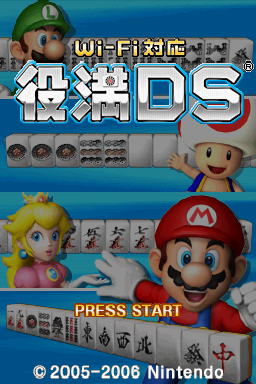
Mario and his friends give the Mahjong tables a recognizably Nintendo face, which helps the game feel less austere than a plain tile simulator. The character-driven theme is a pleasant invitation, even though the tiles and the hands being played remain the real center of attention.
Story
Yakuman DS does not lean on a dramatic adventure to push you forward. Its premise is simply Mario and friends gathering to play Mahjong, and that modest framing suits the game: the tension comes from the hands, the opponents, and the conditions attached to each challenge.
Challenge Mode creates its own small sense of progression by placing you against specified opponents under specified requirements. There is no need for a large narrative hook when each assignment can stand as a compact test of whether you understand what the table demands.
Ranking Mode carries that competitive thread further. Moving from rank 20 toward rank 1 gives your wins a context beyond any single match, making the personal climb more important than character drama. If you want a story-first Mario game, look elsewhere; if you like a simple competitive premise that stays out of the way, it fits.
Overall Experience
Yakuman DS is a focused Mahjong package with more staying power than its cheerful Mario dressing might suggest. Free rules, varied challenge difficulties, a rank climb, and local games up to four players cover several ways to engage with the same core table game. The payoff is strongest once you stop treating each match as a novelty and begin enjoying the longer process of learning, improving, and taking on tougher conditions.
Give it a chance if you want Mahjong with Nintendo characters and a clear set of solo goals. Skip it if the Mario name has you hoping for action or a broad party-game collection; this is built around one game and expects you to meet it on its own terms. For historical and release context, see the Yakuman DS game history.
The 2006 rerelease, Wi-Fi Taiō Yakuman DS, broadened the multiplayer side with Friend Code online play and voice chat. For the original 2005 DS version, though, the main recommendation remains straightforward: it is a worthwhile pick for a gamer who wants structured Mahjong practice and competition, not a casual Mario side show.


Reviews
There are no reviews yet.