 Retro Replay Retro Replay gaming reviews, news, emulation, geek stuff and more!
Retro Replay Review
Gameplay
The first few minutes of Bubble Blobb II are easy to understand and surprisingly tense to execute. Your ball continually travels up and down, while the Shift keys give you control over its horizontal direction. That limitation is the whole hook. You are not choosing when to launch or when to stop; you are constantly correcting a moving line, trying to meet a block at the exact place and colour needed.
Matching colours gives the game its puzzle bite. Hit a block that matches the ball and it disappears, but reaching the exit means understanding which blocks should go first and which ones must remain. Colour-changing blocks turn the route into an ongoing calculation, while rainbow blocks can temporarily scramble that calculation by changing your colour at random. The result is less relaxed than it sounds: a lucky change can open a path, while a badly timed one can send you toward a deadly block with little room to recover.
The special blocks are where the levels begin to feel like proper little contraptions rather than obstacle courses. Question-mark blocks can alter the layout, often clearing walls or exposing something important such as the exit. Arrow-marked blocks can be pushed, but only if your ball has the matching colour, so positioning them becomes a deliberate part of the solution. You have to think ahead while still reacting to the ball’s relentless bounce, and that combination is the game’s best trick.
Its newer hazards also make the sequel sound tougher in a worthwhile way. Plus and minus blocks periodically fire a spark between them, creating a timing problem inside an already constrained route. One-way streets stop movement in the direction of their arrows, so a seemingly open corridor can become a trap if you drift into it from the wrong side. Losing a life on deadly blocks means careless experimentation has a cost, which can frustrate, but it also gives each successful exit a satisfying sense of having solved the screen under pressure.

Graphics
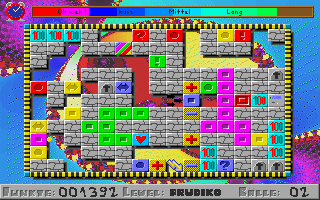
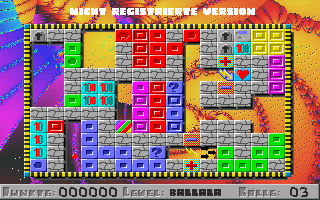
Bubble Blobb II is built around clear, colourful maze screens: a bouncing ball, colour-coded blocks, rainbow tiles, question marks, arrows, and obvious hazard markers. The plus-and-minus blocks add visible sparks between them, giving their danger a straightforward on-screen warning. It is a functional arcade-puzzle look, with the important information placed right in the path of the ball.
Story
This is not a game about characters or a grand plot; its momentum comes from moving through a sequence of maze-like levels toward each exit. The “story” you feel while playing is the changing state of the board: a wall disappears, a hidden route opens, or a block you need becomes reachable.
That stripped-down approach suits the format. Each level gives you a clean immediate goal, then makes you earn it by manipulating colours, routes, and blocks. There is no need for extra framing when the next screen can pose a new spatial puzzle so quickly.
If you need a narrative reward to carry you through difficult arcade games, Bubble Blobb II will not be the one that wins you over. Its payoff is practical and immediate: recognizing why a route failed, adjusting your movement, and finally bouncing through the exit you had been trying to uncover.
Overall Experience
Bubble Blobb II takes a familiar brick-clearing idea and makes it much more active. Directly steering the ball means every collision feels like your responsibility, and the maze layouts give the game a stronger sense of place and purpose than simply clearing a field of blocks. Improved controls are especially important here, because the game asks you to make precise lateral adjustments around hazards and narrow opportunities.
Expect some harshness. Random colour changes and deadly blocks can turn a promising attempt into a lost life, and the constant vertical motion does not always leave time to calmly reconsider a plan. That is part of the game’s old-school character, though: it rewards memorising layouts, respecting the timing of hazards, and gradually turning awkward movement into instinct.
Give it a chance if you enjoy compact DOS arcade puzzles where execution matters as much as reasoning. The blend of colour matching, movable blocks, changing layouts, and forced motion gives Bubble Blobb II more personality than its simple setup suggests. It is a demanding little maze game, but the rules are clear enough that failure usually points back to something you can improve on the next run.


Reviews
There are no reviews yet.