Retro Replay Retro Gaming History, Reviews & Emulation
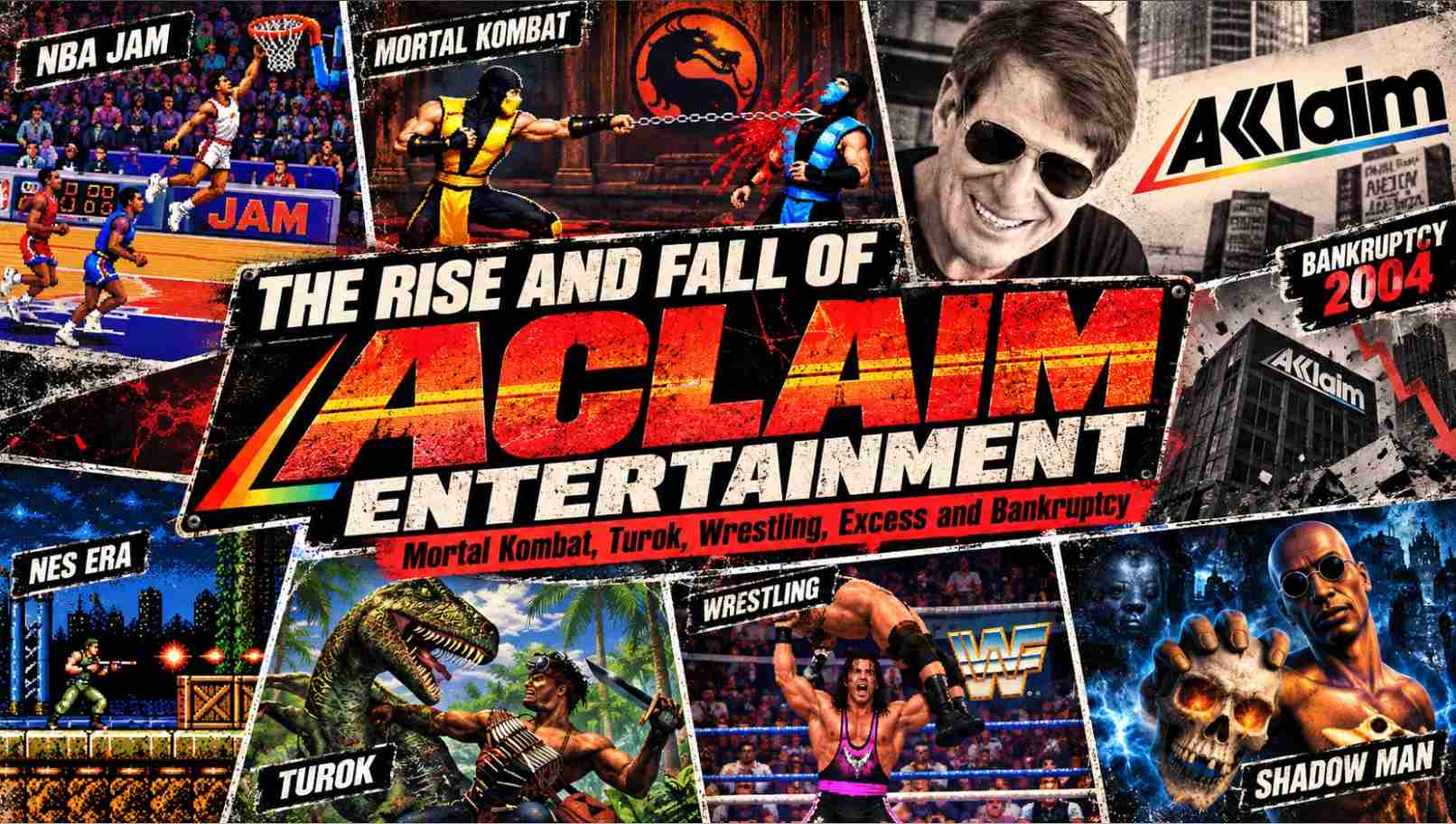
On one television, a digitized fighter tears through Mortal Kombat. On another, a giant-headed basketball star catches fire in NBA Jam. The boxes carry the same publisher’s name. Acclaim did not invent either arcade sensation, but it knew what both could become once they reached living rooms: games people would ask for by name, argue about at school, and buy before the magazine review arrived.
That instinct built a Long Island company into one of the loudest publishers of the 1990s. It bought licenses, signed arcade deals, acquired studios, and placed famous faces on shelves from the NES to the Nintendo 64. At its best, the games justified the noise. Turok gave the N64 a huge, strange adventure; Shadow Man and Re-Volt showed more range than the company’s advertisements suggested. At its worst, the noise became the product, until even outrageous publicity could not cover the accounts.
Three publishers, one shelf
Greg Fischbach, Robert Holmes, and Jim Scoroposki founded Acclaim in 1987 after working inside the game business. They were not starting with a single machine or a miracle prototype. They understood the distributors, platform holders, and stores that decided which cartridges a child could find. Fischbach became the public face of a company that treated the box and the retail relationship as seriously as the code inside.

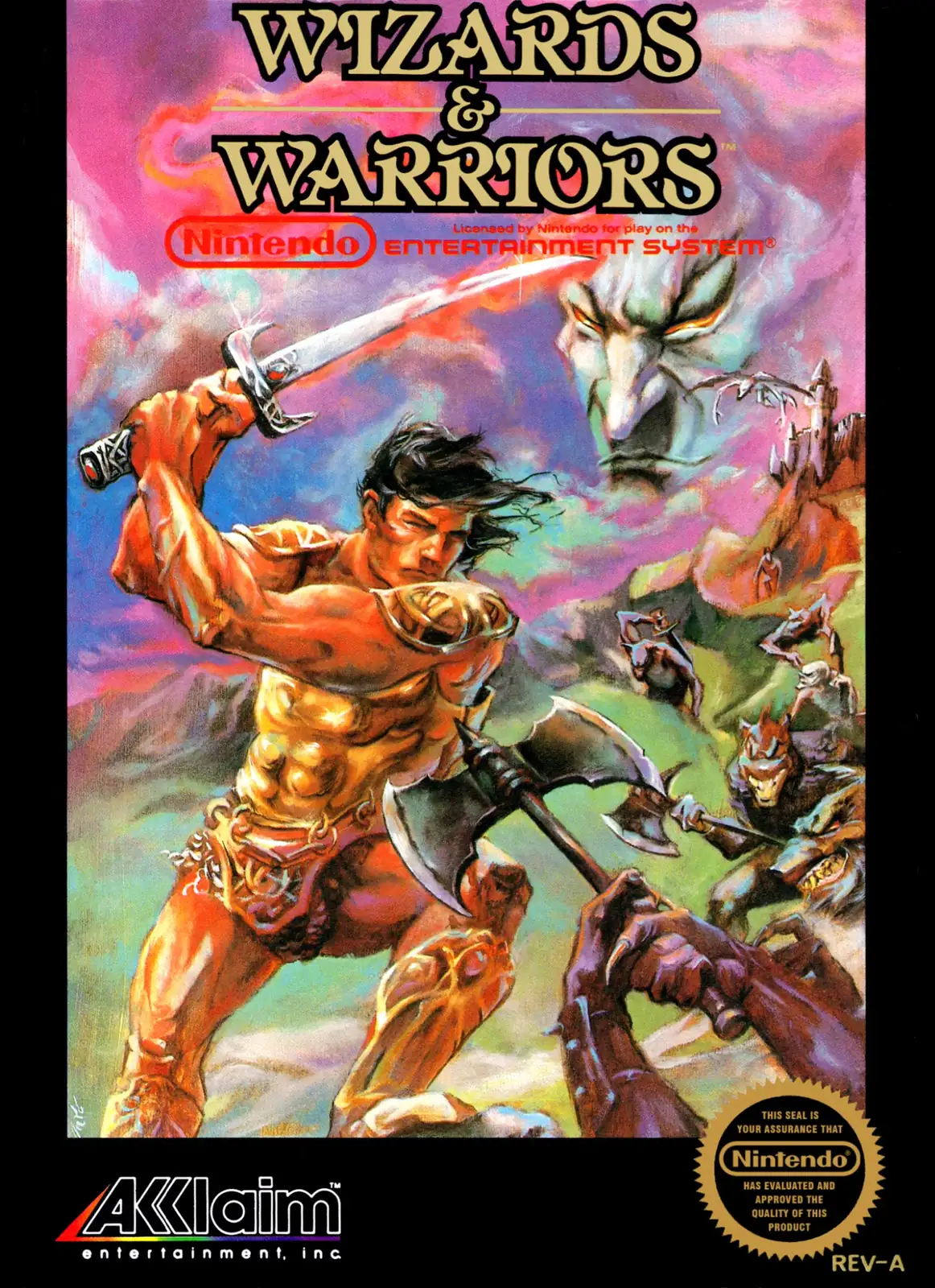
Nintendo’s tightly controlled NES market rewarded publishers that could deliver dependable products on schedule. Acclaim found a foothold with games such as Wizards & Warriors. Its fantasy art promised a grand adventure; the game offered tough platforming, collectible gems, and a recognizable hero. It was not a perfect cartridge, but it told retailers and buyers what they were getting at a glance. That clarity became an Acclaim habit.
The company would grow much bigger by licensing names that were already famous. A good license could shorten the distance between a shelf and a customer’s attention. It could not make a poor game enjoyable once the cartridge booted. That tension, visible from Acclaim’s early years, would follow it through every boom.
First, get their attention
Acclaim’s first major licensing deal was WWF WrestleMania, according to Robert Holmes in David Craddock’s account of Acclaim’s Midway relationship. A wrestling fan knew the performers before seeing a screenshot. The game could promise the spectacle of a televised match in two words, then had to discover whether a controller could deliver it.
That was the publisher’s advantage and its risk. Sports stars, comics, film characters, and arcade names gave Acclaim many routes into a crowded store. Every deal also brought costs, terms, and a deadline. During good years, royalties were the price of making a game visible. During weak years, they could become a bill that arrived whether a title caught fire or not.
The rainbow gives Acclaim another Nintendo doorway
Before Mortal Kombat made Acclaim a household name, it bought a far less glamorous advantage. In 1990, MCA agreed to sell LJN, the publisher behind a rainbow logo on NES cartridges. The Los Angeles Times reported that the deal would let Acclaim release five more NES games each year under the LJN name, a useful opening under Nintendo’s publisher limits. The logo already carried a reputation among players; to Acclaim it was also publishing capacity.
The transaction brought its own argument. UPI reported a dispute over the final adjusted purchase price after the April deal. Buying another imprint was not an invisible back-office move. It gave Acclaim more shelf space and more accounting problems to solve. Retro Replay’s LJN history follows the games and studios beneath that rainbow.
Midway gives Acclaim two kinds of arcade fever
One Midway game came home with digitized fighters, a block button, and finishing moves that sent adults to television studios and politicians to hearings. The other put oversized basketball stars on a court where gravity appeared negotiable. Acclaim handled home releases of Mortal Kombat and NBA Jam, and for a few years that relationship made the company’s name difficult to avoid.
Ed Boon and John Tobias were central to Mortal Kombat‘s creation at Midway. Acclaim’s role was different: bring the arcade fight into living rooms, coordinate platform versions, and sell the event. The distinction matters to the people who built the game and to the question of who controlled its most famous images. A Genesis owner and a Super Nintendo owner could buy the same title and argue about very different versions of its violence.



Acclaim understood that the dispute itself drew attention. David Craddock’s reporting on the proposed NES version shows how many commercial and technical decisions sat behind a simple question such as “Why isn’t it on this console?” The fighters belonged to Midway’s creative world, while Acclaim’s publishing machine had to negotiate hardware, platform rules, and the audience each version could reach.

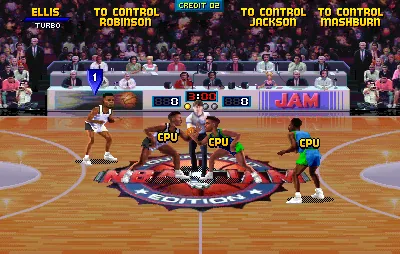
NBA Jam gave Acclaim a very different night at the arcade. A player could hear a catchphrase, pick two familiar stars, and begin making impossible dunks almost immediately. The home versions carried the same invitation: bring the loud cabinet into the living room. Screenshots of Tournament Edition preserve the roster screens and on-court spectacle, but the real sales pitch was how quickly two people could start shouting at the same television.
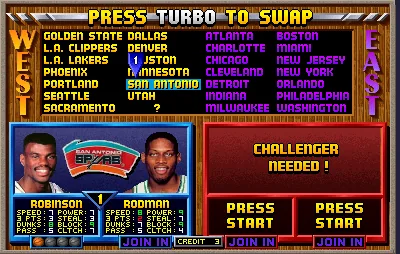
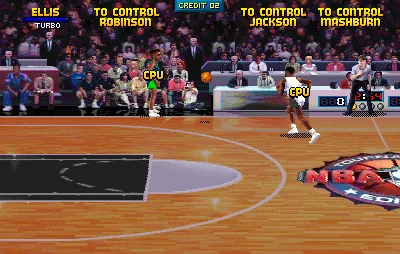
These hits made Acclaim look like an arcade king, though the developer and publisher were doing different jobs. Midway built the sensations. Acclaim put them on more shelves. The partnership also exposed a vulnerability: when the deal changed, Acclaim could not simply order another Mortal Kombat out of its own studios.
Mortal Monday and the cost of being seen
September 13, 1993 was sold as “Mortal Monday.” Acclaim put home versions of Mortal Kombat on Sega and Nintendo machines at once and made the date itself part of the campaign. The ESRB’s oral history follows how the release fed a fast-growing public debate about violent games. Acclaim marketing executive Dona Fraser remembered the title as the first game she worked on. A publisher could scarcely ask for more awareness; it could not control what every parent, retailer, or senator would decide the pictures meant.
The two home versions also made the argument tangible to players. Nintendo and Sega handled the violence differently. An arcade game whose finishing moves had helped build its identity reached homes through platform-specific rules and compromises. Children traded stories about those differences while adults debated whether anyone should have sold the game at all. Acclaim was riding a hit and helping force the industry to invent a clearer way to tell buyers what was in the box.
The arcade deal Acclaim could not keep
Acclaim’s partnership with Midway had a built-in expiration. In David Craddock’s interview, Acclaim cofounder Robert Holmes remembered Williams/Midway watching royalty checks from home versions grow while its own arcade teams created the source games. Success made the split harder to justify to Midway. Holmes recalled an awkward 1994 investor call in which Williams staff pressed Acclaim about what it would have without those titles. His account is a participant’s memory, but it captures the threat Acclaim faced at the very height of its hit run.
Midway eventually moved its home-game business closer to itself rather than renewing the old arrangement on Acclaim’s terms. Acclaim still knew how to market a sensation; it no longer had guaranteed access to Midway’s next one. That loss helps explain the turn toward buying studios and developing franchises it could control.
Acclaim starts buying the people who make the games
The Midway arrangement showed how much Acclaim could earn by publishing somebody else’s phenomenon. Buying studios offered a different prize: the people, tools, and schedules behind future games. Probe in Britain, Iguana Entertainment, Sculptured Software, and other teams joined a growing network. Some could port an arcade hit across machines; others could make a new property Acclaim might own for years.
That was a real change in the company’s risk. A distribution deal can expire. A studio has payroll every month, whether its next game is ready or not. Acclaim gained more control over production and more responsibility for the time it took. When Turok became a hit, that investment looked inspired. A few years later, the studios would still need to be paid even as licenses, retailers, and console technology grew less forgiving.
Turok gives the Nintendo 64 teeth
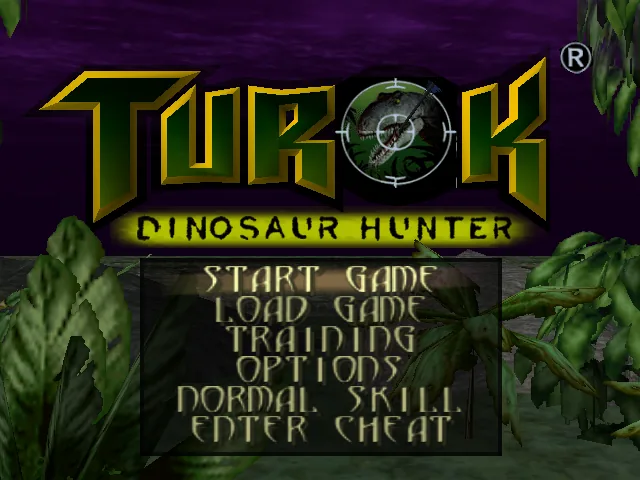
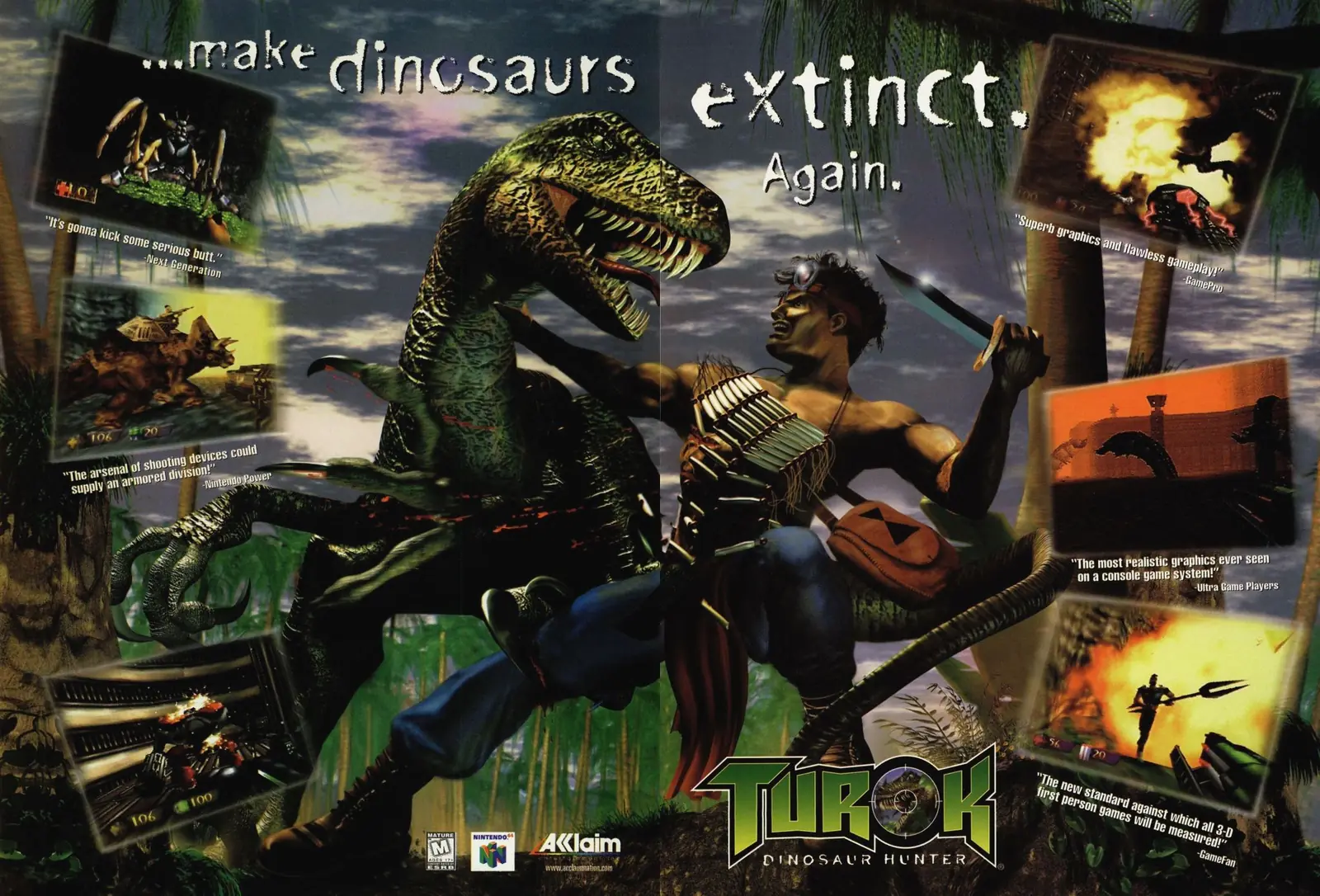
A dinosaur closes the distance and the bow suddenly feels much too slow. Turok: Dinosaur Hunter made that kind of panic its calling card on Nintendo 64. Iguana Entertainment built a first-person adventure of winding paths, weapons, foggy distance, and enemies that seemed to belong to a harsher world than Nintendo’s family-friendly image. The character had a comics history; the game had to make him convincing to players who had never opened one.
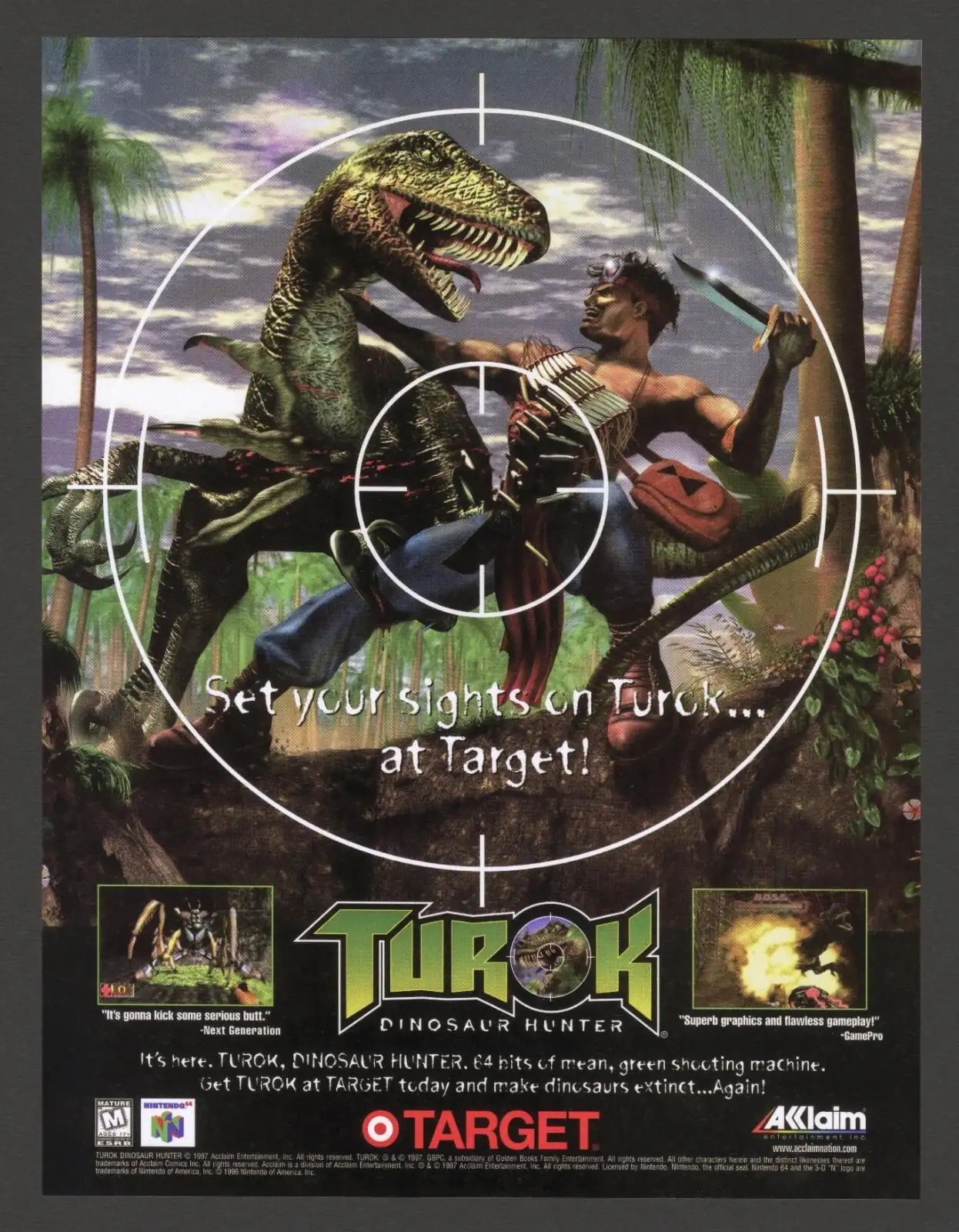
Jim Shooter’s Valiant work sits behind part of the property history, while Acclaim’s comics interests made Turok more than a borrowed mascot. He was a franchise Acclaim hoped to develop across games and media. The company then advertised the cartridge with its usual force, including a Target promotion that made a prehistoric hunter look like a mass-market event.

At the controller, the game had a harder job than the advertisement. A first-person shooter on a console pad still had to teach movement and aiming. Turok’s dense spaces and enormous enemies gave the player a reason to learn. Its fog, often remembered as a limitation of the hardware, also made an approaching shape unsettling. The game could feel technically rough and powerfully atmospheric in the same minute.
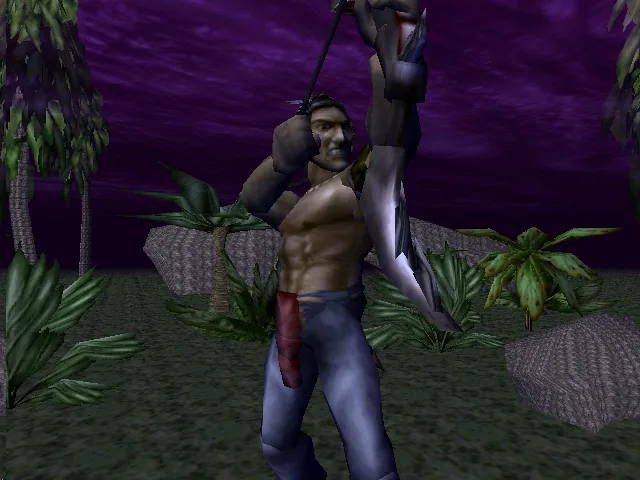

Acclaim’s advertising made no secret of the aggression. The campaign asked buyers to expect dinosaurs, weapons, and something less polite than a Saturday morning adventure. For once, a loud box led to a game with a distinct world behind it. The irony would arrive later: in 2004, Acclaim’s own filing said the Turok licensor had challenged its rights over unpaid royalties. A property that once announced the company’s strength became one of the clearest signs of its distress.
A sports game for every aisle
Not every Acclaim buyer wanted blood or dinosaurs. NFL Quarterback Club and All-Star Baseball gave the publisher a place in the sports aisle, where yearly rosters and familiar competition could bring players back. Wrestling covered another audience entirely. The catalogue’s breadth made Acclaim feel larger than any one studio or genre, though it also left more release dates and licensing bills to manage.
Acclaim’s comics operation showed the same desire to hold recognizable properties rather than simply rent a character for one cartridge. The idea had appeal: a game could strengthen a comic, and a comic could give a game a ready-made world. Yet ownership and licensing were never free of cost. By the end, the company was still trying to hold together games, sports rights, and comic-derived properties while its cash narrowed. A crowded shelf can make a publisher look safe until the bills for filling it arrive together.
A sports series faces a demand an action game can sometimes dodge: fans notice the missing names. All-Star Baseball had to feel like the league its box evoked, while NFL Quarterback Club had to earn repeat play beyond the appeal of a star athlete. Acclaim’s later annual reports describe how heavily its business depended on licensed brands and a small set of major franchises. The same shelf presence that made the company appear unavoidable meant a weak yearly release could leave a much larger hole than a one-off experiment.
Other sounds beneath the noise
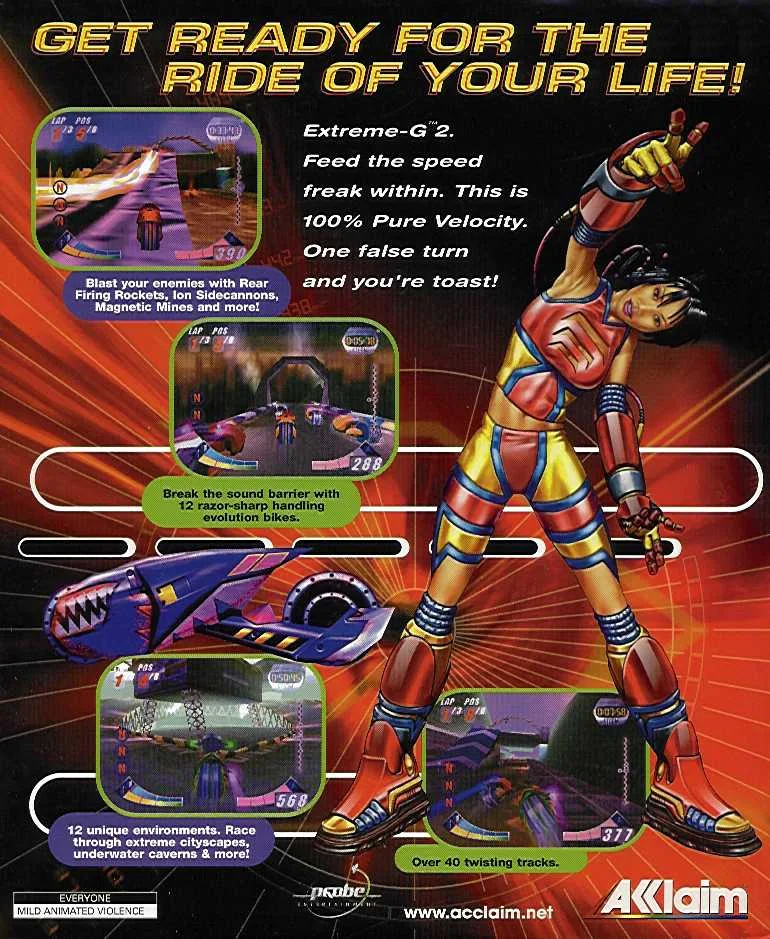
Extreme-G 2 takes the company’s appetite for speed into a futuristic racer. Shadow Man slows down and asks a player to inhabit a darker, stranger world. Re-Volt shrinks the whole camera to toy-car height. These games do not fit the easy version of Acclaim as a licensing company with a taste for outrage. Internal teams had room to pursue mood and play, and some of their work has lasted longer in memory than a scandalous ad.
Shadow Man is the sharpest tonal change. Mike LeRoi moves between the living world and Deadside, the game’s realm of the dead. The original Acclaim manual spends pages explaining that world and the powers that change when Mike crosses into it. Exploration, combat, and the unsettling geography build slowly. This is a game that needs time to get under a player’s skin, worlds away from NBA Jam‘s instant two-person challenge.
The manual also reveals how much production Acclaim backed beyond an advertising concept: characters, mythology, inventory systems, and a PC configuration section for a fast-changing 3D hardware market. A publisher known for noise had financed a game that depended on atmosphere and patience. It deserved to be remembered alongside the more obvious hits.
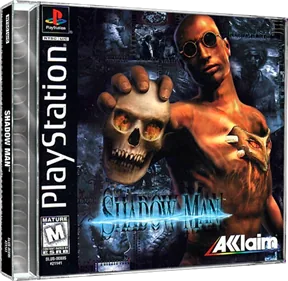
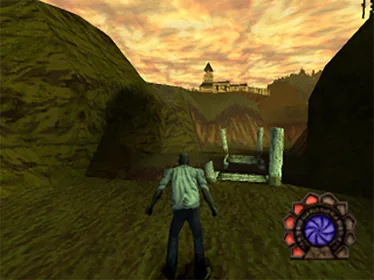
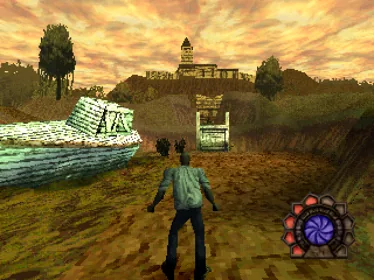
These releases gave Acclaim creative range. They did not solve the business question of which projects could pay for the expanding studio network. The distinction only became obvious when the 1990s boom ended.
The toy car that escaped the corporate personality
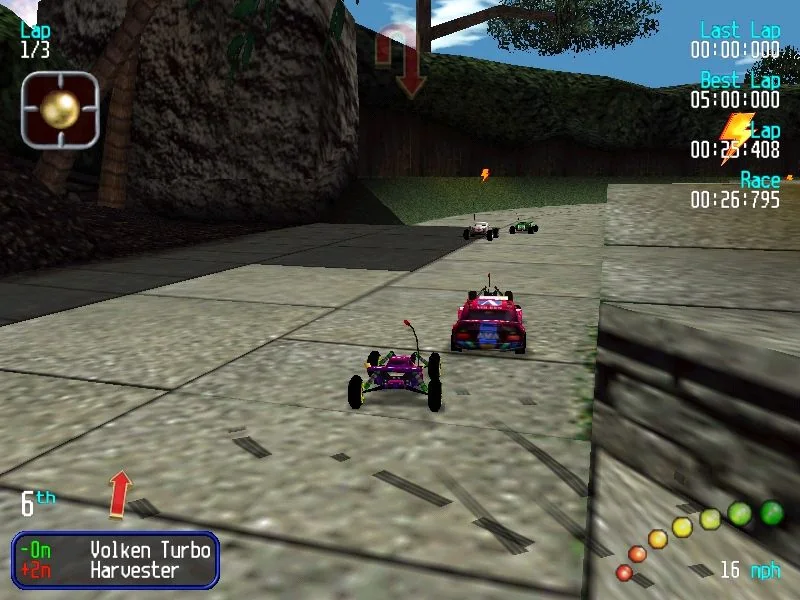
By 1999, an Acclaim box could contain something as playful as Re-Volt. Radio-controlled cars race through spaces built at their scale: ordinary furniture becomes roadside architecture, and a small bump can unsettle a lap. Designer Simon Harrison’s account describes a toy-car racer created from scratch at Probe Entertainment, later Acclaim Studios London. It reached players during the same period in which the publisher was chasing licensed spectacles and attitude.
The original manual gives the cars different handling and asks players to learn slides, pickups, and track hazards. Its appeal lives in the scale shift: a familiar environment suddenly feels huge and dangerous from the viewpoint of a plastic racer.
From WWF spectacle to ECW edge
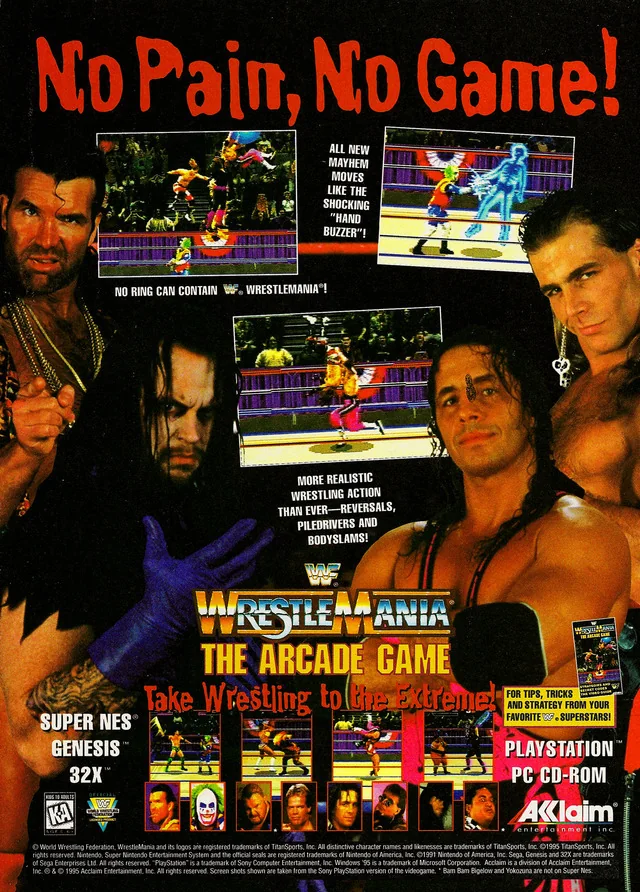
WWF WrestleMania: The Arcade Game understood that television wrestling is theater. The wrestlers loom on screen, attacks are exaggerated, and the action races past careful simulation toward a brawl. Acclaim could sell the performers on the box; the game gave friends a way to recreate the noise in front of one television.
Years later, ECW Anarchy Rulz pursued a more defiant audience. Hardcore wrestling’s edge matched Acclaim’s taste for aggressive packaging, even as the game itself had to compete in a market full of better-understood wrestling controls and increasingly demanding players. The brand gave the release an identity; it could not make the moves feel satisfying on its own.
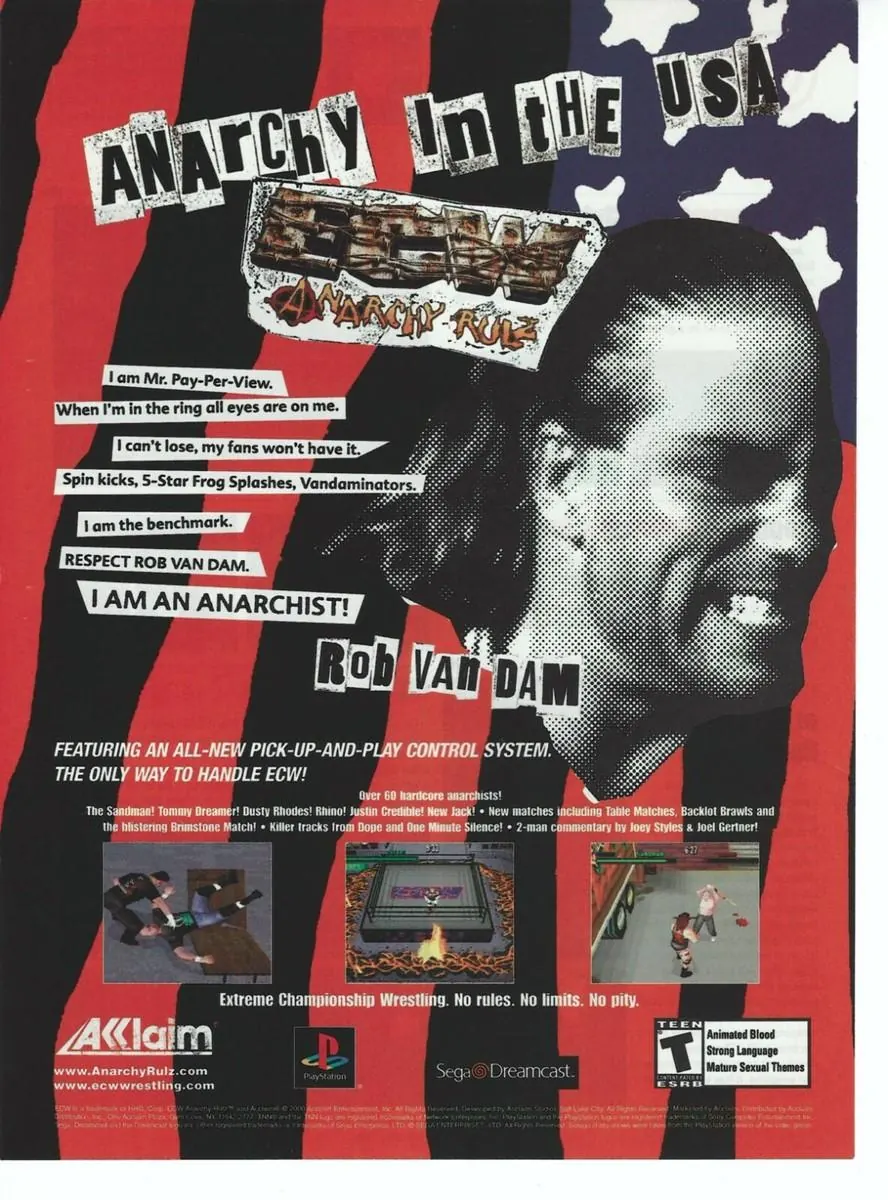
Legends of Wrestling looked backward instead, collecting familiar performers from wrestling history. It was another way to turn recognition into a sale after contemporary licenses became harder to keep. The roster could start an argument on the couch before the first match; the play had to keep that argument fun.

When attention became the game
BMX XXX is where Acclaim’s old gift for making noise began to sound desperate. The extreme-sports game was transformed into a nudity-and-shock pitch, and publicity often crowded out discussion of how it rode. The company had once put Mortal Kombat into homes while the public argued about violent games. Here controversy looked less like a side effect of a hit and more like a substitute for one.

Acclaim’s late wrestling and extreme-sports releases still bore the old instinct: give a familiar audience a name they recognize. But the market around the company had changed. PlayStation 2, Xbox, and GameCube games cost more to make; retailers wanted reliable sellers; license payments did not shrink because a project struggled. Acclaim had bought studios and widened its catalog, which meant more people and more obligations when the hits slowed down.
A publisher can survive a tasteless ad. It cannot market its way out of a business whose expenses keep arriving faster than revenue. By the early 2000s, Acclaim’s stunts were easier to remember than its release schedule. The financial documents soon made the underlying problem impossible to dress up.
The comic empire shrinks
Acclaim’s 2003 annual report says it had exited regular comic-book publishing in fiscal 2000, while still hoping to earn from characters such as Turok and Shadow Man in games and other media. That was a quiet retreat from the expansive idea that a game publisher could own every part of an entertainment property. The rights remained valuable only if Acclaim could keep making games and meeting the agreements around them.
The same report says Turok: Evolution represented 20 percent of gross revenue in fiscal 2002. That concentration made the later royalty dispute especially revealing. One franchise could carry a large share of a year’s business and still become a point of conflict when the company’s cash ran thin.
Licenses become liabilities
In the final year, the contracts that had once made Acclaim powerful began turning against it. The company’s 2004 annual filing says Classic Media told Acclaim that its Turok license had been terminated after certain royalties for Turok: Evolution went unpaid. Acclaim disputed or tried to resolve several other licensing and development conflicts. The filing also describes a Major League Baseball Players Association dispute over late royalty payments and a legal fight over Combat Elite: WWII Paratroopers. These were Acclaim’s reported positions and counterparties’ claims at the time, not a later court verdict on each dispute.
The same document reports a $9.5 million accounting error involving a bank advance from fiscal 2001. The correction increased debt and reduced previously reported earnings. A company built to turn licenses into recognizable games was now warning investors that missing payments could cost it the licenses themselves. That is more revealing than another outrageous advertisement: the business engine was failing at precisely the point where its most valuable names had to be renewed and defended.
The balance sheet gets the last word
Acclaim’s advertisements used to make the company look invincible. Its January 2003 leadership announcement sounded different. Greg Fischbach resigned as co-chairman and chief executive; Rodney Cousens stepped up as the company talked about reducing operating expenses and returning to profitability. The language was carefully corporate. The change in direction was not.
By March 2004, Acclaim’s annual filing reported a $56.4 million net loss for the year, about $1.1 million in cash and cash equivalents, and a working-capital deficit of roughly $110.9 million. These figures came from Acclaim’s own restated accounts. They explain why a publisher with a famous logo could no longer behave like the 1990s company that seemed able to buy another license whenever it needed a hit.
Studio closures and reduced outside development spending followed. The filing describes five internal studios still operating in the United States and Britain and says internal work generated about 38 percent of gross revenue in the year ended March 2004. Acclaim had become both a publisher of outside projects and a company paying for its own development capacity. That breadth was an asset while products sold. In a contraction, every team needed a plausible path to the next release.
The final contrast is hard to improve on. Turok had once made Acclaim look like a company that could build its own platform-defining franchise. In 2004, its licensor said overdue royalties had ended the agreement. Acclaim said it was trying to resolve the dispute. Soon the company itself entered bankruptcy. The end came from ordinary contracts and cash, not from a spectacular failure of imagination.
The name on so many boxes
Acclaim helped bring arcade hits into homes, published games that made the Nintendo 64 feel bigger, and turned wrestling into a recurring living-room contest. It also backed quieter oddities: Shadow Man‘s unsettling world, Re-Volt‘s toy-car racing, and the speed of Extreme-G. Those games make the story more interesting than a reel of outrageous advertisements.
By 2004, the company that had sold confidence for nearly two decades could no longer pay for its scale. Its bankruptcy came through filings and obligations, not a final dramatic match. The old strength—spot a famous name, acquire it, and get a game in front of people—had built a remarkable run. It also left Acclaim exposed when development grew costlier and a recognizable box no longer guaranteed a hit.
Put NBA Jam or Turok on today and the best work still speaks loudly enough. The lesson in Acclaim’s end is not that the swagger was imaginary. It is that a publisher has to keep making games worth the attention it knows how to attract.
Further Reading and Related Links
- GamesBeat: Greg Fischbach on founding Acclaim and returning to publishing
- David Craddock: Rob Holmes on the end of Acclaim’s relationship with Midway
- David Craddock: Why Mortal Kombat never appeared on NES
- SEC: January 2003 Acclaim press release
- SEC: Acclaim Entertainment 2004 Form 10-K
- MobyGames: Wizards & Warriors
- MobyGames: NBA Jam Tournament Edition screenshots
- MobyGames: Extreme-G 2
- MobyGames: WWF WrestleMania: The Arcade Game
- MobyGames: Shadow Man
- Wikipedia: Valiant Comics
- Wikipedia: Acclaim Entertainment overview
Keep exploring Retro Replay: History of · Game Database · Retro Reviews