 Retro Replay Retro Gaming History, Reviews & Emulation
Retro Replay Review
Gameplay
Star Hunter DX starts from a familiar place: you steer a fighter through side-scrolling stages and survive dense enemy fire. Its one big twist is good enough to carry the whole game. Luna can charge a Bullet Time gauge by destroying enemies or catching attacks in a bomb blast, then slow enemies and their projectiles while continuing to move and fire at full speed. That gives you breathing room when a pattern starts to close in, but it is not simply a panic button.
Bullet Time also turns enemy bullets from hazards into potential profit. Destroy enemies while time is slowed and their shots become gold cubes to collect. The smart play is often not the safest one. You can trigger the slowdown early, clear the danger, and protect a run, or wait until hostile fire has built into a much richer harvest. That push and pull makes score chasing feel connected to survival instead of tacked on afterward.
The hard part is accepting that the game wants you to learn, not merely scrape by. Star Hunter DX is deliberately old-school difficult, and anyone expecting a casual victory lap may hit a wall. The extensive practice mode is the right answer to that frustration, giving newcomers room to work through trouble spots and experienced shooter fans a place to polish routes. It rewards patience, repeated attempts, and the nerve to stay in danger a second longer than feels comfortable.
Graphics
The 2D side-view action puts Luna’s fighter, incoming fire, enemies, and gold cubes in the same compact battlefield, so the central gamble stays visible: a crowded field of bullets can suddenly become a field of rewards. The scrolling sci-fi stages and five-planet journey give the action a broader backdrop than a single endless arena, while the screen’s real focus remains the moving fire you need to read under pressure.
Story
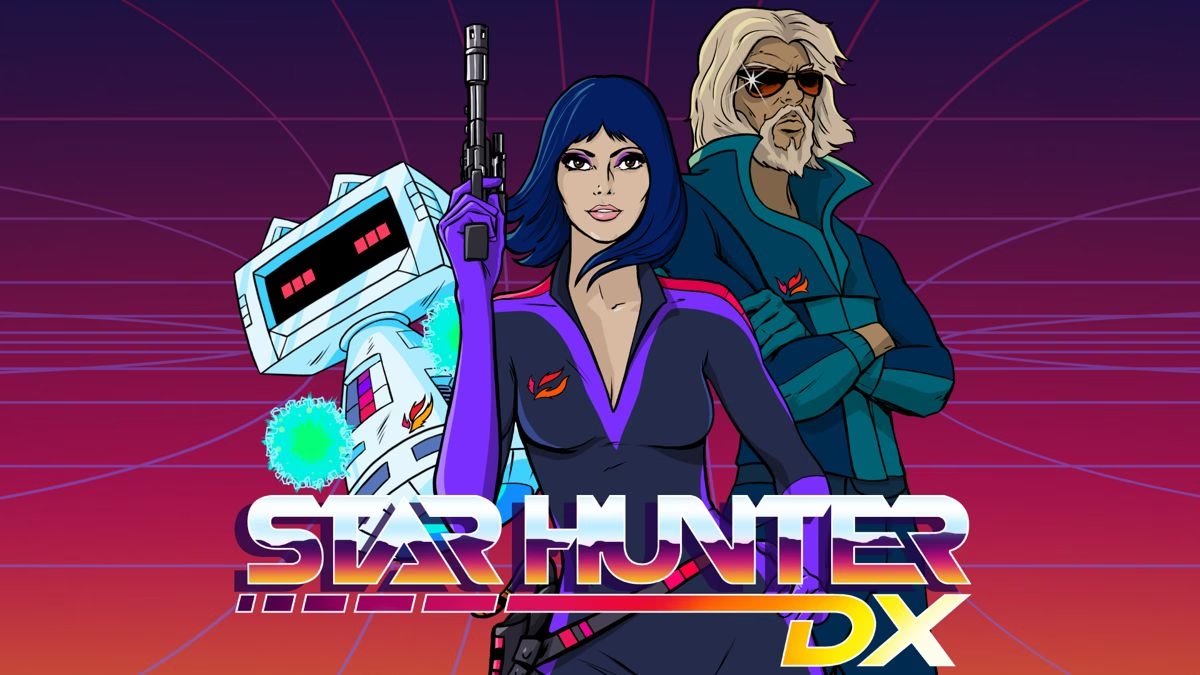
Luna Starr has a clean arcade-game motive: her former space-pirate crew betrayed her, and she intends to settle the score. She has become a bounty hunter by the time the chase begins, which gives the pursuit a little more personality than an anonymous pilot moving from boss to boss.
The story sends her across five planets to track down the mutinous crew and face them in lethal bullet-hell dogfights. That is a direct, useful setup for a shooter. It gives each confrontation a personal target without slowing the game down with a more elaborate narrative structure.
Do not come to Star Hunter DX looking for a sprawling space opera. The revenge plot is a frame for tense fights and repeatable score runs, not the main payoff. Still, Luna’s grievance is specific enough to give your progress some momentum beyond simply reaching the next high score.
Overall Experience
Star Hunter DX works because its scoring idea changes how you look at danger. A wall of bullets is never only something to dodge. It is also a possible gold mine, provided you can charge Bullet Time, time its use well, and keep control when the screen gets hostile. That makes the game’s difficulty feel purposeful even when it is harsh.
It will land best if you like arcade shooters that demand practice and invite you to revisit a run with a better plan. The leaderboard focus fits that mindset, giving score chasers a reason to revisit a run. You can read the publisher’s Star Hunter DX description for its own overview of that score-chasing loop.
For a newcomer, use practice mode before mistaking early losses for a dead end. For a veteran, the Bullet Time economy is the reason to stick around: it asks whether you can turn restraint, timing, and nerve into a better run. Star Hunter DX does not hide its old-school edge, but it backs that toughness with a mechanic that makes each hard-won improvement feel earned.



Reviews
There are no reviews yet.