 Retro Replay Retro Gaming History, Reviews & Emulation
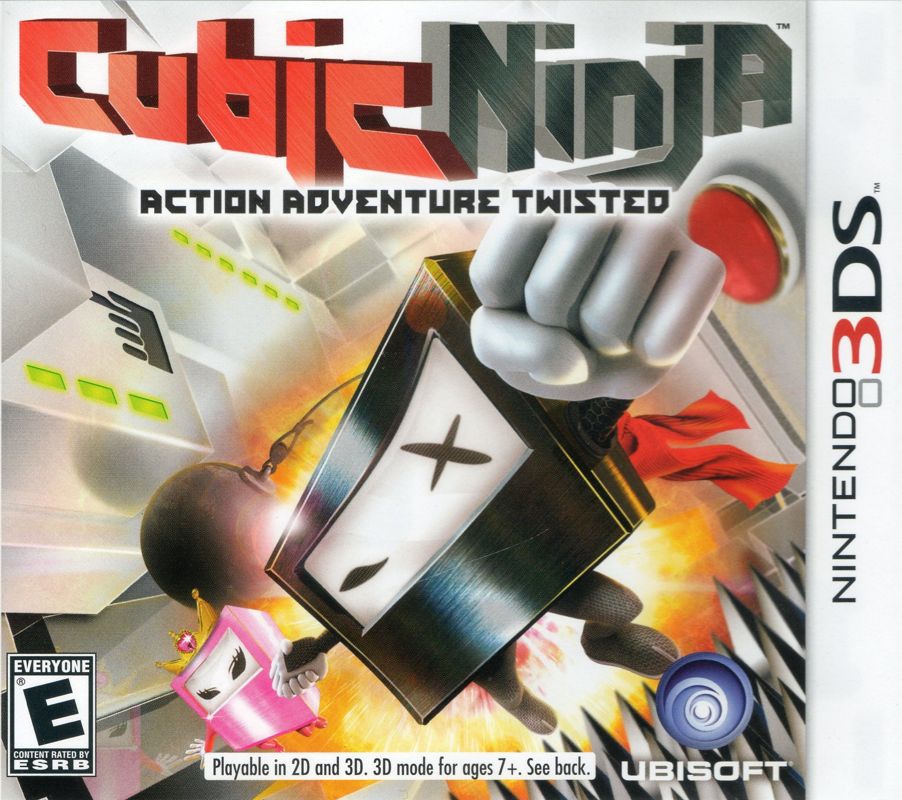
Retro Replay Review
Gameplay
The first few rooms make Cubic Ninja easy to understand and oddly difficult to put down. CC is a small black cube ninja, and tilting the 3DS sends him rolling through each compact stage. You are not being asked for quick button combos; you are reading a room full of tunnels, traps, explosives, spikes, and flamethrowers, then figuring out how to use gravity without sending yourself into a hazard. It is closer to handling a little physical maze than conventional platforming.
That distinction matters because the game is not strictly timed. You can pause mentally, rotate the system, and work out a route instead of panicking through a countdown. Still, it records best times, so clean runs have value once you understand a layout. The stages are short enough that a mistake rarely feels like a huge loss, but repeated deaths can turn fine control into a nuisance, especially when a slight change in the handheld’s angle produces more movement than you wanted.
Scrolls tucked into levels unlock Ninjutsu skills that add welcome alternatives to simply rolling from point A to point B. Shrink helps CC fit through tight spaces; Switch triggers every switch in a stage; Star fires in every direction; and Shield lets you survive several hits in a game otherwise built around one-hit deaths. If you die five times consecutively, you can finish with maximum scroll help, though the resulting white flag honestly marks that assisted clear. That is a sensible concession: stubborn stages need not become permanent roadblocks, while clean completions still mean something.
Boss encounters follow the same tilt-driven logic rather than suddenly changing into a separate combat game. Time Attack, Survival, medals, unlockable usable characters, and shareable ghosts give committed players reasons to replay. The level creator is the standout extra: progressing through the main game unlocks more parts, and QR codes let you import and share stages. You can also choose Circle Pad controls, with an X-button foreground movement option, if you would rather avoid the constant physical swiveling. It is not the central novelty, but it may be the more comfortable way to play for longer sessions.
Graphics
Cubic Ninja keeps the view focused on small puzzle rooms and the little cube-shaped CC as he moves around their hazards. The important objects are easy to spot: tunnels, spikes, explosives, flamethrowers, switches, scrolls, and the occasional rest room all serve as clear landmarks while you plan a route. The game can use 3D when you play with the Circle Pad, but it switches that option off during tilt play.
Story
The story has the loose, cheerful absurdity of a puzzle game that knows the stages matter more than drama. CC discovers the location of a bandit hideout through the Internet and heads in to rescue a princess from lab-coated bandits. It gives the action a reason to move from room to room without asking you to invest heavily in its world.
That goofy tone is helped by the contrast between “ninja rescue mission” and hazards such as rest rooms. These can supply power-ups, although relying on them too much brings consequences. It is a small joke rather than a rich narrative thread, but it suits a game about a square ninja being tilted around death traps.
Do not come expecting characters or plot to carry the campaign. The bandit hideout functions mainly as a container for increasingly awkward-looking obstacles and boss puzzles. That is enough here: the story stays out of the way and lets the next room’s route-finding problem take over.
Overall Experience
Cubic Ninja is at its best when you are holding the 3DS at an angle that finally makes a route obvious, then threading CC through a dangerous little room without touching a hazard. Its tilt controls are not a throwaway trick; they define how you think about every stage. For some players, that tactile weirdness will be the whole reason to try it.
For others, the same idea will wear thin. The game asks you to keep changing your grip and viewing angle precisely when a trap layout calls for careful movement. Because death normally comes in one hit, frustration can arrive quickly when the obstacle is not your plan but the feel of getting the handheld positioned just right. The no-time-limit structure and assist option soften that edge, but they do not remove it.
The payoff is a sizeable set of short, spatially minded challenges with replay modes and an editor that meaningfully extends the package. It is not a broadly essential 3DS game, and its 5.3 score reflects a concept that is more interesting than consistently satisfying. But if you enjoy unusual control experiments, compact puzzle rooms, and the idea of building or scanning QR-code stages, Cubic Ninja has enough character to warrant a curious afternoon. For more background on the game, see Cubic Ninja’s history and release information.



Reviews
There are no reviews yet.