 Retro Replay Retro Gaming History, Reviews & Emulation
Retro Replay Review
Gameplay
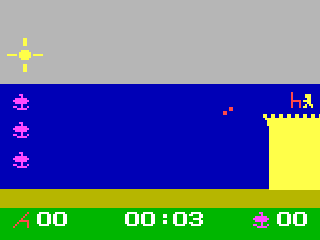
The first minute of Syracuse is wonderfully direct. One person slides Archimedes’ mirror up and down the tower, trying to catch one of three incoming Roman galleys in the reflected sunlight; the other is already judging a catapult shot. You do not need a long explanation before the rivalry starts. The Archimedes player wants two clean sun hits to ignite a galley, while the Roman player wants to wreck the mirror and bring ships safely to the tower.
What makes the match more interesting than a simple aiming contest is that neither side can settle into a comfortable rhythm. Roman rocks travel farther when the button is held, and their path can be adjusted in flight with the joystick. That leaves room for clever correction, but also for misses born from overconfidence. Archimedes can replace a broken mirror by leaving the screen on the right, which prevents a single successful rock from ending the contest outright, though doing so costs valuable time.
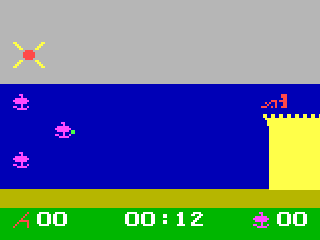
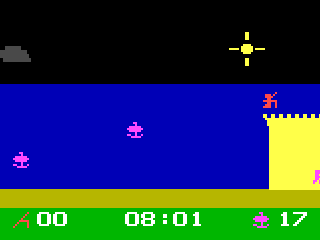
The moving sun gives the fight its best wrinkle. It crosses from left to right over an eight-minute day, and clouds can cut off the rays. You are always working around a changing firing opportunity rather than merely lining up a permanent laser. The four variations, altering sunbeam speed, mirror positions, rock speed, and mid-flight adjustment, are valuable because the base game is so compact. Syracuse will not sustain a solo afternoon, but with two competitive people it can produce a lively run of rematches.
Graphics
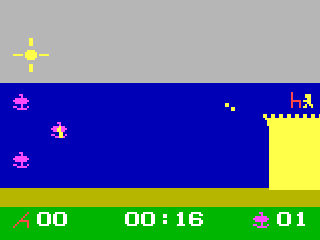
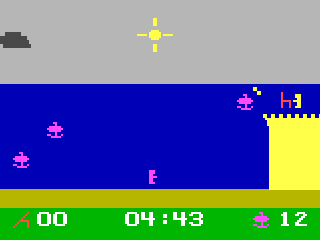
The action is built around a tower, Archimedes and his mirror, and three Roman galleys advancing across a single screen. The sun’s trip across the sky and the occasional cloud are easy-to-grasp visual cues for when the mirror can do its work, while the counters along the bottom track broken mirrors and sunk ships.
Story
Syracuse has no sprawling campaign to uncover. Its entire dramatic hook is the Siege of Syracuse and the legendary heat-ray mirror attributed to Archimedes, condensed into a contest over whether Roman ships can reach the tower.
That narrow framing works in its favor. The historical premise gives both players instantly legible roles: defend the city with an improbable weapon or silence it before landing troops. Every burning galley and shattered mirror feels connected to that simple siege scenario instead of being a detached score chase.
Still, this is history as an excuse for a duel, not a lesson or a narrative adventure. If you want characters, scenes, or a developing plot, Syracuse has little to offer. If the image of directing sunlight onto warships is enough to make you want one more round, its theme does exactly what it needs to do.
Overall Experience
Syracuse is at its best when both players accept that they are sharing one tense little battlefield. The Roman player has the satisfying problem of leading and bending rock shots; the Archimedes player has to watch the sun, clouds, mirror position, and three separate threats. Its asymmetry gives each side a distinct kind of pressure without burying either under complicated rules.
Frustration can set in when timing turns against you. A cloud blocking the rays or a mirror breaking at the wrong moment can feel brutal, and the fixed setup means there is only so much variety any one game can hold. Yet those interruptions also stop either player from treating a lead as guaranteed, which is exactly why a short round can stay competitive.
Give Syracuse a chance if you enjoy early competitive games that get to the point fast and turn a strange historical legend into an honest back-and-forth challenge. It is modest, but not throwaway: the clock, shifting sunlight, replacement mirrors, and catapult control give its two-player fight more bite than its one-screen premise suggests.


Reviews
There are no reviews yet.