 Retro Replay Retro Gaming History, Reviews & Emulation
Retro Replay Review
Gameplay
Another Century’s Episode gets its hook into you through motion. You begin as a rookie UCE pilot, but the game does not make you crawl through a slow tutorial version of robot combat. Every mech can fly and boost without interruption, including machines that were not built that way in their original series, and that decision gives battles a wonderfully loose, aggressive rhythm. You are constantly choosing where to enter the fight, when to pull away, and which target deserves your attention.
It feels like FromSoftware taking the mission-by-mission discipline of Armored Core and applying it to a far more exuberant anime crossover. Missions have multiple objectives, so success is not merely about clearing a map and moving on. That structure keeps you alert, especially when you are chasing a better rank or trying to finish a stage’s secret objective. The first run is about surviving and seeing what a machine can do; repeat attempts are where the game’s score-chasing, reward-minded side starts to click.
The roster is a major reason to stick around. Forty real-robot mechs drawn from nine series means there is room to experiment, and their weapons and abilities are modeled on their source material. Ace points let you buy machines, expand storage for a larger hangar, and improve individual units. That progression turns missions into more than isolated action scenes: a solid performance feeds directly back into the machines you can field next.
Frustration is most likely to set in if you want a single straightforward campaign run and nothing else. Secret objects and rank improvements clearly encourage revisiting missions, and some of the game’s longer-term rewards sit behind that repeat play. If the thought of returning with a new mech to clean up an old objective sounds satisfying, it becomes a strong loop. If not, the structure can feel like work between the big robot fights.
Graphics
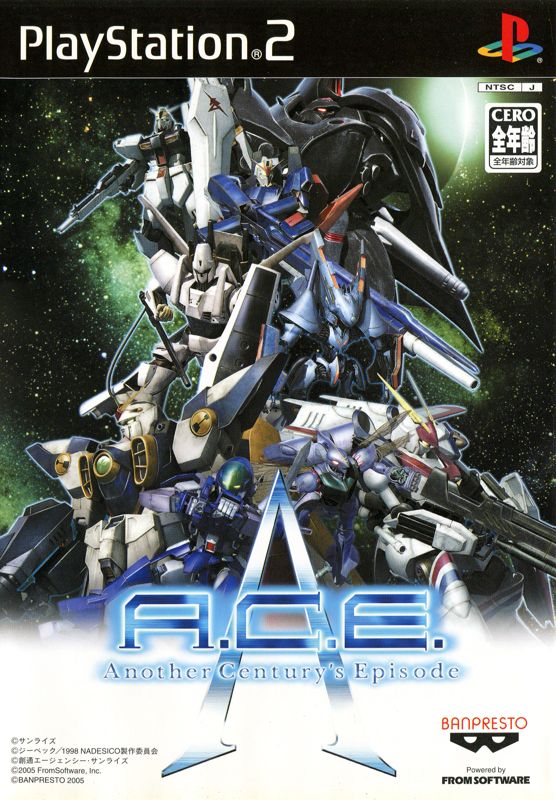
The camera stays in a third-person view built around airborne mechs fighting across mission battlefields. The real draw is seeing machines from Dunbine, Zeta Gundam, Gundam Wing, Nadesico, Dragonar, L-Gaim, Layzner, Brain Powered, and Char’s Counterattack sharing the same game, with distinct weapon sets and abilities giving the robot lineup its on-screen personality.
Story
The plot has a clean genre foundation: energy shortages lead to the discovery of E2, a powerful new resource, and rival forces quickly want control of it. The United Community of Earth sends its defense forces to protect Earth from rebel groups, putting your rookie pilot at the center of an interstellar political conflict.
That premise mostly serves the action rather than competing with it. The crossover’s real narrative pleasure is that you fight alongside and against characters from its nine robot anime series while moving through the UCE campaign. It gives each mission a reason to exist and ties the broad selection of machines into one conflict.
Do not come in expecting the E2 dispute to outweigh the robots themselves. The campaign is most effective as connective tissue for consecutive missions and new encounters. For game-specific history and release information, see this overview of Another Century’s Episode.
Overall Experience
Another Century’s Episode understands that a crossover mecha game lives or dies on whether it lets you feel untethered. Its continuous boosting and aerial combat give it that release immediately. The mission format keeps the pace brisk, while the unlock economy gives you a practical reason to care about results after the initial thrill of simply piloting a familiar machine.
It is a better fit for you if you enjoy replaying action missions with a different loadout of robots, pushing for ranks, and hunting secrets than if you want a story-led adventure. Free Mission mode opens after the campaign, letting you revisit any stage for those unfinished goals, while the two-player battle mode gives unlocked machines a simple head-to-head arena beyond the main progression.
For a 2005 PS2 crossover, this is an admirably focused piece of robot action: fast, replayable, and smart about making its huge licensed roster matter in play rather than just on a selection screen. Fans curious where the series went next can also look at Another Century’s Episode: R. This first entry earns a recommendation for anyone who wants anime mechs flown at full speed, not carefully escorted through a slow strategy game.


Reviews
There are no reviews yet.