 Retro Replay Retro Gaming History, Reviews & Emulation
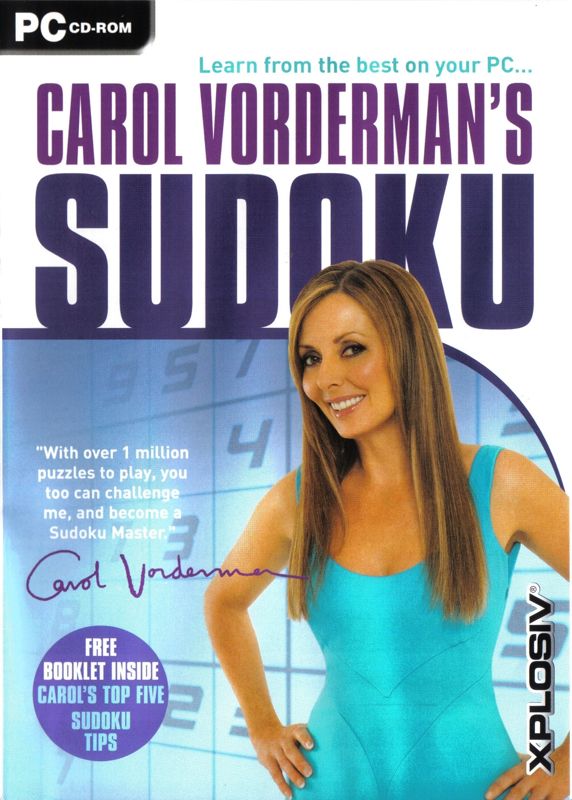
Retro Replay Review
Gameplay
The first hour has a pleasingly direct rhythm: pick a difficulty, start filling a grid, and let the familiar logic puzzle take over. Classic mode is the place to settle in if you want Sudoku without artificial pressure. Four difficulty levels give you room to build confidence or jump straight into a tougher brain-teaser, and that flexibility matters because Sudoku lives or dies on whether the puzzle is meeting you at the right level.
The arcade modes are where this edition earns its licensed packaging. Centering challenges on speed and accuracy changes the feeling of a solve: you are no longer just patiently spotting the next safe number, but trying to preserve momentum without making a costly lapse. That can be invigorating when you know the rules well, though timed play will naturally frustrate anyone who prefers to stare at a difficult grid until a pattern emerges. Career and Challenge Carol keep feeding you increasingly difficult puzzles under a time limit, which gives solo sessions a more structured pull than endlessly selecting standalone boards.
Multiplayer is unusually well suited to a game like this. Free For All has both of you attacking the same puzzle and racing to claim more squares, so it turns quiet deduction into a scrappy contest for opportunities. Quickfire’s turn-taking format is cleaner and more deliberate, while Time Attack lets each competitor solve a separate board for a purer speed test. Adjustable handicaps are a smart inclusion: you can actually play with someone less practiced without every match becoming a foregone conclusion.
The practical extras round it out well. Tutorial videos help if Sudoku’s logic has never clicked for you, and the solver is useful for checking a stubborn puzzle rather than abandoning it outright. Persistent statistics saved to the memory card add a small but welcome reason to care about improvement across sessions. For mode details and assists, the official PSP manual is worth a look.
Graphics
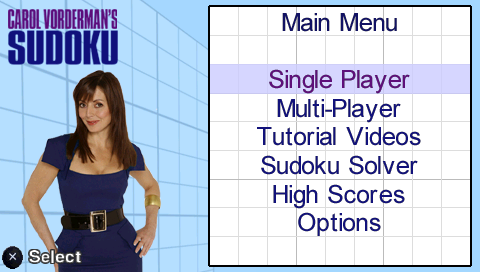
This is a top-down Sudoku game, so the grid is the star. The fixed, overhead view keeps every square in front of you and suits both quick number entry and competitive play; it is a sensible fit for a puzzle that depends on scanning rows, columns, and boxes without distraction.
Story
There is no dramatic tale pulling you from puzzle to puzzle. The hook is instead the steady escalation of Career and Challenge Carol, where harder timed boards give your progress a clear shape.
Carol Vorderman’s name frames the experience, and the tutorial material makes that branding feel tied to teaching the game rather than merely sitting on the box. If you want a puzzle game with characters, twists, or a narrative destination, this is plainly not built for that craving.
That restraint fits Sudoku. Each board creates its own tiny story of false starts, deductions, and the satisfying moment when a crowded grid finally opens up. The progression modes add enough context to make successive completions feel like more than isolated worksheets.
Overall Experience
Carol Vorderman’s Sudoku is strongest when you treat it as a versatile Sudoku set rather than expecting a radical redesign. You can play a straightforward classic puzzle, chase speed and precision in arcade challenges, work through timed progression, or turn the same fundamentals into a competitive two-player match. That range gives a very simple core more staying power than a bare-bones digital grid.
The trade-off is that every mode still depends on your affection for Sudoku itself. If the act of carefully eliminating possibilities already feels relaxing or compulsive, the timer-based variants and tracked stats give you fresh reasons to return. If Sudoku leaves you cold, the extra modes will not magically make number placement exciting; they mostly ask you to do it faster and with fewer mistakes.
It is an easy recommendation for a household where one person is learning and another is already fast, since tutorials, difficulty levels, solver support, and handicaps cover a lot of ground. Solo puzzle fans get a capable routine, while competitive players get three distinct ways to measure themselves against a rival. The payoff is not spectacle—it is a sturdy, well-considered way to keep a classic puzzle close at hand.


Reviews
There are no reviews yet.