 Retro Replay Retro Gaming History, Reviews & Emulation
Retro Replay Review
Gameplay
Your first few matches are a noisy, entertaining scramble. Weak, medium, and strong attacks give you an immediate fighting-game foundation, while guarding, sidesteps, throws, and specials keep the action from becoming a simple button-mashing contest. Then you begin to notice how much each fighter bends those basics around their own Style action. That variety is the reason to stick with All Star Battle after the initial novelty wears off.
Stand users can bring their partners into the fight, while other characters draw on Ripple, vampiric powers, or mounted abilities. It is an ambitious way to put such a broad manga cast in one arena, and it makes choosing a character feel meaningful rather than cosmetic. If you are here for the fantasy of pitting favorites from different eras against each other, the game delivers that collision better than almost anything else in its package.
Meter management adds welcome stakes. Heart Heat and Great Heat attacks can turn a clean opening into a big signature moment, so there is a satisfying tension between spending resources now and holding them for a stronger payoff. Practice mode is worth using, especially if the terminology initially feels like a wall. Local versus is where the game has the most staying power, because a friend can appreciate the strange matchups even before both of you fully understand every character-specific wrinkle.
Graphics
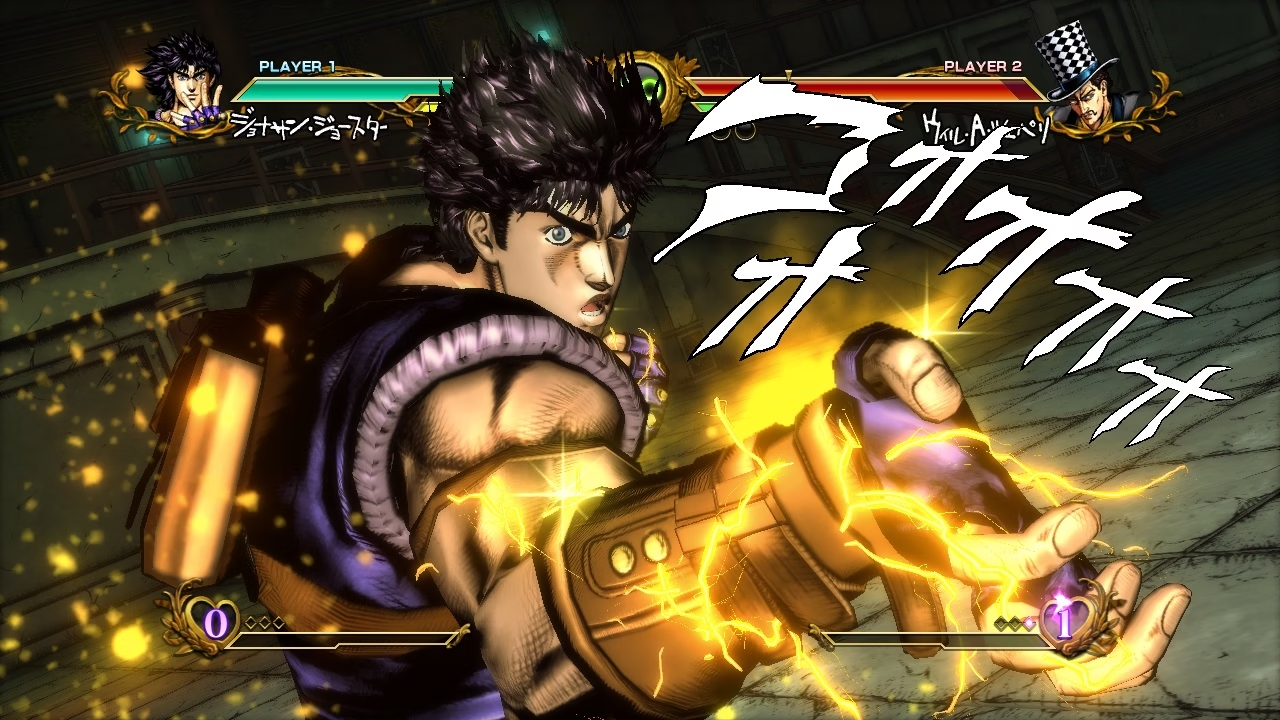
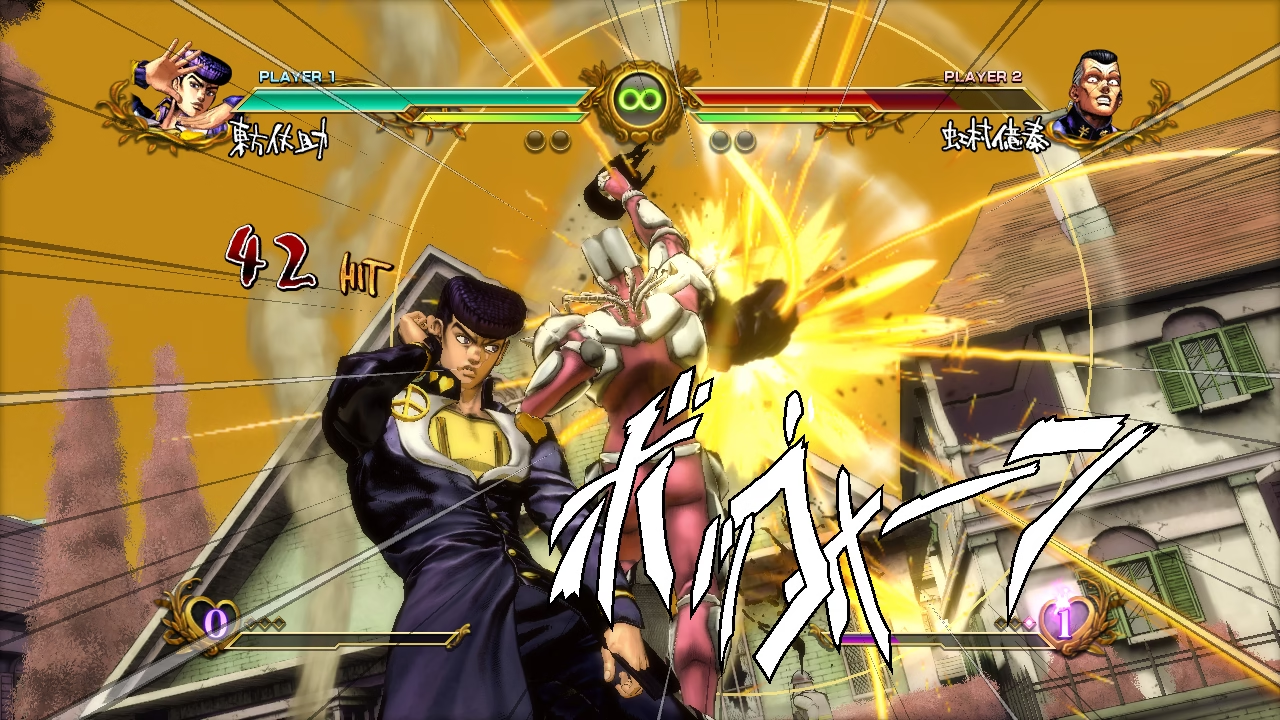
The in-match visuals do a terrific job of translating Araki’s drawn style into 3D. Jonathan’s blue outfit and violet scarf stand out as golden sparks gather around his fists, while Josuke and his white-and-pink Stand pop against cream houses, green shutters, and lavender trees. Thick outlines and fine crosshatching give faces and clothing a hand-drawn texture that most licensed fighters would not attempt.
Special attacks push the camera in close, then fill the screen with yellow impact bursts, black speed lines, and oversized manga sound-effect characters. It looks fantastic when an attack lands, though the lettering and effects can crowd the action enough that you may lose sight of the exact spacing for a moment.
Story
Story mode revisits selected confrontations from the manga rather than building one large original campaign. That format is a fine excuse to jump between eras and rivalries, but it also means the mode moves in short, battle-centered bursts. You are dropping into highlights, not settling in for a full retelling.
For longtime JoJo fans, the shorthand can be part of the fun. Recognizing why two characters are facing off gives each encounter extra charge, and the roster’s range becomes a celebration of the series’ long history. The game trusts you to bring much of that context with you.
Newcomers may find the story material abrupt. The scenes do not have the room to introduce every odd power, personality, or relationship before asking you to fight. If your priority is learning the world from the ground up, start with the manga or anime and return here once the faces and rivalries have some meaning.
Overall Experience
All Star Battle is at its best when you treat it as a playable JoJo festival. The rules are familiar enough to begin throwing punches quickly, yet the character-specific powers keep matches from feeling interchangeable. Some friction sets in as you work through its vocabulary and discover that the story mode is more of a curated fight reel than a robust adventure, but the individual matchups are often worth the effort.
This original PS3 version is a particular snapshot of the concept, not the later expanded revision. If you are comparing adaptations, the older Capcom arcade JoJo fighter offers a different adaptation with a different cast focus, while All Star Battle reaches across the manga’s first eight parts in 3D. The original release was announced by Bandai Namco as a CyberConnect2-developed PS3 game, with its release details documented in the original Bandai Namco launch announcement.
Give it a chance if the characters themselves are the draw and you have someone nearby for local matches. You will get the most from it by choosing a favorite, spending time in practice, and enjoying the ridiculous scale of the crossover. It is less convincing as a gateway for curious outsiders, but fans can forgive a lot when a match captures the right pose, power, and theatrical finishing blow.
Reviews
There are no reviews yet.