 Retro Replay Retro Gaming History, Reviews & Emulation
Retro Replay Review
Gameplay
The hook is immediate: plug an electric guitar into the included Real Tone cable, pick a song, and suddenly every note you play matters as input. Rocksmith uses the flowing-note format popularized by Guitar Hero and Rock Band, but the physical demand changes the relationship completely. You are not pretending to play a riff; you are learning where it sits on the fretboard and trying to make it happen on time.
Its smartest decision is adaptive difficulty. Early runs can begin with single notes, then build toward fuller arrangements as you prove you can keep up. That gives newcomers a way into songs that might otherwise be intimidating, and it makes improvement feel tangible rather than theoretical. The catch is that the game cannot make the guitar painless. When your fingers are slow or a transition will not stick, the music keeps exposing it. That frustration is productive, though, because it points directly at what needs work.
Riff Repeater is where Rocksmith becomes more than a clever novelty. Breaking a song into an intro, verse, solo, or outro and drilling it at a chosen difficulty or speed is exactly what you need after a rough first pass. Free Play demands every note, Accelerator responds to your performance and speed, and Leveler gives you repeated chances to raise your mastery percentage. These modes turn failure into practice instead of forcing you to restart an entire song for one bad measure.
The skill minigames are a welcome change of pace rather than empty distractions. They target specific fundamentals including chords, sustains, shifting, and tremolo, using variations on games such as Galaga, Simon Says, baseball, and a chord-based zombie shooter. They will not replace sitting down with a difficult song, but they give repetitive technique work a bit of personality. Amp mode also lets you shape your guitar sound with pedals and amplifiers mapped to three activation slots, while song presets aim for an appropriate sound out of the box.
Graphics
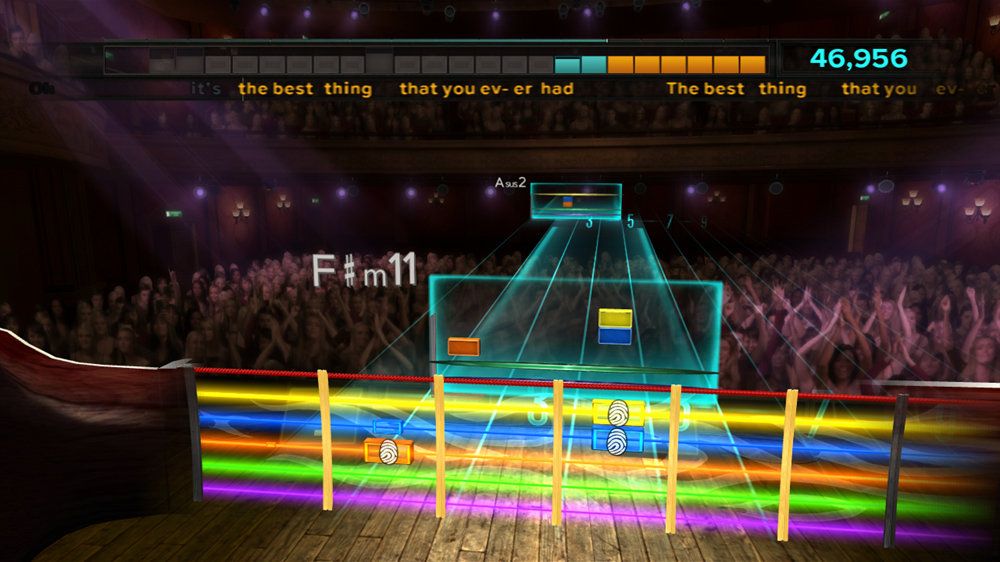
The central note highway is built for a guitarist: notes flow toward you, a horizontal fretboard guide sits at the bottom, and lyrics and accuracy information run above. It is a busy screen, but the important information is arranged around the question you are always asking—where do my hands go next?
Story
Rocksmith is not interested in telling a conventional story. Its Journey mode supplies a light progression structure, with songs and unlockables tied to achieving a double encore, but this is a route through the music rather than a narrative campaign.
That restraint fits the game. Your actual story is the changing relationship with a song: the first time you barely survive a passage, the moment the difficulty adds more notes, and the eventual run where a riff stops feeling impossible.
If you need characters, plot turns, or a reason beyond musical progress to continue, Journey mode will not carry the experience. The reward here is plainly personal: hearing your own playing get closer to the track.
Overall Experience
Rocksmith is at its best when you treat it as a game that happens to demand real practice, not a shortcut around practice. Its over-50-song mix of classic and modern rock gives you a solid reason to return, and the gradual ramp from individual notes to complete riffs makes the learning curve less forbidding than picking up a song cold.
It is also more demanding than the rhythm games it resembles. Accuracy and timing count, and no on-screen system can press the strings cleanly or build finger strength for you. Some sessions will feel less like chasing a high score and more like being confronted with a weak spot in your technique. For the right player, that honesty is the whole point.
Give it a chance if you own an electric guitar and want structured, entertaining encouragement to improve. The combination of adaptive songs, targeted repetition, and skill-focused diversions gives it real staying power beyond the initial novelty. For background on the original release, the official Rocksmith page captures its guitar-first pitch. Rocksmith may not make you good overnight, but it makes the path to getting better unusually playable.


Reviews
There are no reviews yet.