 Retro Replay Retro Gaming History, Reviews & Emulation
Retro Replay Review
Gameplay
The first hour has an easy pull because Tides of Destiny throws you into a strange predicament, then gives you a whole island of small reasons to stay busy. You are not simply marching from quest to quest. Aden can meet Fenith Island’s residents, fight, fish, cook, craft, and work the land while pursuing a way to separate Sonja from his body. That familiar Rune Factory blend still works: after an outing, coming back to turn materials into something useful or tend crops gives the adventure a pleasantly domestic rhythm.
The Golem is the game’s biggest change of pace. It carries you across the waters around Fenith Island, turning exploration into a search for new places and answers rather than keeping everything tied to town. It is a sensible fit for a series that already mixes a homey routine with fantasy danger, and it gives the journey more scale. The farming setup also has a strong, clean hook: you can unlock four farms, with Spring, Summer, and Fall devoted to their own crops, while Winter becomes a mine for ore and gems.
Combat is more directly action-focused than in Rune Factory: Frontier, with Dual Blades and Katanas joining the weapon selection. That variety matters when you are regularly splitting your time between battles and chores; you can settle into a weapon style that makes the fighting feel less like an obligation between harvests. Still, the game can feel pulled in several directions. Its systems are individually inviting, but moving among ocean exploration, combat, farming, and social obligations does not always create a smooth sense of momentum.
Practical advice: play it for the loop, not for one isolated pillar. If you only want a tightly focused action RPG, the farming and crafting may feel like distractions. If you only want a pure farm sim, the combat and exploration demand more attention than you may want. But if the idea of choosing your own pace—sailing out, gathering materials, then returning to cook, craft, or plant—sounds relaxing, the mixture has real staying power.
Graphics
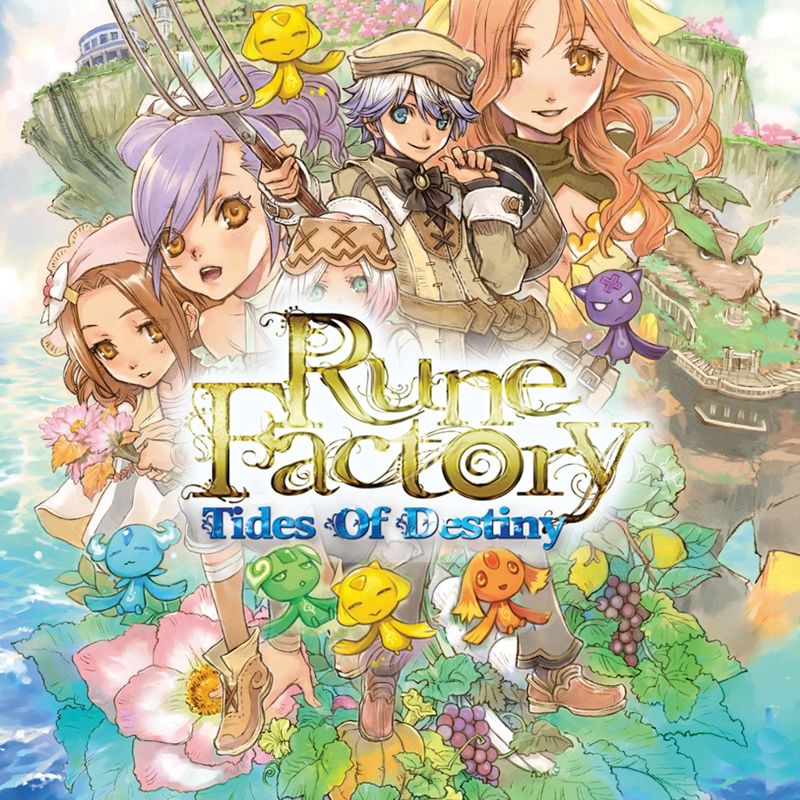
The game uses a colorful anime-fantasy look built around Fenith Island, its surrounding ocean, and the oversized Golem that carries Aden across the water. The third-person view suits its blend of town life and action, and the seasonal farm concept gives the different growing areas a clear visual purpose: spring cabbage, summer corn, fall eggplants, and a winter mine full of ores and gems.
Characters are a major part of what you look at, and the extensive voice acting helps the island’s locals register as more than task markers. The Golem is also an immediately memorable sight simply because it makes travel feel distinct from another on-foot run between fields and dungeons.
Story
Aden and Sonja’s shared-body setup is a strong opening premise because it makes the central goal personal from the start. They are not just stranded somewhere unfamiliar; they have lost the basic ability to exist separately. The search for the truth behind their situation, a route home, and Sonja’s own body gives the island adventure a clear emotional destination.
There is a nice tension between that urgency and the game’s laid-back routines. You may be trying to solve an alarming supernatural problem, yet much of your time is spent befriending locals or building up supplies through farming, fishing, cooking, and crafting. For the right mood, that contrast is part of the charm: Fenith Island becomes a place you live in rather than merely pass through.
The near-complete voice acting is a meaningful advantage for a story so dependent on the relationship between its central pair and the people they meet. Late in the game, the option to take control of Sonja and pursue one of four male marriage choices adds a notable extra angle to the usual relationship side of Rune Factory. It does not erase the fact that Aden leads most of the journey, but it gives the endgame a welcome shift in perspective.
Overall Experience
Rune Factory: Tides of Destiny is an appealingly busy RPG that earns its best moments when you stop treating its activities as a checklist. Sailing in the Golem, fighting with a preferred weapon, digging into the winter mine, and returning to a farm or kitchen can create the satisfying sense that your everyday work feeds into a larger adventure. The game has enough moving parts that your favorite portion will likely determine how much you enjoy it.
Its downside is that the same abundance can make it feel uneven. There is an action game here, a farming game here, a crafting game here, and a relationship-driven island story here; they do not always pull with equal force. A 6.8 fits: this is a good-hearted, worthwhile entry with clear ideas, not the most polished fusion of those ideas.
Give it a chance if you like Rune Factory specifically because it refuses to make you choose between a sword and a watering can. The ocean-going Golem and seasonal farm structure make this installment stand apart, while Aden and Sonja’s predicament provides a better reason than usual to see the journey through. For background on the game’s release and development history, the Rune Factory: Tides of Destiny overview is useful; for actually playing it, expect an uneven but often cozy fantasy vacation.


Reviews
There are no reviews yet.