 Retro Replay Retro Gaming History, Reviews & Emulation
Retro Replay Review
Gameplay
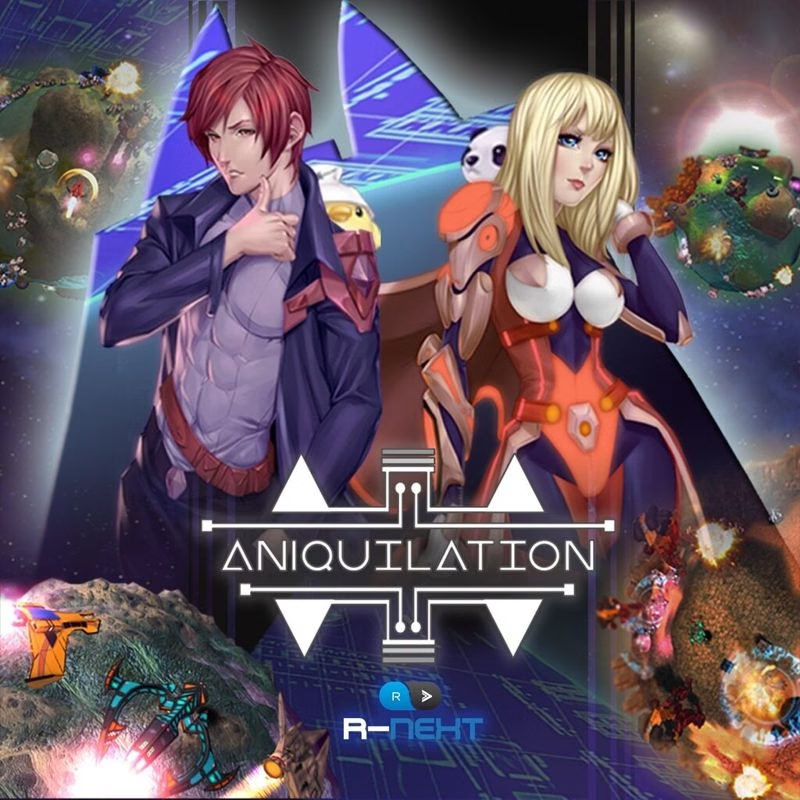
Aniquilation grabs you with a simple, satisfying thought: if something is flying at you, perhaps you can send it flying back. The sword is the heart of the game’s combat, letting you slash, reflect, and throw projectiles, enemies, and environmental objects. That gives its twin-stick shooting a welcome streak of mischief. Rather than treating the battlefield as background clutter, you are encouraged to weaponize it.
The basic arsenal has enough range to support that idea. Five projectile weapon types, two special abilities, a dash, a temporary invulnerability shield, and ship-specific capabilities give you several ways to push forward. The most interesting moments should come when shooting alone is not enough and you start combining a reflected threat with a thrown object or a well-timed dash. It is a more active fantasy than simply clearing waves from a safe distance.
There is a lot being asked of you, though. Between weapon fire, sword actions, abilities, destructible targets, recovery bases, enemy attacks, and terrain that can become a weapon, the action can sound busy even before another human player enters the picture. Give it a chance if you like learning an arena’s possibilities through experimentation. If you prefer a shooter with a narrow, immediately legible combat loop, the density of options may feel more distracting than empowering.
The campaign also mixes in racing-like tubular travel stages between planets, which is a welcome attempt to change the rhythm rather than leaving you in combat arenas from start to finish. Ship unlocking and upgrades through XP and gathered resources add a reason to keep playing beyond a single successful run. You can read more about the game’s core combat ideas on its official publisher page.
Graphics
The action is viewed from a diagonal-down angle across compact planets and distinct level environments. That perspective suits a game built around thrown objects and reflected fire, since it puts the immediate space around your ship in view. The small-world concept is the most memorable visual idea here, especially because some planets can change as you play.
Story
You follow a pilot and her leader, stranded after chasing a mystery beyond their home galaxy. It is a familiar sci-fi setup, but it gives the journey a useful forward pull: each planet is another stop on the way home, another source of energy for their people, and another piece of a larger problem.
The story’s strongest hook is its insistence that their arrival in this particular galaxy was not an accident. That turns the premise from a straightforward lost-in-space chase into a question of why these characters were drawn there, and why the legendary Aniquilation may be the only answer. It is appropriately high-stakes material for a game where whole planets are part of the battlefield.
The true ending depends on finding the galaxy’s most powerful weapon, so exploration has narrative weight as well as upgrade value. That is a good fit for completion-minded players, although it also means the fullest resolution is tied to how thoroughly you search for that weapon. If you enjoy a campaign that makes its ultimate outcome something to earn, the structure gives the adventure extra purpose.
Overall Experience
Aniquilation is easy to respect for aiming beyond a standard twin-stick shooter. Its best idea is not the guns or the upgrades by themselves, but the invitation to treat almost everything nearby as something you can swat, hurl, or redirect. When that interaction becomes second nature, the game has the potential to feel far more playful than a conventional arena blaster.
It also has real range for a small-scale action game. You can tackle the story alone or in split-screen co-op, then move into base defense, goal scoring, contagion, and free-for-all modes. Those modes are built around different objectives, which should make a multiplayer session feel less repetitive than endlessly running the same deathmatch setup.
The payoff will be strongest for you if experimenting is part of the fun. Aniquilation looks built for the kind of player who sees a dangerous projectile, an enemy, and a nearby object and immediately wants to test whether they can all be turned into one ridiculous counterattack. Its crowded toolset may not be for everyone, but its willingness to make the arena itself part of the fight gives it a personality worth trying.


Reviews
There are no reviews yet.