 Retro Replay Retro Gaming History, Reviews & Emulation



Retro Replay Review
Gameplay
Mortal Kombat X feels great the moment a round turns from cautious footsies into a close-range brawl. Punches, kicks, throws, uppercuts, teleports, weapon attacks, and special moves all carry the exaggerated impact you want from Mortal Kombat. It is accessible enough that you can pick a fighter, learn a few reliable strings, and start having fun quickly. Stick with it, though, and the pace becomes much more deliberate as you learn when to block, spend meter, break a combo, or turn a small opening into a much uglier one.
The three variations per character give the roster more substance than its raw size suggests. Rather than treating Scorpion, Kitana, or another familiar face as a single fixed toolset, the game asks you to choose a version with its own moves and weapons. That is a strong reason to revisit fighters you might otherwise dismiss after a few matches. Newcomers such as Cassie Cage, D’Vorah, Kotal Kahn, and Takeda also make a convincing case for themselves beside the veterans, so this does not feel like a roster living entirely on nostalgia.
There is plenty to do once you need a break from standard versus matches. Story mode offers a guided tour through much of the cast, while Towers, Living Towers, ranked play, King of the Hill, Survivor, and Test Your Luck provide different ways to keep fighting. The shifting conditions in Living Towers can be entertaining or annoying depending on your mood, especially when you want a clean competitive match instead of a weird complication. Faction Wars adds another layer of long-term incentive, though the real reason to stay is the sturdy combat.
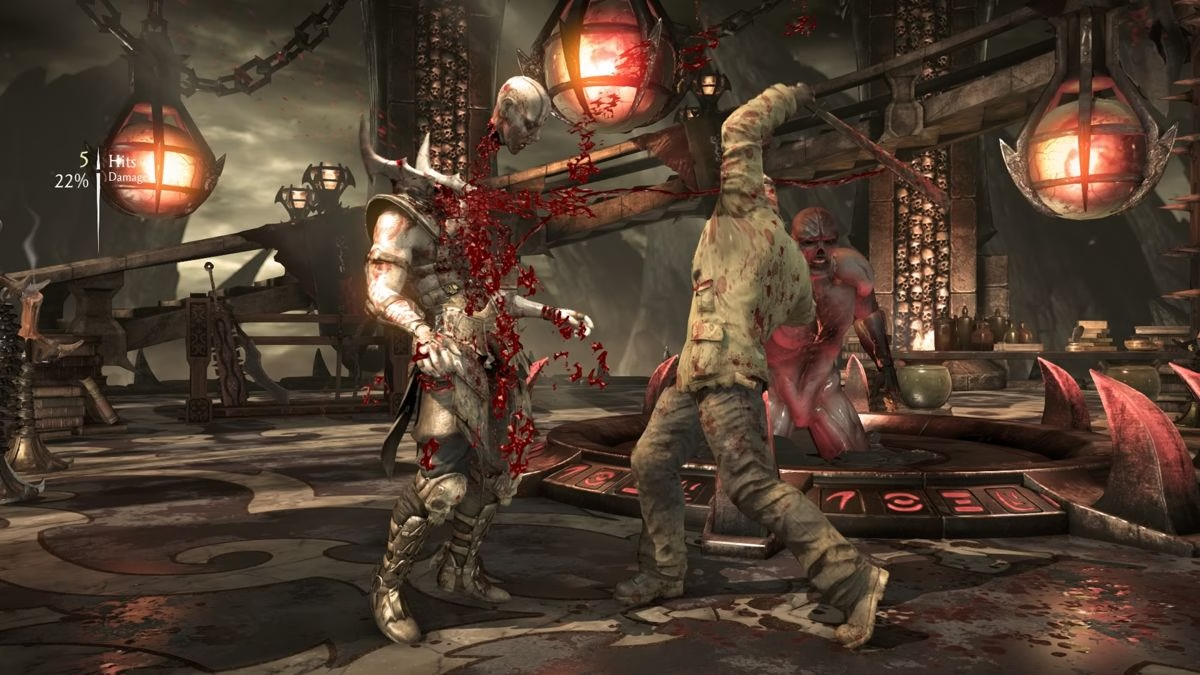
Finishers remain central to the personality of the game, and Mortal Kombat X gives you a ridiculous number of ways to end a bout. Fatalities are still gleefully excessive, while Brutalities are especially satisfying because they can grow naturally out of a winning combo. Environmental interactions add a little movement and opportunism to stages without overwhelming the match. If you enjoy fighters where strong fundamentals and theatrical violence can coexist, this is an exceptionally easy game to lose an evening to.

Graphics
The PlayStation 4 fights look suitably nasty. Fighters wear convincing armor, cloth, scars, and grime, and the arenas are packed with harsh stonework, chains, burning fixtures, and stained floors. Blood sprays freely during Brutalities and lingers across the ground, making every match look progressively more wrecked as the round goes on. Bright flames and orange furnace light pop against the game’s darker browns, grays, and reds.
The Krypt offers a different look, putting you in a snowy courtyard with bare trees, cold blue-gray shadows, and small pools of warm torchlight before leading into cramped, web-choked tunnels. Its oversized spider encounter has a pleasingly gross, tangible presence. That first-person detour is less polished-looking than the main fights, but it gives the unlock hunt some atmosphere beyond simply buying extras from a list.

Story
The campaign picks up after the 2011 reboot and jumps forward roughly two decades, using that gap to bring a younger generation into the conflict. Cassie Cage, Jacqui Briggs, Takeda, and Kung Jin give the story fresh faces, while established fighters still carry much of the melodramatic supernatural weight. It is a smart structural choice because you get the comfort of familiar rivalries without spending the whole campaign looking backward.
The central threat is Shinnok, whose return depends on the struggle over his amulet and Quan Chi’s escape. Mileena’s scheme and Kotal Kahn’s position as Outworld’s new emperor give the plot several competing interests, even when the writing is unapologetically heightened. Mortal Kombat has never needed subtlety to work, and this game is more fun when you accept the betrayals, ancient artifacts, and realm-spanning stakes as an excuse to get the next rivalry into the arena.
Its biggest strength is how naturally the story feeds into fights. Characters have clear reasons to clash, the campaign keeps moving, and the new cast earns room beside staples like Scorpion, Sub-Zero, Raiden, Johnny Cage, and Sonya Blade. You should not expect nuanced drama from every scene, but it delivers the kind of loud, comic-book tournament chaos that suits the series.
Overall Experience
Mortal Kombat X is a very good fighting game because it respects both sides of the audience. You can enjoy it as a messy couch competition full of familiar faces and outrageous endings, or you can dig into variations, meter management, and matchup knowledge until each round becomes a sharper contest. Its systems have enough depth to keep improving, yet its basic aggression and clear impact make it welcoming from the start.
Frustration can set in when a variation-dependent matchup leaves you feeling underprepared, or when random Tower conditions get in the way of the kind of fight you wanted. The abundance of modes and unlocks can also make the game feel busier than necessary. Still, none of that weakens the immediate pleasure of two fighters circling, one player committing too hard, and the other turning that mistake into a devastating combo.
If you liked the 2011 reboot, this is a stronger, broader follow-up that keeps its predecessor’s direct combat while adding meaningful variety to the cast. If you are new to Mortal Kombat, it is a great entry point as long as you are comfortable with graphic violence and willing to spend time learning more than one combo. The payoff is a fighter with real competitive bite, a memorable roster, and enough spectacle to make even a loss entertaining.


Reviews
There are no reviews yet.