 Retro Replay Retro Gaming History, Reviews & Emulation
Retro Replay Review
Gameplay
The first few hours ask you to enjoy being pulled in three directions at once. CrossStory lets you switch among Rean, Lloyd, and C within a chapter, and the routes show parallel events from their own viewpoints. You need to make progress with each group before moving on, so this is not a structure that lets you simply camp with your favorite cast. That constraint can break the rhythm when one route has you hooked, but it also makes the game feel like a coordinated ensemble piece rather than three disconnected campaigns.
Combat has the dense, satisfying cadence Trails fans expect. Standard turn-based fights draw on arts, crafts, tactical links, and Brave Orders, leaving plenty to think about when you build a party and decide how to spend resources. The standout addition is Valiant Rage, which spends the Assault Gauge on a partywide attack, heal, or arts effect involving reserve members. Since it also restores BP for other commands, it gives you a reason to plan turns around a bigger swing instead of treating every encounter as a simple exchange of attacks.
True Reverie Corridor is where the giant roster stops being just a fan-service roll call. Its randomized dungeon setup allows mixed teams from across the routes, while episodes, minigames, and system upgrades give repeated runs a useful purpose. It is an easy place to lose time testing combinations you could not assemble in the main paths. If you want a quick, self-contained JRPG, the mandatory route hopping and menu-heavy tactical planning may feel like work. If tuning a party is part of why you play Trails, this is one of the game’s richest toy boxes. The official Hajimari system guide is useful for getting a clearer sense of how its interlocking systems fit together.
Graphics
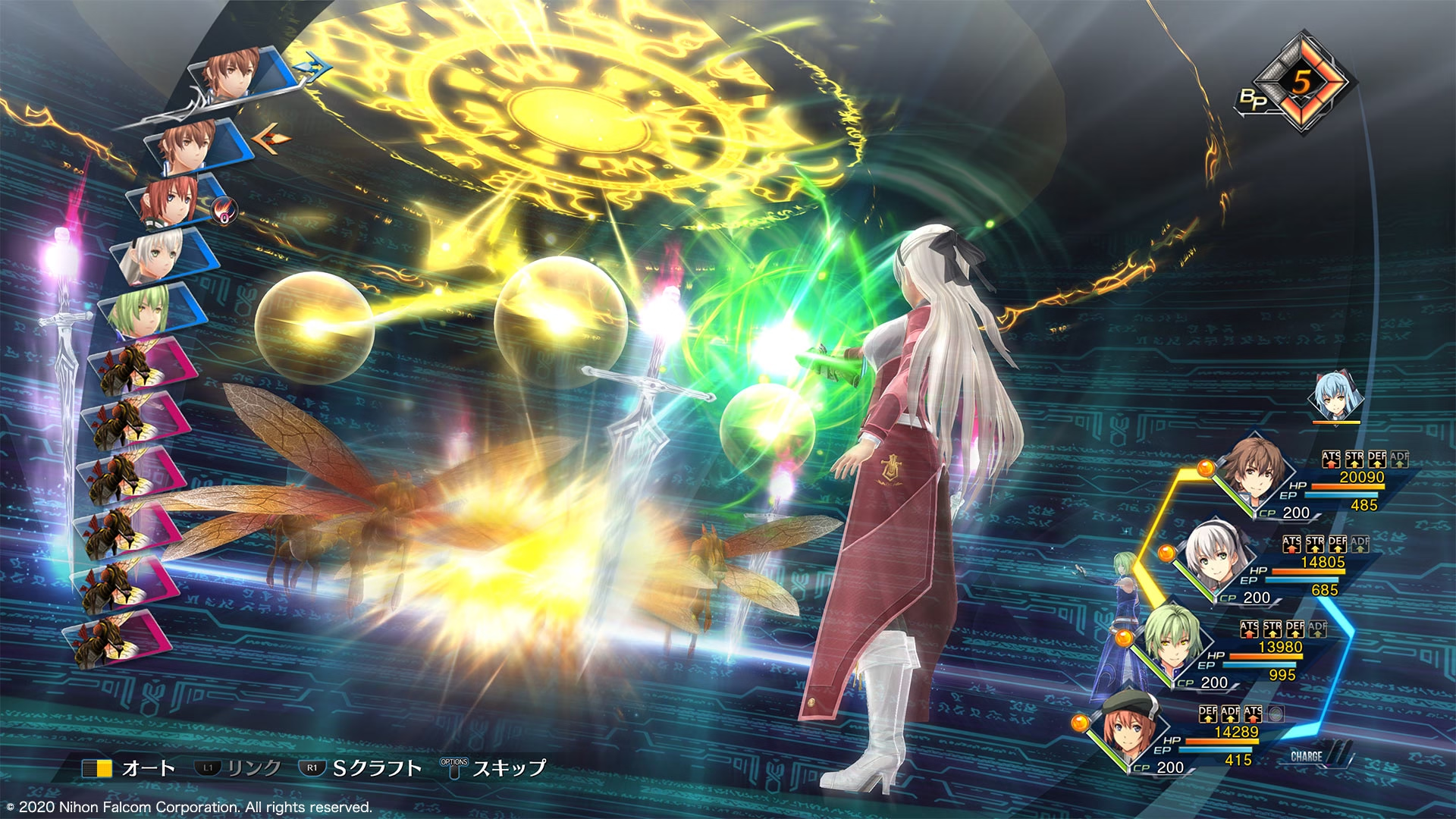
Battle scenes go big on saturated anime color. One Valiant Rage sequence places a white-haired fighter in a long red coat beneath an enormous yellow magic circle, with green-gold energy, glowing gold orbs, and thin silver blade trails cutting through brown winged monsters. Cyan circuit-like glyphs light the dark arena floor and walls, creating a sharp contrast with the spell effects. It is striking, although the stacked gold orbs and green glow can hide the enemies caught in the attack.
Story
Hajimari no Kiseki draws much of its force from reunion and accumulation. Rean Schwarzer and Lloyd Bannings carry two established sides of Zemuria, while the mysterious masked C supplies a third perspective that is deliberately harder to place. The aftermath of the Great Twilight crisis gives the game an immediate sense that it is dealing with consequences rather than starting from scratch.
That makes this a poor place to make Trails your first long-term commitment. The story assumes that names, factions, and earlier conflicts already mean something to you, and it has little reason to slow down for introductions. The original release is entirely in Japanese, which compounds the challenge: this is a dialogue-rich RPG whose emotional and political threads depend on close reading.
For anyone who has followed the series, though, the three-route setup has real dramatic value. Seeing the same period from different angles lets the game build curiosity without relying on one protagonist to carry everything. If you want earlier context for the broader worldbuilding, The Legend of Heroes: Trails in the Sky is a valuable starting point, though it is not a direct prerequisite with the same combat structure.
Overall Experience
This is a large, confident anniversary-style RPG that knows exactly who it wants in the room. Its best moments come when the route structure, oversized cast, and tactical options reinforce each other, turning familiar characters into new possible teammates and parallel plotlines into a reason to keep checking the other side.
The tradeoff is momentum. Having to advance several routes can make a strong thread wait its turn, and the abundance of characters and systems can feel less welcoming than exhausting if you are not already invested. Hajimari does not smooth out that friction for newcomers. It leans into its history.
Give it a real chance if you are a Trails fan who wants deeper party building and a story built around long-running continuity. Skip this original PS4 edition if Japanese text is a barrier, because the writing is too central to the experience to treat as background noise. For the right audience, its payoff is the rare feeling of a long-running RPG series gathering its many moving parts into one remarkably playable package.


Reviews
There are no reviews yet.