 Retro Replay Retro Gaming History, Reviews & Emulation
Game Overview
Gameplay
Thumper starts fast and stays fast. Your beetle moves forward on its own, so there is no cautious warm-up period where you can feel out the pace. You are immediately reading the track, timing hits on glowing points, holding through sharp turns, and bracing for obstacles that demand a quick directional input or a sustained button press. The limited controls are a major strength. You rarely have to wonder what the game wants from you. The hard part is delivering the right response at speed.
What makes the rhythm work is its physicality. A successful input is not just a note acknowledged by the game. You slam into the track, carve around a turn, burst through a barrier, or unfold wings to break through hoops. Clearing a dense run of actions feels forceful and strangely athletic, especially when your successful moves build on the grinding, booming industrial soundtrack. Miss a glowing track element and the beat drops out briefly; crash into other hazards and the consequences are more immediate.
That punishment is where Thumper will either lock you in or wear you down. Each section forgives one crash or missed obstacle, then restarts you on the second. The levels contain roughly 20 linked sections, so a stubborn sequence can turn progress into a cycle of practice, failure, and another attempt. Unlimited lives keep it from becoming stingy, but they do not make it easy. The later addition of multiple lanes gives the game more to ask of your attention, while optional collectibles offer score chasers another reason to tighten their runs.
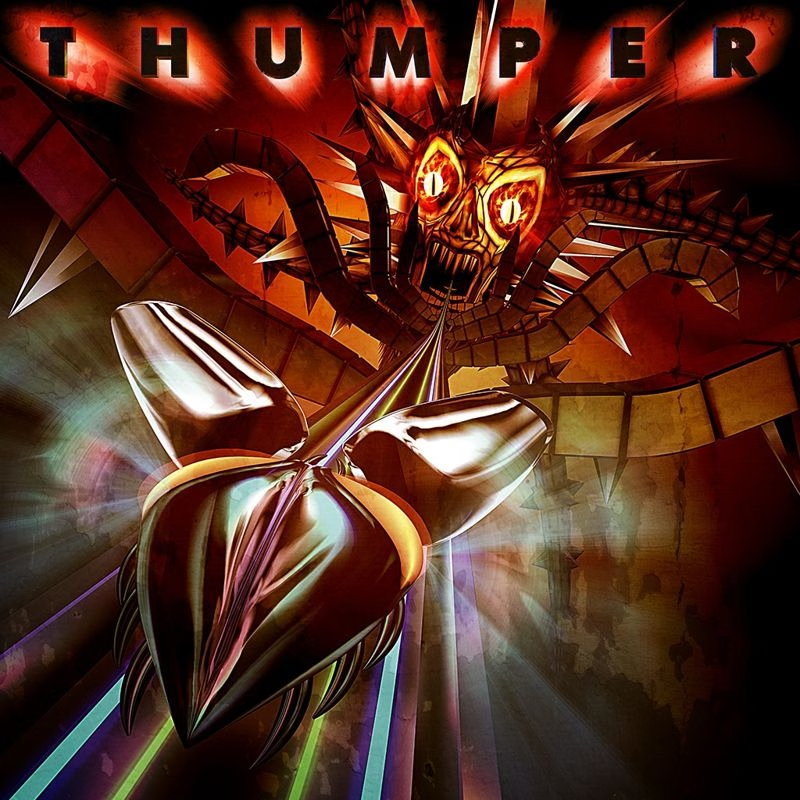
Boss encounters break up the track work without letting the pressure disappear. You repeat a sequence until you can clear it cleanly, then thump a glowing button to damage the looming head. These fights fit the game because they test the same skill Thumper has been drilling into you: keep the rhythm while your nerves are telling you to rush. They are less about discovery than execution, which is exactly the point.
Story
Thumper is not interested in explaining much. The recurring giant head gives the journey a threatening focal point, while the space beetle and endless void create a hostile, surreal setup. That sparseness works here. You are not stopping for plot; you are pushing through nine escalating levels that feel like an assault course built around a single ominous presence.
Overall Experience
This is a rhythm game for you if you want concentration and impact instead of a breezy playlist. The industrial sound is not background decoration. Your good play actively fills it out, so a clean passage can feel like you are forcing order out of noise. When it clicks, Thumper produces a fierce tunnel-vision state that few music games can match.
Its narrow focus is also its limitation. The automatic movement, compact input set, and repeated obstacle vocabulary create a focused test rather than a varied adventure. If you dislike replaying difficult passages until your hands learn them, the rigid restart rule may feel exhausting. The game does not do much to soften its demands, and it is unapologetically built around mastering sequences rather than merely seeing what comes next.
For the right mood, that severity is the payoff. Thumper turns a few buttons and a forward-moving track into a tense, percussive fight for control, then rewards precision with real momentum. It is intense, demanding, and occasionally frustrating, but its best runs have a brutal momentum that makes an immediate restart feel less like a setback and more like a dare.



Reviews
There are no reviews yet.