 Retro Replay Retro Gaming History, Reviews & Emulation

Retro Replay Review
Gameplay
The first few minutes of Le Concert: pp Pianissimo are easy to understand: music cues travel in from the right, and you answer them with the correct conductor-like movements and button inputs at the proper moment. The premise is modest, but it has a different flavor from rhythm games built around flashy performers. You are trying to keep an orchestra together, and that makes accuracy feel less like button-mashing and more like maintaining control of a musical passage.
There are five immediately available stages, so you can sample its repertoire without a long unlock grind. Better performances improve your ranking, giving you a concrete reason to replay rather than simply clear each piece once. That loop is the heart of the game: learn the timing, tighten your performance, and chase a result good enough to open the hidden sixth stage. If you enjoy returning to a song until your hands settle into its rhythm, Pianissimo has a satisfying, focused structure.
The two control styles are a smart touch. Gamers mode uses ordinary PlayStation button prompts, which is the sensible place to start if you just want a clear rhythm-game interface. Musicians mode replaces those prompts with musical dynamics, making the game more specialized and potentially more rewarding if that notation means something to you. It is not a different game so much as a different language for reading the same performance, and it gives the concept a welcome bit of personality.
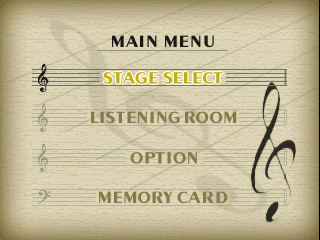
The main point of friction is also plain: progression toward the complete ending depends on playing well, not merely seeing all five standard stages. Beat stage five and you only receive a very short ending; finish stage six for the real ending and credits. That can make an imperfect run feel more consequential than usual, but it also gives improvement a genuine payoff. The listening room, which fills with each cleared stage’s music, is a nice incentive to revisit what you have completed.
Graphics
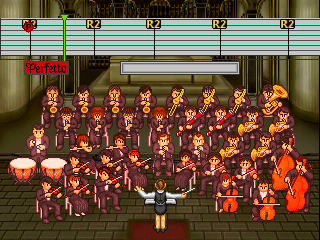
The action is built around music pieces entering from the right side of the screen, with the young female conductor at the center of the performance. Its clearest visual priority is helping you track those approaching cues and respond in time, while the pre- and post-stage dialogue scenes break up the performances.

Story
Pianissimo does not lean on an elaborate narrative. Instead, it frames its stages with conversations between the conductor and other characters, giving each performance some context and making the route to the final stage feel like more than a bare list of songs.
That light touch fits the format. You are here primarily to conduct and improve, and the dialogue works best as a breather before another attempt rather than a reason to rush through the rhythm sections. The protagonist’s role as a young classical conductor is enough to distinguish the game from a generic music-game setup.
The ending structure is the story’s most effective motivator. A short conclusion after stage five tells you that you have reached a milestone, but the real resolution is reserved for anyone who earns access to and clears stage six. If you tend to enjoy games that make their final reward conditional on mastery, that extra hurdle is likely to land better than a standard credits roll.
Overall Experience
Le Concert: pp Pianissimo is a small, concentrated rhythm game with an unusually calm classical-music angle. Its strongest quality is how directly it ties improvement to its finish: do well, raise your rank, unlock the secret stage, and hear the full closing. There is no need for a huge song list when the game is asking you to develop a cleaner relationship with the pieces it has.
Give Gamers mode a fair shot first, then try Musicians mode if you are comfortable reading musical dynamics or simply want a less conventional prompt system. The latter is a neat reason to revisit familiar stages, while the listening room gives you a low-pressure way to enjoy the music you have earned. Including Johann Strauss Sr.’s “Radetzky March” gives the selection a recognizable classical anchor.
This is worth a chance if you want rhythm action with a conductor’s point of view and do not mind repeating stages for a better result. It is less suited to anyone who wants the ending handed over after a single clear. For the right mood, though, its short route, classical focus, and mastery-gated finale make for a pleasantly purposeful PlayStation rhythm game.

Reviews
There are no reviews yet.