 Retro Replay Retro Gaming History, Reviews & Emulation
Retro Replay Review
Gameplay
The first few stages of Le Concert ff make a clear case for its conductor premise. Rather than merely treating songs as a sequence of detached inputs, it asks you to direct the orchestra with the correct movements and button presses at the proper time. Musical pieces enter from the right of the screen, and your performance ranking rises with better timing. That simple loop gives every missed input a little sting: you are not just dropping a note, you are losing control of the performance.
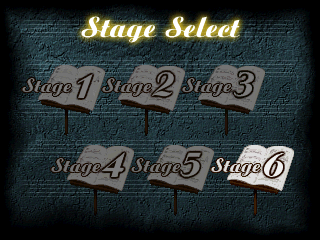
There are five open stages to tackle before the game starts asking more of you. Beat stage 5 and you will reach a short ending, but the real target is stage 6, which only appears after you have earned good enough results and leads to the full ending and credits. That is a smart incentive for a rhythm game. You have a concrete reason to return to earlier stages, sharpen your timing, and care about the ranking beyond the satisfaction of a clean run.
Gamers Mode uses regular PlayStation controller-button prompts, while Musicians Mode swaps them for musical-dynamics markings. The latter is the more distinctive option and the one most closely tied to the conductor theme, although it asks you to be comfortable recognizing that notation rather than relying on familiar button symbols. If that sounds like an extra layer of friction, start in Gamers Mode; once the rhythm and motion pattern click, Musicians Mode is there to make the act of reading the performance feel more musical.
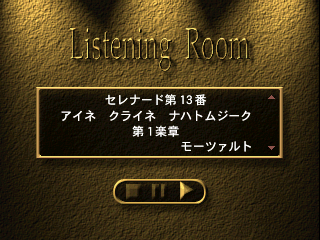
The listening room is also a welcome reward instead of a throwaway extra. Finish a stage and its music becomes available to hear outside play, giving your successful runs a tangible payoff. With Mozart’s “Eine kleine Nachtmusik” among the selections, the game has at least one immediately recognizable classical anchor. It is not a sprawling progression system, but its unlocks are neatly tied to playing well.
Graphics
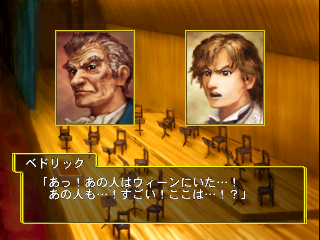
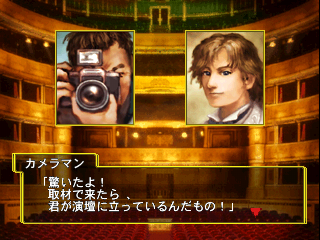
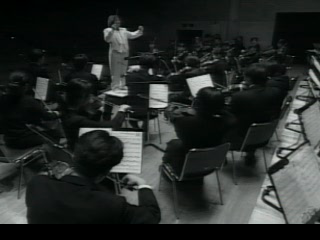
The key visual information is direct: music pieces travel in from the right, letting you follow what is approaching as you conduct. The pre- and post-stage dialogues put the young conductor and other characters on screen between performances, giving the stages a character-focused break rather than leaving the game as an uninterrupted series of music prompts.
Story
Le Concert ff keeps its story framing close to the stage structure. You play a young male classical-orchestra conductor, with dialogue scenes before and after each stage involving him and the other characters. That gives the performances a bit of context without pulling attention away from the rhythm play.
The game’s most meaningful narrative beat is tied to how well you perform. Reaching stage 5 earns a short ending, while strong enough results unlock stage 6 and the real ending with credits. It is a straightforward but effective arrangement: the better conclusion is not simply handed over for finishing the basic route.
Do not come in expecting the dialogue to be the main attraction. Its job is to connect the concerts and give the conductor a social setting between them. The stronger story hook is the way the ending turns improvement into a personal goal: if you want the complete close, you need to prove you can conduct well enough to reach it.
Overall Experience
Le Concert ff is a small, focused rhythm game whose conductor angle does more than decorate the concept. Directing an orchestra through timed motions gives the action a pleasant thematic fit, and the rank-gated sixth stage ensures that solid play matters after the initial clear. If you enjoy revisiting songs until your timing improves, that loop has real pull.
Its biggest strength is that it respects two different ways into music games. Gamers Mode gives you the immediate familiarity of controller prompts; Musicians Mode asks you to engage with dynamics notation instead. Neither has to replace the other. One is the sensible starting point, while the other gives the game a more specialized challenge once you are ready for it.
The payoff is modest but worthwhile for the right mood: six stages, unlocked listening-room tracks, and a full ending reserved for good performance. Give it a chance if classical music and score-chasing rhythm play sound more inviting than a huge song list. The route to stage 6 may frustrate anyone who only wants to see the credits once and move on, but that same hurdle gives the game its reason to keep practicing.


Reviews
There are no reviews yet.