 Retro Replay Retro Gaming History, Reviews & Emulation



Retro Replay Review
Gameplay
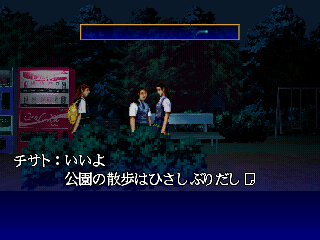
The first hour’s pull comes from being allowed to physically guide Yukari, Mika, and Chisato through a school that should be closed. That sounds basic, because it is: you walk the trio across 2D spaces, sometimes through areas with more depth, and wait for the next unsettling prompt. But that direct movement matters. It makes the game feel less like a static menu-driven Japanese adventure and more like you are accompanying three curious teenagers into places they really ought to avoid.
Do not come expecting puzzle-box design. Tansaku-hen has no inventory, no combat, and no secondary system to master. Its whole rhythm is walking, reaching narrative moments, and choosing dialogue or actions. Once that clicks, the stripped-back structure can be effective: your attention stays on where you are going, what rumor you are following, and whether you are about to make the choice that turns a bad feeling into a bad outcome.
The trouble is that the same simplicity leaves little to lean on when the pacing slows. If you need frequent mechanical surprises, the walking and occasional decisions can feel thin. The branch structure also gives decisions real weight, since reaching a bad ending prevents access to the following chapter. That raises the stakes, but it can sting when you were hoping to press on rather than replay for a better result.
It is a better fit for a patient horror-adventure fan than for someone looking for challenge in the usual sense. Treat each chapter as a compact ghost story and the limited interaction feels purposeful. Treat it like a conventional exploration game with lots of secrets, tools, and obstacles, and you may find yourself waiting for systems that never arrive.
Graphics
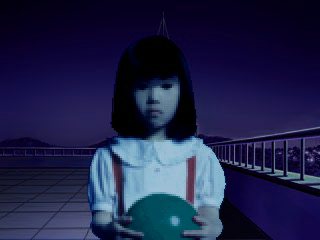
Tansaku-hen stands apart from many Japanese games of its era by using digitized images and photographs of real people instead of an anime or manga look. The three girls and the school-based horror are therefore grounded in a more uncanny, almost too-real register, which suits a story about ordinary students wandering into supernatural rumors.
The side-view movement across 2D backgrounds keeps your position easy to judge, while some locations add a sense of depth closer to a third-person adventure. It is an unusual visual match for a high-school ghost story: less cartoonish, more like an old urban legend captured on something you were not meant to see.

Story
The game understands why school ghost stories endure. A music room after dark, a disturbing photograph, an unexplained disappearance, and sounds where there should be silence all turn familiar school spaces into sources of dread. Rather than building one huge mystery, Tansaku-hen divides its material into chapters, each centered on a different eerie tale.
Yukari, Mika, and Chisato give the premise its needed human center. They are not armed specialists or monster hunters; they are high-school girls driven by curiosity, carrying only a flashlight into the dark. That vulnerability makes the setup stronger than it would be with a tougher, more prepared cast. You are following people who can investigate a rumor, but cannot simply overpower whatever the rumor becomes.
Choices matter because they can produce different endings, including outcomes bad enough to block the next chapter. That structure gives the stories a pleasingly cautionary edge. Curiosity drives the girls forward, but the game does not promise that curiosity will be rewarded cleanly, and that is exactly the right attitude for this kind of horror.
Overall Experience
Twilight Syndrome: Tansaku-hen is not broad, busy, or mechanically deep. It is a lean horror adventure that bets almost everything on atmosphere, movement through a forbidden school at night, and the uneasy consequences of choosing what to do next. For the right mood, that restraint is a strength rather than a shortcoming.
You should give it a chance if the thought of walking through bite-sized Japanese school ghost stories sounds more enticing than collecting items or surviving fights. Its digitized-photo approach also gives it a character that is markedly different from the anime-styled horror adventures you may expect from the period. There is a specific kind of creepiness in seeing real-looking teenagers step into these familiar urban-legend scenarios.
Still, this is a game that asks for patience and a willingness to replay if an ending goes wrong. The payoff is not a flood of mechanics; it is the lingering discomfort of a simple premise handled with commitment. Tansaku-hen earns its recommendation as a focused, old-fashioned scare for gamers who enjoy horror that leaves you alone in a hallway with a flashlight and your own bad ideas.


Reviews
There are no reviews yet.