 Retro Replay Retro Gaming History, Reviews & Emulation
Retro Replay Review
Gameplay
Puyo Puyo Tetris starts out as a cheerful collision of two games you probably think you understand, then quickly exposes how differently they ask you to think. Puyo Puyo wants you to build color connections and set off chains. Tetris asks for a tidy stack, quick clears, and nerve when the board starts climbing. In head-to-head play, both systems turn into attacks, so every smart decision carries a little extra urgency.
That tension is where the game earns its crossover status. This is not a compilation that places two puzzle classics beside each other. You are constantly asked to read an opponent’s pressure while keeping your own plan alive. A Puyo player can patiently assemble a threatening chain, while a Tetris-minded player can recover from a messy board and fire back through line clears. The best moments come when you recognize that your preferred game is not automatically the safer one.
The alternate rule sets prevent the package from becoming a one-note versus game. Swap periodically trades your active board between separate Puyo and Tetris fields, forcing rapid mental gear changes. Fusion puts Puyos and tetrominoes in one shared field, which is exactly as chaotic as it sounds. Party adds disruptive items, and Big Bang shifts toward rapid preset puzzles. Not every mode will become your favorite, but together they make experimentation feel worthwhile.
There is a real barrier to entry if you come in fluent in only one half of the crossover. You can lose badly to someone who understands Puyo chains, and you can just as easily get overwhelmed by a confident Tetris stacker. That can be frustrating before the rules settle in. Stick with it, though, because learning how the two styles create and answer pressure is the whole point, and it gives the game considerably more staying power than a standard puzzle collection.
Fans of the chain-building tradition seen in Puyo Pop Fever will recognize the satisfaction of setting up a cascading attack, but Tetris changes the rhythm around it. This is a better pick for competitive puzzle fans willing to learn than for anyone hoping to casually dominate from their first evening.
Graphics
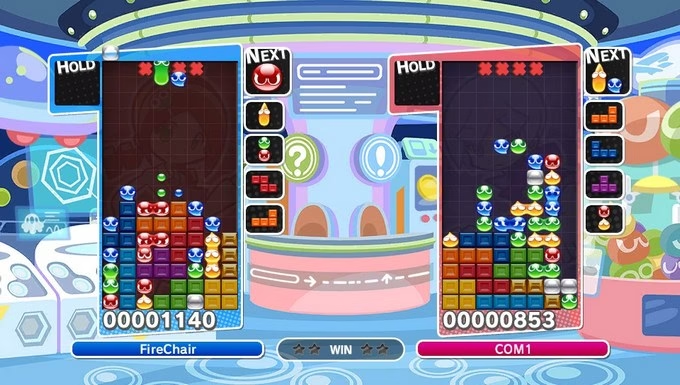
On the PS Vita’s battle screens, two dark transparent vertical wells keep the action front and center. Rounded red, green, blue, and yellow Puyos with big white eyes sit beside bright square Tetris blocks, and their soft, glossy look makes a fun contrast with the rigid tetrominoes. Behind them is a pastel-blue futuristic room with curved ceiling rings, a pink central panel, green accents, and circular wall shapes. It is colorful and playful, though the candy-colored backdrop can compete for attention around a busy board.
Story
The adventure wraps its matches and challenge variations in a lighthearted crossover story. Puyo characters meet newcomers from the Tetris side, and the tone stays appropriately breezy for a game about dropping shapes and popping blobs.
Do not come looking for a serious dramatic campaign. The story works best as a friendly excuse to keep changing circumstances and move from one puzzle challenge to the next. It gives the crossover a bit of momentum without pretending that the matches need high stakes to matter.
That restraint suits the game. You are here to see the two puzzle worlds collide, then get back into another round with a slightly different wrinkle. The narrative serves that purpose cleanly and does not get in the way of the real competition.
Overall Experience
Puyo Puyo Tetris is an excellent competitive puzzle game because it respects both halves of its name while making their clash feel fresh. The basic idea is easy to grasp, but the better you get at reading attacks, recovering from trouble, and switching plans, the more rewarding each match becomes. It can turn a quick session into a long run of rematches surprisingly fast.
The original Japanese PS Vita version arrived in 2014 as a new crossover rather than a recycling of prior releases. Sega’s original Puyo Puyo Tetris specifications place this Vita edition among the initial February 6 release platforms. That context matters because its strengths are already fully present here: two distinct puzzle languages, a generous spread of battle variations, and a lively competitive focus.
Its biggest weakness is also part of its depth. A seasoned rival can make you feel helpless until you learn the unfamiliar side of the matchup, and Fusion in particular can demand comfort with a lot of visual clutter and competing priorities. Yet the payoff is absolutely worth the effort if you enjoy puzzle games that reward study as much as reflexes. This is a crossover that justifies itself every time a tense board turns into a comeback.


Reviews
There are no reviews yet.