 Retro Replay Retro Gaming History, Reviews & Emulation
Retro Replay Review
Gameplay
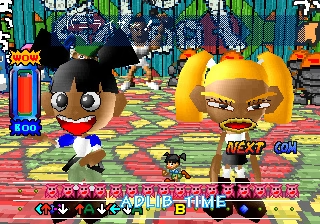
The first hour of Jung Rhythm is all about getting comfortable with its call-and-response routine. A partner sings and dances through a phrase, prompts fill the first bar at the bottom of the screen, and you answer in the second. It is a simple setup, but it puts you in the pressure cooker quickly: you have to watch, listen, retain the sequence, and deliver it when your turn arrives.
What starts to click is the rhythm of observation and reply. The lyrics sit in a shaded box overhead while the lower bars track the exchange, so the game gives you several things to follow at once. That can feel busy at first, particularly in Japanese, but the core challenge is clear enough that you can learn by doing. The 70-point passing mark gives each performance a concrete target, and the five-category grading makes a merely adequate run feel different from a truly clean one.
Ad-lib inputs are the ingredient that keeps the format from feeling like pure recitation. Specific ad-lib sections invite you to put something of your own into the duet, while the scored structure still asks for discipline everywhere else. Practice mode is a welcome fit for a game built around repetition, and the two-player battle mode should be the better choice when you have another rhythm-game diehard nearby and want a direct skills contest.
Frustration will set in if you want a relaxed music game or need every lyric to be immediately legible. This is a performance test first, not background entertainment. Still, its focused format has charm. Fans of Space Channel 5 may recognize the pleasure of matching a musical partner’s response, though Jung Rhythm is its own earlier Saturn curiosity rather than a polished imitation of anything else.
Graphics
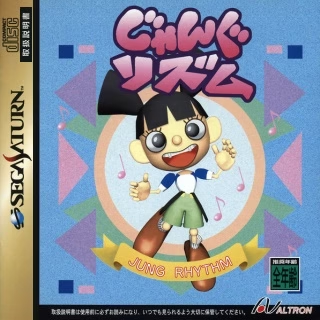
The dance stages are bright and busy, with spectators, multicolored floors, and large-headed polygonal performers placed front and center. Vanilla’s blonde twin ponytails, wide facial expression, and rounded body give her an intentionally goofy cartoon look, while her partner’s tall dark hair helps the pair read distinctly during a duet.
There is obvious Saturn-era chunkiness in the models, especially around their edges, but the oversized faces are expressive enough to suit the comedy. The active screens have a lively, colorful look that matches a game about aspiring pop-star theatrics. For Saturn-specific images and release details, see the Jung Rhythm Saturn game listing.
Story
Vanilla Essence’s ambition is refreshingly uncomplicated: she dreams of becoming a star. Jung Rhythm follows that dream from breakfast onward, turning everyday progress into a string of musical encounters rather than loading the game down with grand drama.
The tone is openly silly, and it knows it. A favorite superstar named Mr. Chorking is exactly the sort of odd detail that tells you this is meant to be playful rather than cool. Vanilla’s journey has a clean forward pull because every successful segment moves her closer to performing with her idol.
Short FMV scenes connect the story segments, giving the progression a little more shape than a disconnected set list. The payoff is a duet with Mr. Chorking, which is modest as a narrative climax but perfectly suited to a game that treats musical performance as both the challenge and the reward.
Overall Experience
Jung Rhythm is a compact, eccentric rhythm game whose strongest asset is its commitment to the bit. You are not saving the world or uncovering a mystery. You are helping an expressive would-be star survive increasingly demanding musical exchanges and reach the performer she admires. That directness works.
Its Japanese-language status makes it a more natural recommendation for import-friendly Saturn fans, especially anyone comfortable learning from repeated prompts and performance feedback. If you need extensive explanation in English, the initial learning process may feel more like homework than fun. If you enjoy figuring out a game’s musical language through practice, it has a better chance of getting under your skin.
The payoff is worth it for collectors and rhythm-game fans who value strange, cheerful artifacts with a real competitive edge. It does not need a huge concept when the duet structure, ad-libs, pass threshold, practice option, and versus mode all point toward the same satisfying goal: learn the routine, nail the response, and do it better next time.


Reviews
There are no reviews yet.