 Retro Replay Retro Replay gaming reviews, news, emulation, geek stuff and more!

Retro Replay Review
Gameplay
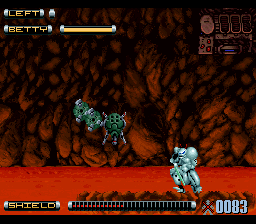
The first few minutes make a clear promise: Tracer is a giant robotic ninja with a sword, and the job is to force your way through hostile side-scrolling stages. That is simple enough, but Genocide 2 has a useful wrinkle in Betty. You can fire this returning weapon in eight directions, and it doubles as a shield against enemy bullets. Instead of treating every encounter as something to rush down with the blade, you are encouraged to look for a safer angle, throw Betty, and use its return path to control space.
Betty is also where the Super Famicom conversion becomes more demanding. Its use is limited, and once its active time runs out it must recharge. That restriction can create tense decisions when bullets are filling the route ahead: spend the weapon now to protect yourself, or hold it for a nastier stretch later. The limitation prevents it from being a permanent answer to danger, although it can also make the action feel harsher when you most want that defensive option available.
Stages are built around reaching the end, with some asking you to destroy targets en route. The important long-term pressure comes from persistence: both the items you collect and the damage Tracer suffers carry into later stages. A messy clear is not cleanly erased by the next level, so there is real value in learning routes and avoiding needless hits. Fastest completion times are recorded for each stage as well, giving repeat attempts a practical goal beyond merely surviving.
That structure makes Genocide 2 more satisfying when you play with some patience. You are not only trying to finish a screen; you are preserving your condition for what follows and gradually tightening your time. If you want breezy, consequence-free platforming, the carryover damage may grate. If you enjoy old action games that reward discipline and route knowledge, it gives the sword-and-Betty routine more weight.
Graphics
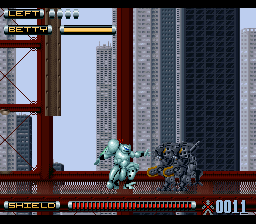
You see a side-view science-fiction action game centered on Tracer, a ten-metre robotic ninja, moving through hostile stages and facing mechanized opposition. This version is visually downgraded from its PC counterpart, so its look is one of the areas where the conversion is plainly less complete.

Story
The setup is familiar but suitably direct: a world is still rebuilding after war, while the mega-corporation CONEX turns reconstruction into an opportunity for conquest. It consumes competitors, benefits from new weapons technology, and edges toward world control. You step in as a hero from the previous war, now piloting Tracer to stop it.
There is no ambiguity in the conflict, and that works in the game’s favor. CONEX is a corporate war machine with openly predatory ambitions; Tracer is the answer sent to cut through it. The story gives the stages a clean forward drive without asking you to untangle a complicated political plot before the action starts.
Its limitation is that the premise is broad rather than nuanced. You should come for the straightforward sci-fi rebellion framing and the fantasy of sending a robotic ninja against a conquering corporation, not for a deeply layered war drama. Still, it is enough context to make the mission feel like more than a sequence of disconnected exits.
Overall Experience
Genocide 2 has the kind of focused, slightly severe action loop that can get under your skin once Betty starts to click. The sword handles the immediate threat, while the returning, bullet-blocking projectile makes positioning matter. Add persistent damage, carried items, and individual stage times, and the game has more replay-minded friction than its basic goal structure initially suggests.
It is also undeniably a reduced version. This conversion loses minor enemy types and a mid-boss, removes the original first stage, reverses the first two levels of stage 2, and cuts back Betty with its recharge limit. Those changes matter because this is not a large game trying to hide behind an enormous amount of content; each encounter and stage adjustment is felt.
Even so, there is a solid niche here for you if old-school mecha action appeals and you enjoy earning cleaner runs through practice. The payoff is not extravagant, but mastering Betty’s angles and protecting Tracer across successive stages can be genuinely rewarding. Everyone else may find the restrictions and compromised conversion harder to forgive.



Reviews
There are no reviews yet.