 Retro Replay Retro Gaming History, Reviews & Emulation

Retro Replay Review
Gameplay
The immediate pleasure of Live a Live is choosing a door and not knowing what sort of RPG waits behind it. You can start with a martial-arts tournament, an old master looking for an heir, a ninja mission, or a prehistoric tale without spoken language. That freedom is more than a novelty, since each choice changes the pace and the kind of attention the game asks of you.
Combat is turn-based, but it does not play like a standard line of heroes and enemies trading blows. Fights unfold on a single square field where you move around the opposition, consider attack range, and avoid area attacks. Charging time matters too, so a powerful move is not automatically the right move if it leaves you poorly positioned. Once that rhythm clicks, even a small encounter has a pleasantly tactical edge.
The chapters earn their keep by bending the formula. The feudal Japan scenario makes avoidance and infiltration more valuable than picking every fight, while the near-future chapter works psychic abilities into its puzzle solving. The spaceship story changes gears again, emphasizing exploration and investigation over the usual battle routine. That variety is the game’s greatest strength, although it also produces rough pacing when one chapter’s idea excites you more than the next one.
Resetting your cast with each new story can be frustrating if you want the steady buildup of one long RPG party. Here, you are repeatedly learning a new protagonist, a new goal, and sometimes a new set of priorities. Yet the individual chapters are compact enough that the resets rarely become exhausting. Treat it as a collection of sharply different RPG experiments, and the structure feels daring rather than scattered.
Graphics
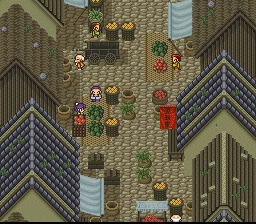
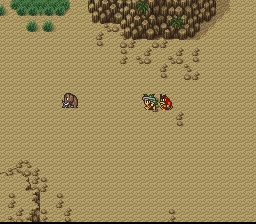
The original SNES game uses small overhead sprites and muted pixel-art environments. Chinese streets pack gray tiled roofs, hanging red cloth, plants, and narrow cobblestone paths into a convincing little neighborhood, while dark wooden rooms frame the master among red and purple furnishings. The prehistoric fields trade that density for tan, stippled ground, rough cliffs, a green-haired hero, and even a brown mammoth.
These locations are distinct, but the character sprites are tiny and some ground tiles repeat heavily. The art works best when a chapter gives it a strong place to depict, whether that is a crowded street or a bare prehistoric stretch.
Story
Each opening story begins as its own self-contained genre piece. One chapter follows a master selecting the right student; another finds a ninja entering a warlord’s castle; the western tale builds around danger closing in on a frontier town. The prehistoric scenario communicates love and friendship before language, while the space chapter turns a robot’s investigation into a tense mystery among a crew.
That anthology format makes the writing feel brisk. You are not spending hours on setup before anything happens, and the game can move from rivalry to revenge, horror, training, or infiltration without dragging one mood across the whole adventure. The present-day tournament is comparatively simple, but that directness suits its focus on fights.
At first, the lack of an obvious connection can make the chapters feel like a showcase rather than one story. Completing all seven is essential, because the later scenarios begin to explain why these settings belong together and push the game toward its larger finale. The payoff is worth the detour, especially if you enjoy RPGs willing to trust that very different moods can eventually meet.
Overall Experience
Live a Live is messy in the way ambitious games often are. Some chapters will become instant favorites, while others may feel like a brief interruption before you can return to the setting you liked more. But few SNES RPGs are this willing to discard a familiar routine and try another one.
If you want a continuous globe-spanning party journey, the constant shifts may leave you cold. If you like the time-spanning curiosity of the Nintendo DS edition of Chrono Trigger, this Square RPG offers a very different structure: not one continuous time-traveling quest, but separate stories that gradually reveal their relationship. That distinction matters, and it is why Live a Live feels so surprising even beside Square’s later classic.
Give it a chance when you are in the mood for bold short stories wrapped around tactical RPG combat, not when you need one seamless campaign. The official Square Enix retrospective on the 1994 original is a useful companion after you have spent time with its varied scenarios. Uneven chapters and simple sprite work do not erase how memorable its structure remains, and its finale gives the whole strange journey real weight.



Reviews
There are no reviews yet.