 Retro Replay Retro Gaming History, Reviews & Emulation


Retro Replay Review
Gameplay
The first stretch of Packy & Marlon asks you to accept a strange but earnest bargain: this is a side-scrolling action game where managing diabetes matters as much as reaching the end of a stage. You are searching Camp Wa-kee for food and medical supplies stolen by rats, but you also need to remember blood-glucose checks, insulin, balanced meals, snacks, and how to respond when things go wrong. For its intended young audience, that makes the game’s basic goal unusually tangible. Health care is not a lecture before the fun begins; it is woven into the trip across camp.
Moment to moment, the elephants have simple tools for dealing with trouble. You can throw peanuts and blast water from their trunks at enemies, giving the platforming a light, cartoonish combat rhythm. The six locations—woods, lakes, mountains, playgrounds, and haunted cabins among them—supply a kid-friendly route through the camp, and the days repeat those environments rather than turning the journey into a one-and-done lesson.
Two-player support is a real plus for the audience this was made for. A child can share the outing with a sibling, friend, or parent instead of facing its lessons alone. The questions from hat-wearing animal friends may interrupt the action for anyone who only wants a fast platformer, but they are the point: Packy & Marlon wants knowledge to stick. If you come in expecting pure arcade momentum, the health-management demands can feel like friction. If you accept the game as a teaching tool that happens to have enemies and bosses, the structure makes sense.
Graphics
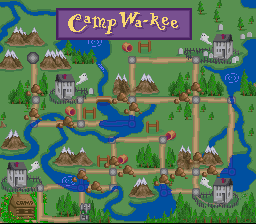
Camp Wa-kee is seen from the side in the familiar 16-bit platform-game style. The clearest visual hook is its cast: two elephant heroes spraying water from their trunks, rats invading a summer camp, and animal helpers distinguished by hats. Woods, lakes, mountains, playgrounds, and haunted cabins give the six-level trek a broad range of kid-friendly backdrops.

Story
The story is direct enough for its audience. Rats have raided the camp and hidden the food and medical supplies, so Packy and Marlon set out to recover them. It gives every stage a clear reason to exist without burying the player under plot.
What matters more is the choice of heroes. Packy and Marlon are diabetic elephants, and their condition is central to the adventure rather than a label pasted onto it. Their routine—checking glucose, taking insulin, eating properly, and handling emergencies—turns the campaign into a practical rehearsal of habits that can otherwise feel intimidating to children.
Veets and Yebur, the bosses behind the Lunch Room Crew, provide a suitably simple final target once you reach the end. This is not a story built for twists or emotional drama. Its success lies in making a medical routine feel like something its young heroes can actively understand and manage.
Overall Experience
Packy & Marlon deserves credit for attempting something many educational games avoid: it puts its lesson inside the play instead of stopping the game to deliver a worksheet. The result is probably most meaningful for children with juvenile diabetes and the adults helping them learn the daily routine. For that group, the repetition of meals, snacks, insulin, and checks is not padding; it is the lesson being practiced.
As a conventional side-scroller, it has a narrower pull. You are fighting rats with peanuts and water, moving through varied camp locations, answering questions, and eventually facing the Lunch Room Crew, but the educational responsibilities remain inseparable from the action. That makes it a poor fit if you want an uninterrupted platforming challenge, and a far more interesting fit if you value games made with a specific, compassionate purpose.
Give it a chance if you are curious about health-focused games, want a cooperative way to discuss juvenile diabetes with a child, or enjoy odd corners of the SNES library. Packy & Marlon is not trying to be universal entertainment. It is trying to make self-care understandable, and its willingness to build an entire adventure around that goal is what makes it memorable.



Reviews
There are no reviews yet.