 Retro Replay Retro Replay gaming reviews, news, emulation, geek stuff and more!
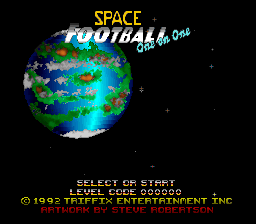


Retro Replay Review
Gameplay
Space Football: One on One gets to its point quickly. You drive a hovercraft, chase a hoverball, carry it toward the touchdown area, and fire on the other driver when they have possession. It is closer to a frantic one-on-one arena duel than a conventional football game, and that directness is its strongest quality. Within the first few minutes, you understand that possession is never secure and that a single well-timed shot can erase a promising run.
The four-second limit on carrying the ball is the rule that gives matches their bite. You cannot lazily protect the ball or spend an age lining up a route; you have to commit, accelerate, and hope you can reach the end before the automatic fumble. That creates satisfying bursts of pressure, especially when both drivers are close to scoring. It can also feel unforgiving when a rough route or a disruption leaves you watching the ball spill away just short of the touchdown area.
Fields with jumps, spinners, and force arrows prevent the basic chase from becoming too predictable. They can create openings, but they can also ruin your line at exactly the wrong moment. Learning when a field feature is worth using is where the game starts to become more than a buttoned-up race for the ball. The tracking option helps keep the focus on the hoverball, while acceleration and reverse give the pursuit a welcome bit of maneuvering instead of making every contest a straight sprint.
The twelve-driver lineup offers four choices at each of three speed levels, and speed is the meaningful decision here. Slower choices should suit anyone who wants a little more time to react around troublesome field layouts; high-speed drivers make the already short possession window feel even more urgent. The game is at its best with another person across from you, because its steals, interceptions, and mistakes are instantly legible and immediately personal.

Graphics
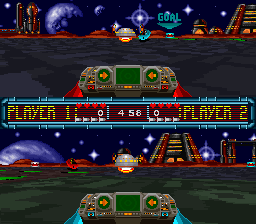
The futuristic sport is built around hovercrafts, a hovering ball, and arena-like playfields with visible hazards such as jumps, spinners, and force arrows. Those field elements matter because you need to spot them while plotting a run, not merely because they decorate the match.
Story
There is no story campaign pulling you through Space Football: One on One. Its fiction is simply the framing for the competition: futuristic drivers settle the score in hovercraft football matches where touchdowns, forced fumbles, and the final timer decide everything.
That thin setup fits the game’s stripped-down attitude. You pick a driver, pick a speed range, and get into a match rather than waiting for character drama or a larger sports narrative to develop. The personality comes from the rivalry you create during play.
If you need a sports game to build toward a season, a championship, or a narrative payoff, this will feel bare. If a self-contained duel is enough, the lack of detours helps it stay focused on the contest.
Overall Experience
Space Football: One on One is a decent, scrappy twist on football whose best moments come from its compressed possessions. The ball carrier is always on borrowed time, so even a small lead never feels completely safe. That pressure gives the game a sharper rhythm than its simple rules initially suggest.
Its limitations are tied to that same simplicity. Matches can become repetitive once you have seen how quickly possession changes hands, and the four-second clock can turn a promising attack into frustration when the field gets in your way. There is little room for the layered tactics or variety you might expect from a fuller sports game.
Still, the core duel has enough sting to make it worth a look if you enjoy direct competitive games and can play with a friend. Go in wanting a fast hovercraft brawl rather than a deep football simulation. When the chase, shot, fumble, and last-second scoring run line up, Space Football makes a surprisingly convincing case for its odd little sport.


Reviews
There are no reviews yet.