 Retro Replay Retro Gaming History, Reviews & Emulation
You are moving comfortably through a level, a jump goes wrong, and suddenly the Kong following behind becomes the one you need to keep alive. Donkey Kong Country makes that small change surprisingly effective. A mistake has a face, and so does the chance to recover.
Rare’s 1994 SNES platformer is easy to remember for its distinctive graphics. Nintendo’s official retrospective description emphasizes the pre-rendered visuals, animation and music that helped establish its identity. Yet the partnership between Donkey Kong and Diddy is just as good a reason to return. It gives a straightforward run through the jungle an extra decision: who should take the lead?
Our Donkey Kong Country review and longplay covers the whole adventure. Here, the spotlight is on that smaller pleasure of learning to play as a pair.
A second chance with a personality
The rules are simple. With both Kongs available, an enemy hit removes the leader and leaves the other to continue. Lose your remaining Kong to an enemy, or fall into a hole, and you lose a life. A DK Barrel can bring your missing partner back. Nintendo explains these basics in its Donkey Kong Country electronic manual.
What makes that arrangement appealing is how clearly it communicates your situation. You do not need to study a row of hearts to understand that things have become precarious. The companion who was keeping you company is gone. Finding a replacement barrel feels like getting the team back together.
There is also a useful shift in attention. With a partner in reserve, you might feel ready to experiment. Alone, you may start watching the next enemy more carefully. The level has not changed, but your appetite for risk has. That is a lot of emotional movement from such a small set of rules.
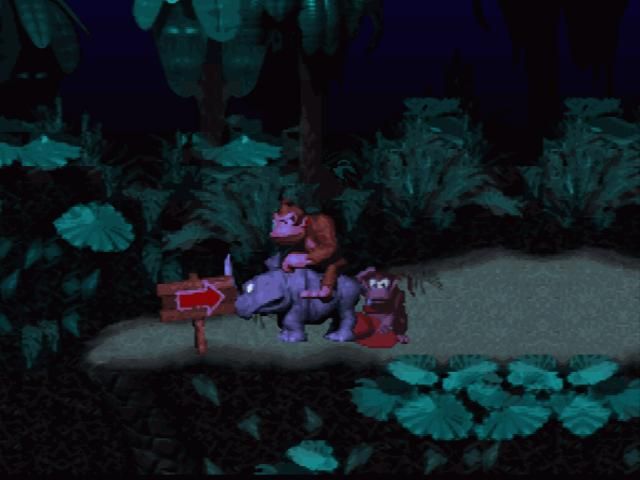
Give the other Kong a turn
It is easy to settle on a favorite and treat the other character as insurance. Try reversing that habit for one level. The original SNES instruction booklet explicitly encourages using both characters, pointing out that different situations favor different Kongs.
That is a better starting point than trying to declare one of them the correct choice for an entire game. Choose a familiar stretch, swap leaders, and pay attention to how comfortable you feel approaching an obstacle. Does the change make you hesitate? Does it encourage you to carry a barrel farther, or deal with an enemy sooner? Those observations tell you more about your own habits than another universal ranking will.
DK also has a hand slap, described in the electronic manual, that can uncover buried objects. It is a small reminder that learning a character means looking beyond the first action that works. A game can be familiar enough to finish while still containing moves you rarely think to use.
The point is not to turn a relaxed replay into homework. It is to give yourself a reason to notice the game again. A favorite character can make a level feel comfortable; choosing the other one can make the same level feel fresh.
Learn the encounter before rushing it
A useful way to practice is to separate survival from speed. First, get through a troublesome encounter in a way you can repeat. Then work on making it smoother. Trying to solve the enemy, the jump and your preferred pace all at once can make a short stretch seem harder than it needs to be.
Watch what actually caused the mistake. Did you commit to a jump too early? Were you still watching the previous enemy? Did you rush because the first half of the level had gone well? A specific answer gives the next attempt a purpose. “Be better at platformers” does not.
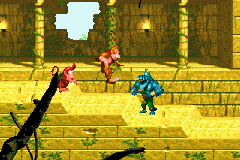
The pair also made the trip to handhelds. Our Donkey Kong Country database entry for Game Boy Advance is a starting point for exploring that version. The screenshot below is from the GBA release, rather than the SNES original; it illustrates the same useful habit of looking at the next encounter before committing.
A small plan for your next replay
You do not need a challenge run or a completion checklist to get something new from an old favorite. Give one short session a few simple aims:
- Switch leaders deliberately. Let both Kongs have time at the front instead of waiting for a mistake to choose for you.
- Practice one awkward stretch. Look for a repeatable approach before trying to make it fast.
- Separate curiosity from completion. Spend a run looking around if that sounds more enjoyable than chasing the exit.
- Stop while you still want another go. A good evening with an old game does not need to end at the credits.
For a different sort of discovery, the archive also includes Retro Gaming Tip #9: Donkey Kong Country shortcuts. Treat it as an optional detour when you want a tip, rather than a checklist you must clear.
Carry the curiosity into the sequel
If this makes you want more of Rare’s platforming, our Donkey Kong Country 2 review and longplay is a natural next read. It follows Diddy and Dixie into the sequel and gives you another partnership to think about. The Game Boy Advance database entry for Diddy’s Kong Quest covers its handheld counterpart.

For now, the original has a modest invitation: bring both Kongs along, and give both a chance. Its most memorable moments need not be the biggest set pieces. Sometimes it is enough to survive a clumsy jump, recover your missing companion, and head into the next screen together.



I still love how the two characters make a simple run feel like a real team effort. Swapping between them keeps the pace lively.
I like that the second Kong is more than a spare hit point. Losing the leader changes how cautiously you approach the next jump, and finding a DK Barrel feels like restoring your options rather than just refilling health.
The DK Barrel changing the whole mood of a level is such a neat touch. Once the missing Kong is back, I’m much more willing to try a risky jump instead of playing every section like a careful escort mission.
Exactly—the DK Barrel does more than restore a hit point in practice. Getting the missing Kong back changes the risk calculation, so a jump that felt irresponsible suddenly seems worth testing; it’s a clever way to make recovery feel like part of the play rather than just damage control.
The idea of deliberately switching leaders is a good one, because I usually treat Diddy as emergency backup rather than learning what changes when he leads. On the original SNES hardware, that simple choice makes a familiar level feel less automatic.