 Retro Replay Retro Gaming History, Reviews & Emulation


Retro Replay Review
Gameplay
The first hour has a useful hook because Ultimate Fighter refuses to stay in one lane. Story mode sends Rick through side-scrolling beat-’em-up stages, but boss encounters break that flow with one-on-one fights. That change of pace gives the campaign a more eventful shape than simply clearing one stretch of enemies after another, and finding miracle water to restore health gives you a concrete reason to stay alert while moving through stages.
The versus side is where the game has the most replay value. Twelve fighters, each with a special martial-arts technique, is a respectable lineup for a tournament built around up to eight human or computer entrants. You can tailor the match rules with round lengths, handicaps, ring-outs through the cosmic saucer setting, and turbo speed levels. The turbo option is the headline addition, and it is a worthwhile one: being able to raise combat speed lets you tune fights closer to your own tolerance for deliberate or frantic exchanges.
There is more here than a standard story-and-versus split. Battle mode is a direct route to a computer-controlled boss, useful when you want a focused challenge rather than a full tournament. Animation mode makes its boss fights turn based, asking you to choose attacks and defenses or hand the contest to the computer. It is an unusual detour, and not every fighting-game fan will want strategy choices in the middle of a martial-arts game, but it gives Ultimate Fighter a distinct personality.
The control options are the dividing line. Fighting uses the familiar fighting-game approach, while Expert places target circles on both combatants and asks you to strike or defend the indicated body areas. Expert sounds demanding because it is: you are taking on another layer of attention during a fight. Start with Fighting controls, use the eight difficulty settings to find a comfortable level, and treat Expert as an alternate challenge rather than the default way to learn the game.
Graphics
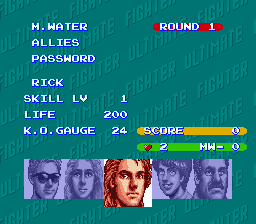
The action is shown from a side view in the scrolling Story stages and in the one-on-one fights, keeping the immediate task clear: advance through the stage or concentrate on the opponent in front of you. In Expert control, the target circles put the important information directly on Rick and his opponent, though that interface naturally makes the fights look busier.

Story
This is unabashed martial-arts pulp. Dargon returns to destroy the Flying Warriors, sends Tusk Soldiers to raid Shorinji, and takes both the Hiryu-no-ken scroll and a sacred sword. The villains then demand that anyone seeking the artifacts meet them at the World Tournament. It is a clean excuse to put Rick on the road and eventually into a bracket of fights.
The setup does not need much decoding, which works in its favor. You know what was taken, who caused the trouble, and what Rick has to do: enter the tournament and win it back. That directness fits a game that keeps interrupting its scrolling action with boss bouts; the story supplies momentum without asking you to stop and untangle a complicated plot.
If you want a heavily layered narrative, this will not be the reason to play. Dargon, the stolen relics, and the tournament challenge are functional stakes rather than deep drama. Still, the premise has enough comic-book urgency to make the mix of stage action, bosses, and tournament fighting feel connected instead of like a pile of unrelated modes.
Overall Experience
Ultimate Fighter is most enjoyable when you lean into its willingness to be several things at once. It has a side-scrolling campaign, conventional one-on-one tournaments, selectable boss battles, and a mode that turns boss confrontations into turn-based decisions. That is a lot of formats for one cartridge, and the result is more interesting than a fighter that only offers repeated head-to-head matches.
The trade-off is focus. A gamer looking for one polished, pure fighting format may find the shifting rule sets and modes scattered, especially once Expert controls enter the picture. But the options are not empty clutter: turbo speed, handicaps, time limits, difficulty selection, and the cosmic saucer rule let you shape the bouts, while Battle mode offers an efficient way to work on boss encounters.
Give it a chance if you enjoy martial-arts games from this era that take risks with structure and want local tournament flexibility alongside a campaign. Go in with Fighting controls first, raise the speed only after you have your bearings, and save Expert and Animation mode for when you want something less conventional. Its payoff is variety rather than refinement, but that variety is substantial enough to make the game memorable.

Reviews
There are no reviews yet.