 Retro Replay Retro Gaming History, Reviews & Emulation
Retro Replay Review
Gameplay
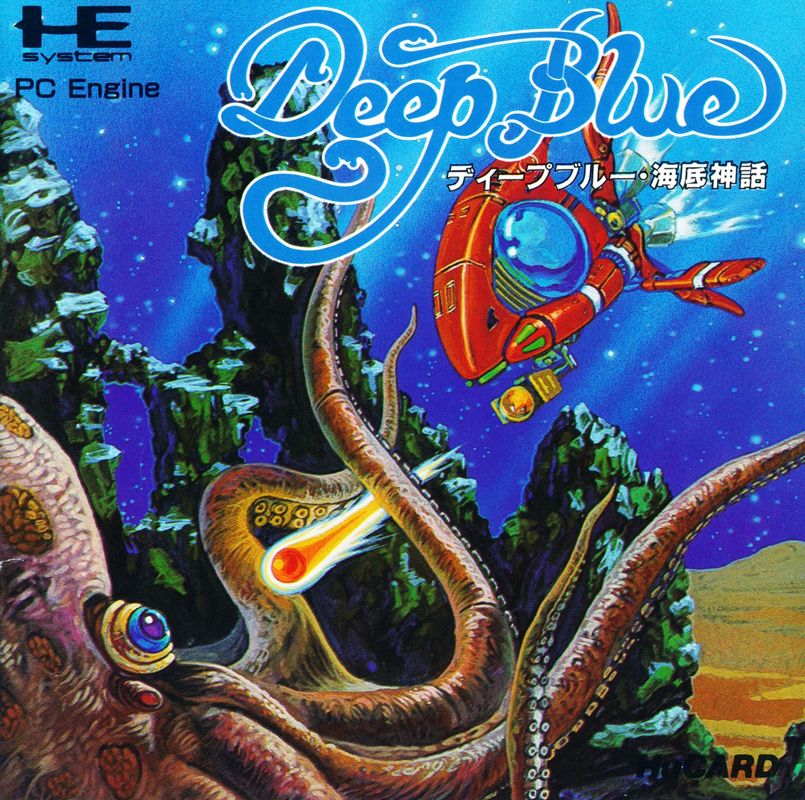
Deep Blue starts with a strong arcade promise: you pilot the A.N.G.E.L. Fish Attack Sub through an ocean overrun by alien-mutated sea life, firing into a steady stream of aquatic threats as the stage scrolls sideways. The first few minutes are easy to understand. You move, shoot, grab useful power-ups, and try not to let the water fill with enemies before you can clear a route. That directness suits a 1989 shooter, and the underwater theme gives its familiar side-scrolling action a little more character than a generic space backdrop would.
What keeps it from being completely flat is the small weapon selection. The default Pulse Shot is your baseline, while the Swirl Cutter and Bubble Beam offer alternate ways to deal with the mutant fish. Healing Power is especially valuable because it completely repairs the sub, and Speed Power can make the craft more responsive when the action gets crowded. These pickups give you a reason to press forward and take risks instead of merely holding back and firing.
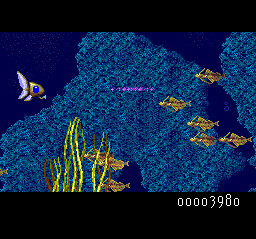
The problem is that Deep Blue asks for a lot of discipline in exchange for a very short campaign. There are only four scenes, and when the A.N.G.E.L. finally explodes, the game ends. No extra-life cushion means a damaged run can become nerve-racking long before the final hit. The sub’s eye uses four colors to show damage, which is a smart, immediate status indicator, but knowing you are near death does not make the next swarm easier to survive.
If you like the old-school routine of replaying a compact shooter until enemy placement and power-up timing start to stick, that severity can be part of the attraction. If you want a more forgiving run, though, Deep Blue may feel like it burns through its good ideas too quickly. The weapons are fun enough to make another attempt tempting; the one-game-over structure is what makes that temptation fade.
Graphics
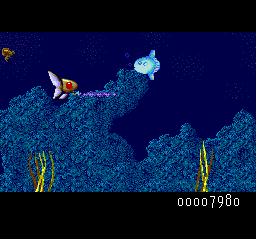
Deep Blue uses side-view, 2D scrolling stages built around an alien-corrupted ocean. You spend the game looking at the small attack sub cutting through underwater scenes while mutated fish and other aquatic enemies approach from around the screen. The colored eye on the A.N.G.E.L. doubles as a clear visual damage readout, letting you see the sub’s condition without looking away from the action.
Story
The story is pure shooter setup, and that is mostly fine. Aliens invade the ocean, mutate its inhabitants, and send the A.N.G.E.L. into the sea to stop the takeover. It gives the enemies a memorable excuse to be fish rather than spaceships, then gets out of the way.
Do not expect the plot to develop beyond that mission. Deep Blue puts its energy into the run itself: surviving swimming terror, finding power-ups, and making it through all four scenes before the sub is destroyed. The stakes are clear, but the narrative is there to launch the action, not carry it.
That simplicity also makes the game easy to pick up without any investment. You are not here for twists or characters; you are here because an attack submarine blasting alien-mutated sea creatures is a solid arcade image. For a different aquatic game with a related name, take a look at Deep Blue Sea.
Overall Experience
Deep Blue has the bones of a decent quick-hit shooter: a distinctive ocean invasion premise, three attack modes, valuable recovery and speed pickups, and a damage system you can read at a glance. Its best moments come when you have a useful weapon equipped, your sub is still healthy, and you are carving through enemies with enough confidence to chase the next power-up.
Its harshness is also impossible to ignore. Four stages is not much room for escalation, and ending the entire game when the A.N.G.E.L. is destroyed makes every run feel fragile. That can create satisfying tension for score-chasing shooter fans, but it also means frustration arrives fast when you lose a run after making progress.
At 4.7, Deep Blue lands as a middling but not hopeless curiosity. Give it a chance if you enjoy lean, demanding TurboGrafx-16 shooters and do not mind repeating a brief campaign to improve. Skip it if you need a longer adventure, a gentler learning curve, or more variety to sustain repeated play.


Reviews
There are no reviews yet.