 Retro Replay Retro Gaming History, Reviews & Emulation
Retro Replay Review
Gameplay
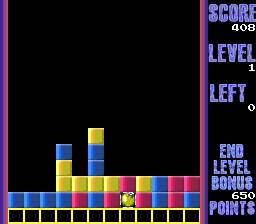
Implode starts with a rule you understand immediately, then makes you rethink your instincts. Rather than waiting for pieces to fall, you watch same-shaped, differently colored blocks push upward from below. Selecting a cluster of three or more matching blocks clears it, and the first few rounds are pleasantly methodical: find a group, remove it, and create breathing room. The pressure arrives when the stack gets taller, the speed increases, and more colors muddy the board.
That rising direction is more than a novelty. You are not arranging incoming shapes or preparing a clean landing; you are constantly judging whether a clear is big enough to buy time before the upper boundary becomes a problem. Bombs add welcome moments of rescue, clearing adjacent blocks when selected, but they do not remove the need to keep scanning the board. If you enjoy puzzle games that turn a straightforward rule into escalating visual triage, Implode has a sharp little loop.
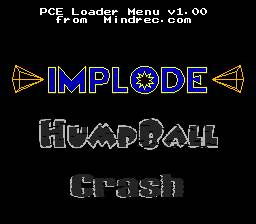
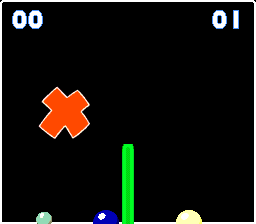
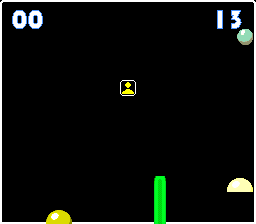
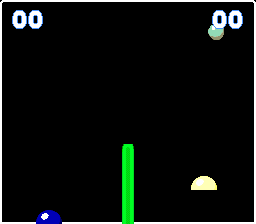
The two bonus games keep the disc from feeling like a one-trick release. Crash is a single-screen overhead arcade race where both cars move automatically around a maze-like course, leaving you to switch tracks, collect every dot, and avoid the other car. It sounds simple because it is simple, but that makes each directional input count. Humpball is the wilder diversion: two creatures jump and move on opposite sides of a pole, trying to knock the ball onto the other side’s floor. Random power-ups can shift the pole, alter ball speed, or change gravity, giving its basic volleying a nicely unruly edge.

Graphics
Implode keeps its puzzle board plain and functional: identical block shapes are separated by color, and the threatening upper border is always the important line to watch. Crash uses a single overhead maze screen for its two cars and scattered dots, while Humpball centers its action on two hump-like creatures, a ball, and the pole dividing the court. These are compact arcade screens built for quick recognition rather than ornament.
Story
Implode does not ask you to invest in characters or a larger plot before it starts testing your reactions. Its drama comes from the board itself: a manageable arrangement becomes a messy climb, and a good clear briefly turns panic back into control.
Crash makes its own miniature story out of a race for territory. You circle the course, trying to claim every dot while another car turns the route into a collision threat. It is an old-school arcade conflict expressed entirely through movement and timing.
Humpball has the most playful premise of the three. Two odd creatures batting a ball across a pole needs no extra explanation, and the changing power-ups create little reversals from point to point. The result is a collection driven by immediate competitive situations, not narrative buildup.
Overall Experience
Implode is a modest but appealing homebrew arcade package, and its best quality is that each game gets to the point quickly. The headline puzzle is the strongest reason to spend time here because its upward-growing stack creates a real sense of mounting danger without complicating the central matching rule. It may take a few attempts before your eye adjusts to reading the board under pressure, but that adjustment is the satisfying part.
Crash and Humpball feel like worthwhile companions rather than distractions. Crash suits short solo sessions where you want a clean reflex challenge, while Humpball is the one to try when you want a more chaotic head-to-head game. The latter’s shifting power-ups make it less controlled, but also more likely to produce sudden swings and laughs.
Give this a chance if you like stripped-down puzzle and arcade games that reward repeated runs, quick reactions, and learning a compact ruleset. The package does not stretch any one idea far, yet the three-game lineup has enough variety to keep a short session from becoming repetitive. Implode itself is the standout, and its reversed block flow is a clever enough wrinkle to make the collection memorable.


Reviews
There are no reviews yet.