 Retro Replay Retro Gaming History, Reviews & Emulation
Retro Replay Review
Gameplay
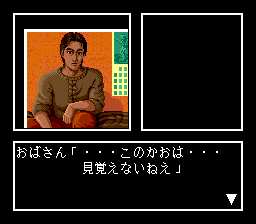
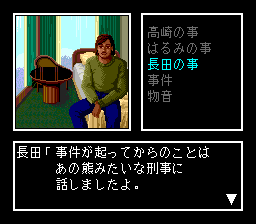
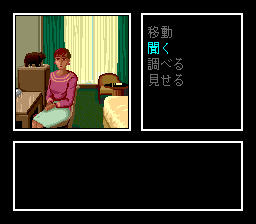
The first stretch asks you to settle into Kamei’s work rather than chase a quick thrill. A man has been stabbed in his Tokyo apartment, and your job is to pull at the obvious threads: inspect what is there, question the people connected to him, and decide where to take the investigation next. The command menu is simple in principle, but it makes you think like an investigator because progress comes from applying the right action to the right person or object.
That structure has a satisfying rhythm once it clicks. “Ask” is not just a way to empty a dialogue tree, and “Show” turns evidence into something you actively use rather than merely collect. You are constantly weighing whether a new item changes a witness interview, whether an overlooked object needs another look, or whether it is time to move on. It is a familiar style of Japanese adventure, but one that suits a police mystery far better than a more arcade-like format would.
Frustration is part of the bargain. The game can demand careful, exhaustive examination, especially when it switches into point-and-click searches of rooms and objects. If you miss the relevant detail, the investigation can stall and the next step may not feel immediately apparent. Go in willing to be thorough rather than clever for cleverness’ sake: inspect closely, revisit people after new evidence appears, and treat each location as a potential crime-scene puzzle.
The split between verb-driven conversations and direct clue hunting keeps the case from becoming only a sequence of interviews. Neither side sounds flashy on its own, but together they make the work feel appropriately hands-on. You are not simply told what Kamei concludes; you spend time earning the information that lets the investigation continue.
Graphics
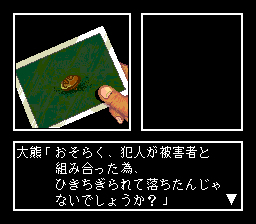
The game uses a first-person investigative viewpoint, with point-and-click moments asking you to study rooms and individual objects for evidence. Those searches give the locations a practical purpose: you are looking at them as Kamei would, not merely passing through them between conversations.
Story
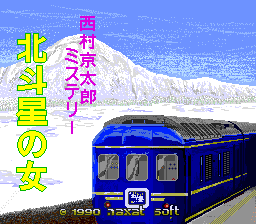
The central hook is strong because the second killing quickly widens the first. One victim is found in Tokyo, another dies in a Hokkaido hotel soon after the inquiry begins, and the title’s Hokutosei train connection gives the case a distinctly Japanese travel-mystery frame. It has the shape of a classic procedural: separate places, suspicious timing, and a link that has to be uncovered through evidence.
Kamei is the protagonist, with Inspector Totsugawa alongside him, so the story is grounded in police work rather than a lone amateur sleuth’s intuition. That matters. The emphasis on questioning witnesses and suspects gives the mystery room to develop through testimony, contradictions, and the meaning of physical clues.
Because it is based on the work of Kyōtarō Nishimura, the game’s strongest promise is a traditional detective-story mood rather than an action-heavy crime tale. Give it a chance if you like cases that take their time connecting a stabbing, a hotel murder, and a railway route into one line of inquiry. The payoff is in following that line carefully, not in rushing to the answer.
Overall Experience
Hokutosei no Onna is a good fit for a particular kind of mystery fan: someone happy to sit with a case, probe each lead, and accept that the next breakthrough may come from one more question or one more look at the room. Its deliberate pace is not an accident; it is the point.
The game’s age shows most clearly in the verb-command structure and its potential for getting stuck, but that same structure gives it a tactile detective-game quality. When a clue finally connects to a person or location, you have participated in the deduction instead of watching it happen from a distance.
For patient adventure fans, the investigation’s Tokyo-to-Hokkaido scope and methodical clue work make this an engaging licensed mystery. It is less welcoming for anyone who needs smooth momentum or immediate guidance, yet the measured police-procedural approach is worth the effort when you want a case to solve rather than a story to simply consume.


Reviews
There are no reviews yet.