 Retro Replay Retro Gaming History, Reviews & Emulation


Retro Replay Review
Gameplay
The first stretch gets its laugh from how quickly it teaches you to distrust your platforming instincts. Pole moves through side-scrolling stages, jumping and firing his pistol on a mission to save Sharon, but this is not a straightforward test of clean runs to the exit. Familiar setups are bait. A pipe, a brick, or another supposedly obvious piece of platformer scenery may be leading you toward a gag rather than the safe answer you expect.
That makes curiosity more valuable than perfect execution. Some surprises emerge naturally as you play, while others ask you to try stranger actions, and each discovered joke is saved in a replayable album. That collection angle gives repeat runs a purpose beyond simply clearing stages. If you enjoy poking at a game to see how it reacts, this has a mischievous pull that a conventional platformer cannot match.
The tradeoff is that the basic jumping and shooting are intentionally only the foundation. Come in wanting a tightly tuned, purely skill-driven platformer and the interruptions may wear thin, especially when a joke depends on you abandoning the normal route or assumptions. Come in ready to be ambushed by the designer’s sense of humor, and the unevenness becomes much easier to forgive.
The comparison to Super Mario Bros. is useful because Pole’s Big Adventure knowingly borrows the kind of visual language that makes you think you know the rules. Its strongest trick is using that familiarity against you. It is a comedy game first, with platforming as the setup and the punchline.
Graphics
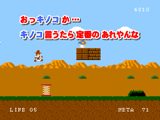
The Wii gameplay leans into a tiny, blocky early-console style. Pole crosses flat brown ground with a thin green grass edge beneath a pale blue sky and white clouds, while cacti and small hills barely break up the desert. The sparse colors make Pole and the hazards easy to pick out, though the backgrounds are intentionally plain.
Bricks, a large beige mushroom, and a tall gray pipe are instantly recognizable platformer images, which makes their use feel knowingly suspicious. A black human silhouette above the pipe is exactly the kind of odd visual interruption that fits the game’s joke-first attitude.
Story
Pole is trying to rescue Sharon, and that is about as much plot as the game needs. The rescue setup gives him a reason to keep moving right, but it is mainly a thread connecting comic interruptions rather than a story with dramatic weight.
The important voice in the comedy is not Pole. Japanese tsukkomi-style retorts are delivered by outside comedian and commentator Takashi Endo, whose commentary helps frame the absurdity around the action. That distinction matters, because Pole is the character on the journey while the commentary acts as a separate comic presence.
If you do not understand Japanese, you can still recognize that the game is setting traps for genre expectations and staging visual jokes. But you will miss wordplay and spoken exchanges that are central to the intended humor. The premise is broad enough to follow without translation; the sharper flavor is not.
Overall Experience
Chindōchū!! Pole no Daibōken is a peculiar, committed joke machine that happens to be built as a platformer. Its best moments come when you stop treating the scenery as trustworthy and start experimenting with it. That is a much more distinctive hook than its basic run-and-jump action.
It is easy to see why the game could frustrate someone looking for a substantial rescue adventure or a traditional platforming challenge. The humor deliberately disrupts momentum, and the plain visuals are more functional than lavish. Yet that same refusal to play things straight is what gives the game a personality most retro-styled platformers never find.
Give it a chance if you enjoy games that turn genre literacy into the joke and reward your willingness to test nonsense. Its comedy is more rewarding with Japanese knowledge, but its strange visual ambushes still communicate plenty on their own. For a contemporary look at its original Wii release and comic premise, see the original Sega announcement and screenshots.


Reviews
There are no reviews yet.