 Retro Replay Retro Gaming History, Reviews & Emulation
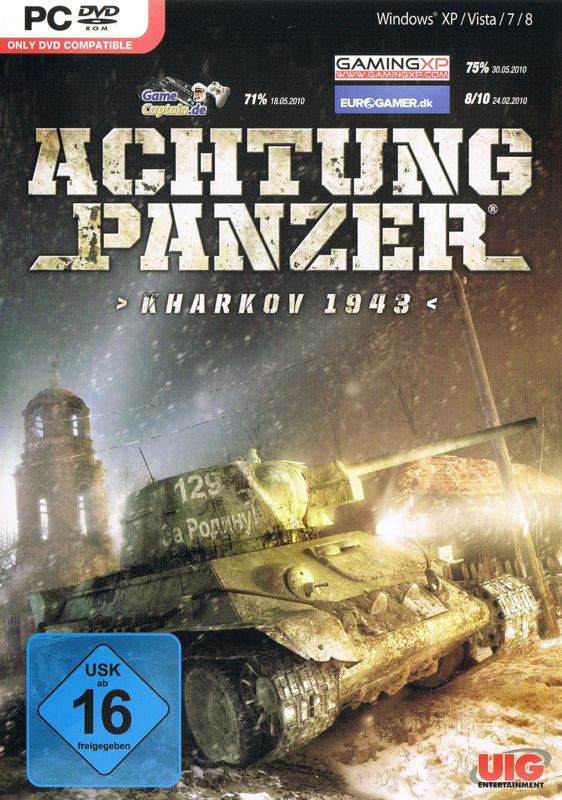
Retro Replay Review
Gameplay
Achtung Panzer: Kharkov 1943 focuses its real-time tactical play on battlefield objectives rather than total annihilation. You are expected to seize and hold important locations, which gives each engagement a stronger territorial purpose than a simple hunt for enemy units.
The absence of resource gathering keeps attention on the forces already under your command. That makes positioning, timing, and using reasonable tactics central to the experience; there is no economic safety net to cover for careless decisions.
The responsive AI and lack of scripted events support a more fluid battlefield rhythm. Opponents react to your maneuvers, so advancing on an objective calls for adaptation rather than reliance on a memorized sequence. Players looking for deliberate, historically grounded real-time tactics will find the game’s priorities clear.
Graphics
The game uses a diagonal-down viewpoint with a free camera, an appropriate setup for following a broad tactical situation while retaining control over how you inspect the battlefield. This perspective suits a game concerned with maneuver and control of ground.
Its visual presentation is functional in service of strategy: the camera is a practical tool for reading positions and considering approaches to objectives. The emphasis is on the state of the battle rather than on a heavily staged presentation.
That approach will appeal most to players who value battlefield oversight and flexibility of view. Those seeking a more cinematic war-game spectacle may find the presentation comparatively restrained, but the chosen perspective supports the tactical focus effectively.
Story
The campaign setting is the USSR front between February and March 1943, covering the Third Battle of Kharkov. It is a historical conflict positioned before the better-known Battle of Kursk, giving the game a specific and less frequently explored World War II setting.
Two campaigns present the conflict from opposing sides. The Soviet campaign centers on the Red Army’s February mobilization, while the German Heer campaign follows the objectives of the offensive.
This is historical framing rather than a scripted dramatic narrative. The missions are modeled after historical events, and the lack of scripted incidents leaves the campaign’s sense of tension to emerge from changing tactical circumstances and the struggle for strategic locations.
Overall Experience
Achtung Panzer: Kharkov 1943 is best approached as a focused historical tactics game. Its strongest idea is the commitment to objectives, maneuver, and battlefield responses instead of base building or routine enemy elimination.
The two-sided campaign structure gives the Kharkov operations useful scope, while the real-time format asks you to make sound decisions under pressure. It is a game for readers who want warfare framed around territory and operational intent rather than an abstract resource race.
Its 7.4 score reflects a solid, specialized strategy experience. The game will be most rewarding for World War II and real-time tactics fans willing to engage with its deliberate, objective-driven design and its unscripted approach to historical combat.


Reviews
There are no reviews yet.