 Retro Replay Retro Gaming History, Reviews & Emulation
Retro Replay Review
Gameplay
The first hour of Dead in Bermuda makes you feel the weight of having too few capable hands. You are not guiding one scrappy castaway across the island. You are trying to keep eight people functional, choosing who works around camp, who heads out to explore, and when somebody needs to stop being useful and simply recover. That broader responsibility is the game’s strongest idea, because every seemingly simple job has a human cost.
What starts to click is the connection between each survivor’s skills, condition, and relationships. A good assignment is not merely a matter of filling a task slot. You need to consider whether that person is tired, sick, injured, hungry, or sliding into depression, then weigh how well they will actually perform. When the group is stable, this becomes a satisfying puzzle of labor and scarce energy. When it is not, one poor call can leave you short on supplies, unable to maintain the camp, and saddled with several worsening problems at once.
Exploration, research, and crafting keep the routine from being only a checklist, while events and choices give trips beyond camp some uncertainty. Randomized maps, items, dialogue, and traits also help later runs feel different rather than like a memorized route. The downside is that survival maintenance can wear on you. There are stretches where you will be cycling through needs and trying to repair yesterday’s damage. The tension is real, but so is the repetition.
If you want a useful comparison point, Survival Kids is another stranded-survival game, but the contrast matters: that game centers on directly controlling one survivor, while Dead in Bermuda asks you to run a fragile group. Come here for hard choices about people and priorities, not for a lone-hero adventure.
Graphics
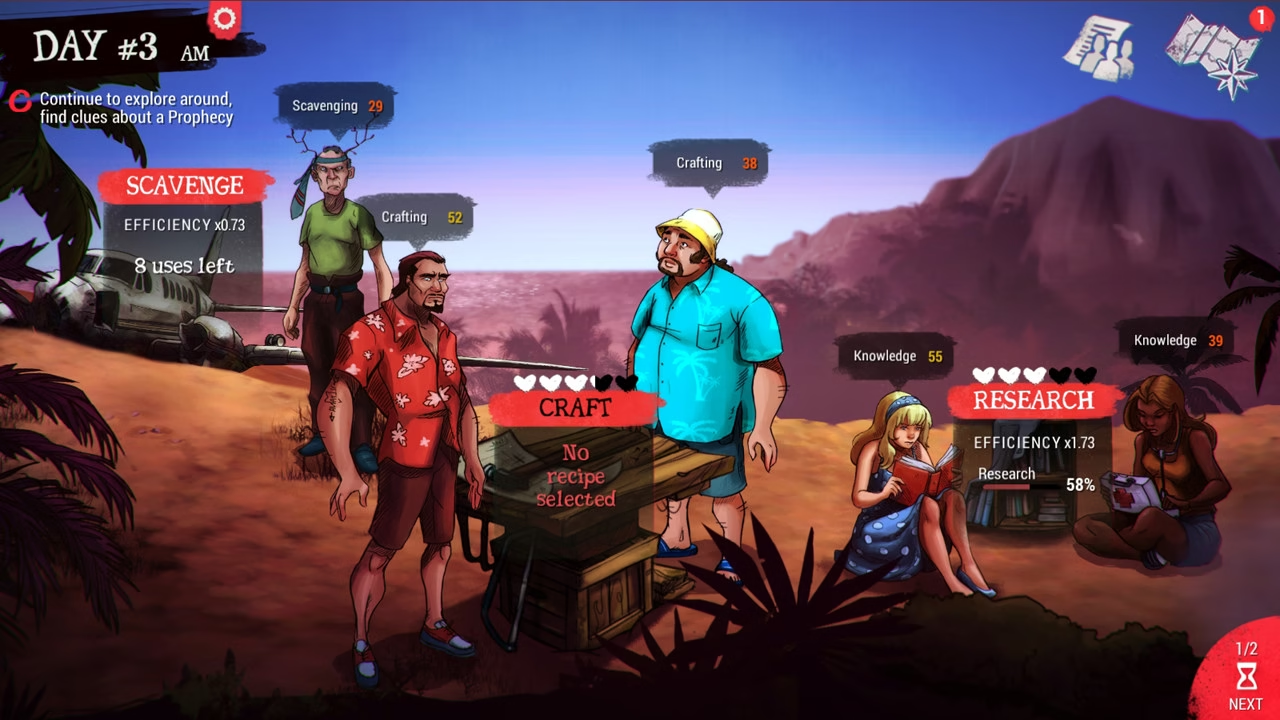
The camp uses large, hand-drawn survivors gathered around stacked wooden crates and an improvised table, so the work area feels crowded in a way that suits a stranded group. Bright clothes and exaggerated faces give the cast immediate character: a huge man in a turquoise shirt and yellow bucket hat stands out, as do the survivor in a red flowered shirt and the blonde girl reading in a blue polka-dot dress.
Reddish sand, wrecked plane metal, blue water and sky, and purple-brown cliffs place the camp firmly on a warm island shore. Dark palm leaves frame the view, while the sea and wreckage keep the crash from fading into background decoration.
Story
The story begins with eight survivors of a plane crash, but it does not stay at the level of basic castaway drama. Their friendships, arguments, and romances develop alongside the work of staying alive, making the camp feel like a group of people with competing emotional needs rather than a set of interchangeable workers. That matters because the game is constantly asking you to think about who can cope with what.
Beyond the personalities, the island gradually points toward an ancient Atlantean prophecy. That supernatural thread gives exploration a reason beyond gathering what the camp needs today. It adds a welcome question mark to a game that could otherwise be entirely about resource pressure.
The balance works because neither side fully replaces the other. The personal conflicts give the management decisions a little sting, while the mystery keeps the survivors’ daily grind from becoming the whole point. You are still spending most of your attention on survival, but there is enough narrative momentum to make the island feel more threatening than an ordinary beach.
Overall Experience
Dead in Bermuda is at its best when your camp is barely holding together and you can see a path through the chaos. You make a few smart placements, give the right person time to recover, send someone else out, and watch a disastrous situation become manageable. That recovery feels earned because the game makes inefficiency painful.
It is not a relaxed survival game. Repetitive upkeep and cascading setbacks can frustrate you, particularly if an earlier assignment leaves the wrong survivor depleted at the wrong time. Yet that harshness is closely tied to what makes its successful days satisfying. You have to accept that people are limited resources with moods, wounds, and relationships, not just numbers on a task board.
Give it a chance if you enjoy survival games where planning means managing a whole community’s capacity to function. Skip it if you want constant exploration or direct control over a single character. For a fuller look at its setup and survival-management focus, the official Dead in Bermuda Steam overview is worth a look, but the essential verdict is simple: this is a demanding, sometimes grindy island-management game whose best decisions feel genuinely tense.



Reviews
There are no reviews yet.