 Retro Replay Retro Gaming History, Reviews & Emulation


Retro Replay Review
Gameplay
The first hour makes a convincing case for Jensen’s augmented life. You start as a security man caught in a disaster, then return rebuilt and immediately faced with the question that drives the whole game: what kind of operative do you want to be? Human Revolution is not interested in locking you into one answer. A mission can be handled with careful stealth, direct combat, hacking, exploration, or some awkward but satisfying mixture of all of them. That flexibility remains its greatest strength.
Stealth is where the game’s slower, more observant rhythm feels most natural. Staying unseen through an entire mission earns bonuses, and the incentive is enough to make you study patrols, seek secret passages, and think twice before turning a hallway into a firefight. Yet the game does not punish a plan falling apart by declaring the mission over. You can fight back, recover health over time, and use the first-person shooting alongside a third-person cover system. Groups of enemies also have commanders, so a smart opening strike can disrupt the rest rather than leaving you to simply outgun everyone.
Progression gives those decisions weight. Experience comes from main and side quests, exploration, hacking, reading electronic books, avoiding enemies, eliminating them, and finding hidden routes. Praxis kits then let you choose which augmentations to improve, whether that means leaning into hacking, stealth, sight, armor, social skills, or combat. This is the satisfying kind of RPG growth: not merely bigger numbers, but a steady widening of your options.
There is friction in that freedom. You have to pay attention, and choices about upgrades inevitably make some approaches more comfortable than others. The conversation battles are particularly high-pressure: during important discussions, you need to read a key character and choose a psychological approach that can affect later events. When you nail one, it feels like genuine espionage. When you do not, it can feel as though a consequential scene hinged on a narrow reading of the dialogue. Still, the game is at its best when it asks you to commit to an approach and live with the result.

Graphics
The viewpoint does useful work in play. Most exploration and shooting unfolds in first person, while taking cover moves the camera to third person, making Jensen’s position against walls and nearby threats easier to judge. The result is a practical compromise for a game constantly moving between cautious infiltration and open combat.

Story
Human Revolution starts with personal damage and keeps widening its scope. Adam Jensen’s attempt to learn why mercenaries attacked Sarif Industries becomes an investigation into corporate power, competing organizations, and a society splitting over biomechanical augmentation. That escalation gives the game more momentum than a simple revenge chase; every lead points toward a larger argument about who gets to shape humanity’s future.
The central conflict works because it does not treat augmentation as a decorative sci-fi prop. Jensen survives only because of extensive enhancements, while the world around him is locked in an ideological fight between people embracing biotechnological progress and people resisting it. You are not just watching a conspiracy unfold; you are moving through a conflict that directly defines your protagonist’s body and abilities.
The writing is strongest when it lets your decisions and conversations participate in that uncertainty. Dialogue with non-player characters, time spent in non-hostile areas, side quests, and the crucial conversation battles all give you room to engage with the world beyond the next combat space. The plot can be dense, but that density suits a cyberpunk espionage thriller built on secrecy, competing interests, and shifting motives.
Overall Experience
Deus Ex: Human Revolution remains a remarkably accommodating RPG-shooter because it respects different instincts without flattening them into the same solution. If you enjoy being rewarded for curiosity, planning, and character-building, it gives you plenty to chew on. A silent hacker, a heavily armored fighter, and a player who alternates between both can all reach the end, but they will not experience every obstacle in the same way.
It is especially easy to recommend if you like games where an upgrade choice changes how you look at a locked door, a guarded room, or a difficult conversation. The shooting has a tactical bent rather than a mindless rush, the stealth has meaningful incentives, and the story has enough political and personal tension to make its branching decisions matter. Give it a chance if you want an action game that regularly asks you to slow down and think.
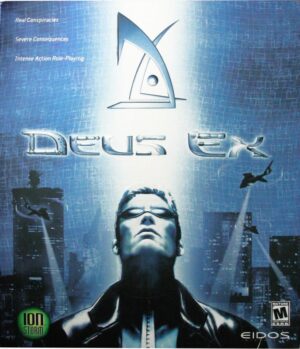
Its 8.6 reputation is earned by the way these parts reinforce one another: the conspiracy gives your choices context, the augmentations make progression tangible, and the missions make room for different solutions. For more context on the series, see Deus Ex: Complete; for game-specific background, the Deus Ex: Human Revolution history is useful. More importantly, this is still worth playing on its own terms if you want a thoughtful cyberpunk adventure that lets you decide how Jensen gets the job done.

Reviews
There are no reviews yet.