 Retro Replay Retro Replay gaming reviews, news, emulation, geek stuff and more!
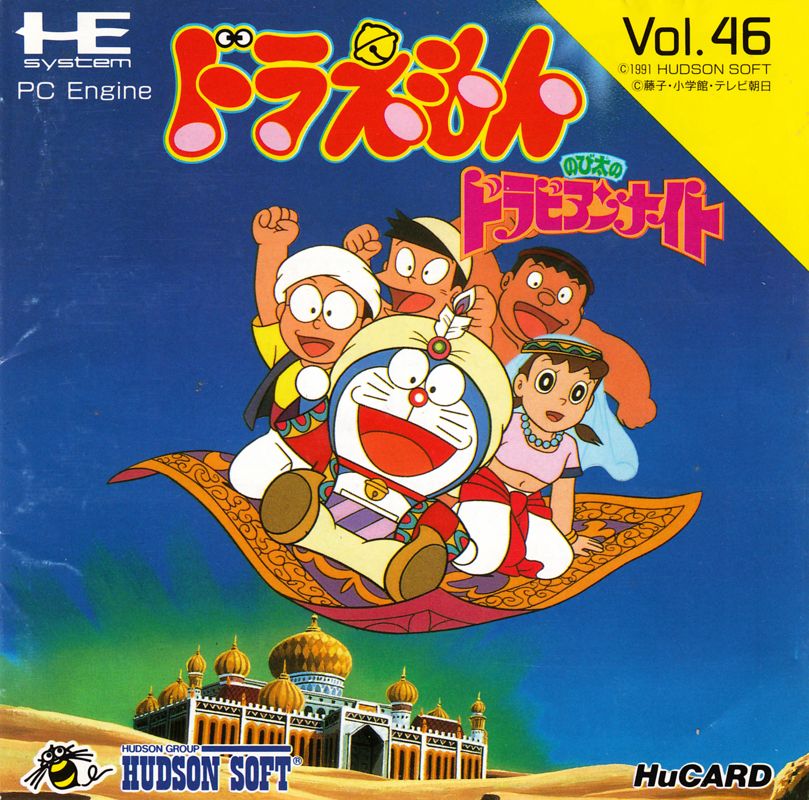


Retro Replay Review
Gameplay
The opening appeal is simple and immediate: Doraemon runs through side-view stages, jumps over trouble, and shoots whatever gets in his way. There is no need to decipher an elaborate system before the game starts asking something of you. If you want a brisk platformer built around forward motion and enemy clearing, it makes a solid first impression.
What keeps that basic formula from going flat is the equipment. Doraemon begins with an ordinary gun, then can find alternatives including a homing bowling-ball launcher and a stun gun. The ability to switch weapons and power-ups whenever you want is a meaningful convenience, not just a list of pickups. A homing shot sounds especially useful when enemies crowd your route, while the stun gun and brief enemy-freezing item give you a way to create breathing room rather than simply trading shots.
Power-ups also add a small but welcome element of judgment. Temporary invincibility and high speed can turn a difficult stretch into a dash, but their limited nature means you have to decide when the moment is worth spending. That is a better fit for the game than making Doraemon permanently overpowered; the action stays direct, but you get occasional chances to tilt it in your favor.
The rooms and caves are where the levels ask you to slow down. Some lead to maze or memory mini-games, and the prospect of an extra life or another significant reward makes them more than disposable distractions. Not every platformer benefits from stopping for a memory challenge, but here these diversions give exploration a practical payoff. If you enjoy poking into every doorway rather than racing straight to the goal, you will get more from it.
Its four-level worlds have an orderly arcade-like cadence, culminating in a boss before the next world begins. That structure is clean and satisfying, though it also means the game is unlikely to convert someone who is already tired of repeating platforming stages on the way to a boss. The weapons, temporary boosts, and optional rooms are the parts that earn the routine its variety.

Graphics
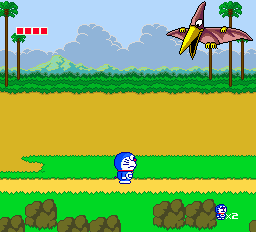
The game uses a side-view platforming perspective, keeping Doraemon, enemies, and the immediate route in front of you. As a Doraemon game, it puts the familiar robotic cat at the center of each rescue run, while the journey through different time periods gives the stages a broad range of hostile destinations to visit.

Story
This is a light rescue adventure built on a very Doraemon-shaped disaster: Nobita demonstrates a time machine, something goes wrong, and his friends wind up stranded across different periods. Doraemon takes responsibility for bringing them back. It is an efficient excuse to send him from one dangerous world to the next, and it does not pretend to be more complicated than that.
Nobita’s role gives the setup a bit of personality. The trouble begins because of his mistake, while Doraemon once again has to clean up the mess. Fans of the franchise should recognize that relationship immediately, and newcomers can understand the stakes without needing a long introduction.
The rescue goal provides a sensible throughline for the repeated world structure. Clearing a boss is not merely a checkpoint; it marks Doraemon moving on in his search for the stranded friends. The story’s value is its momentum: it keeps giving your platforming a clear reason without getting in the way of it.
Overall Experience
Doraemon: Nobita no Dorabian Night is a traditional platformer that understands the value of small rewards. You begin with plain shooting and jumping, then gradually have more tools to choose from, more reasons to enter side rooms, and a regular boss finish line to chase. The result sounds uncomplicated because it is, but uncomplicated does not have to mean careless.
Frustration is most likely to come from the genre’s old-school demands rather than from confusion about what the game wants: you are navigating hostile stages, dealing with enemies, and making limited boosts count. The game is at its most inviting when you treat it as an exploration-minded action game instead of a straight sprint. Check caves, take the mini-games seriously, and use the weapon switching rather than relying on the starting gun out of habit.
Give it a chance if you have affection for Doraemon or want a focused period platformer with more to do than just reach the right edge of the screen. The payoff is not a reinvention of the genre. It is the pleasant accumulation of smart little advantages—an extra life from a side activity, the right weapon for a rough encounter, a timely freeze—that makes Doraemon’s rescue trip feel more engaging than its basic setup suggests.


Reviews
There are no reviews yet.