 Retro Replay Retro Gaming History, Reviews & Emulation

Retro Replay Review
Gameplay
The first pull in Earthrise is the promise that your character is not locked into a neat class lane. Weapons and devices shape your skill progression, so you can pursue the tools that fit how you want to fight instead of committing to a traditional class label. Combat asks you to aim rather than simply lean on automated targeting, which gives its ground-level skirmishes a more immediate feel than a spreadsheet-driven MMO battle.
Its best ideas start clicking once you see how much depends on other people. Resources are refined into gear, and the final quality depends on both the materials and the facilities used. That makes crafting more than a side profession. It creates reasons to organize with a group, protect useful equipment, and care about who controls the supply chain. The connection to EVE Online is clearest here: both games look to player-led economies and real risk for tension, but Earthrise puts you on the ground with a weapon instead of in a spaceship.
PvP gives that economy teeth. Losing loot can hurt, while insurance encourages you to think ahead about what you are taking into a dangerous encounter. Cooperation is not just convenient when equipment and materials matter. It is sensible self-preservation. Unfortunately, the launch-era loop also leaned hard on kill-and-loot objectives, and the limited quest variety made the grind obvious well before the broader sandbox ambitions could carry the experience.
Contemporary original launch impressions also reported slow crafting, substantial lag, glitches, and scant content. Those problems are particularly punishing in an MMO built around friction, risk, and long-term investment. A demanding economy can be compelling when every step feels dependable; when the game itself is rough, the same demands become exhausting.
Graphics
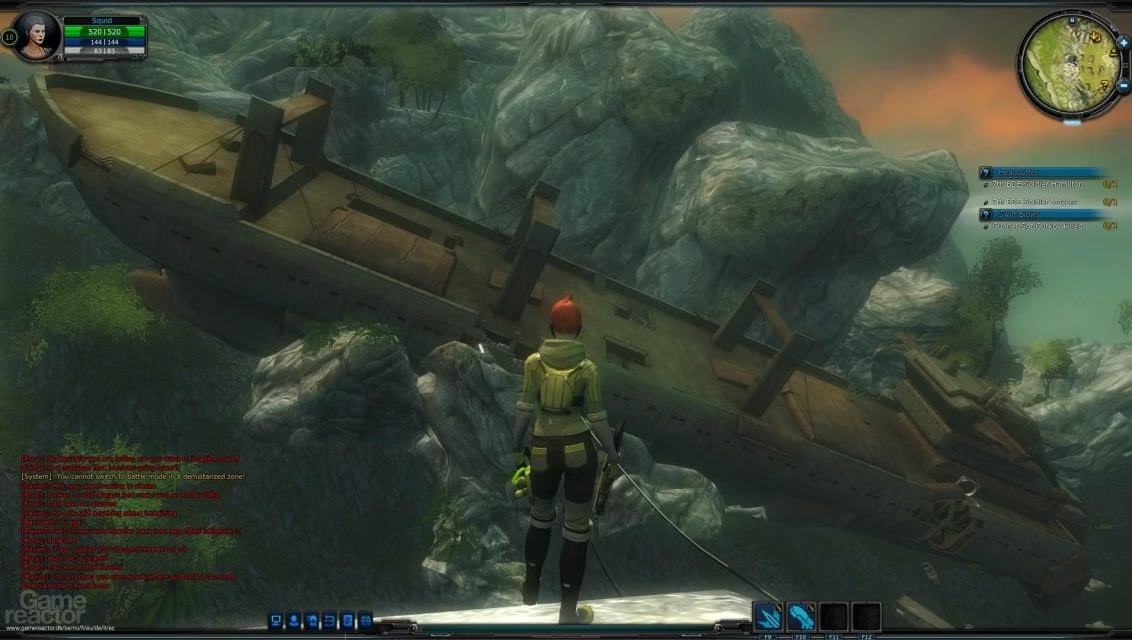
The third-person view shows a muted, worn-down world of green-brown terrain, gray rock, industrial ruins, and oversized debris. One striking early image is a red-haired woman in a yellow-green jacket standing beside cliffs beneath a huge brown shipwreck jammed across a valley. An ochre desert factory, with round domes and chimneys under a hazy yellow sky, gives the setting a convincingly battered industrial flavor.
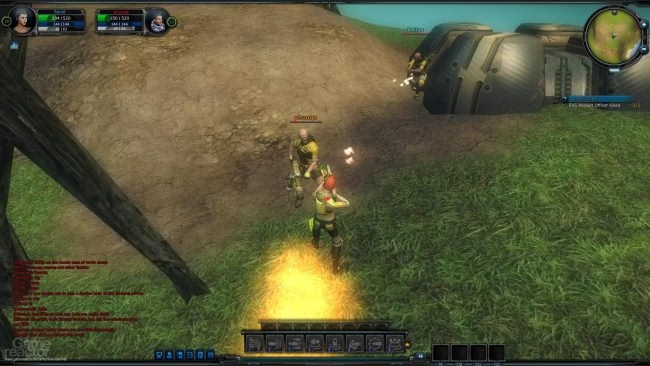
Small fights have some punch when a yellow-orange flame burst erupts between armored characters near a gray metal structure. Still, the character models and terrain look plain and blocky, especially beside the scale of the wrecks and buildings. The environments carry more personality than the people moving through them.
Story
Earthrise is set on the islands of Enterra after war has reshaped civilization. Cloning and stored consciousness allow bodies to be renewed, but that possibility is controlled by an authoritarian regime. Rebels push back against that power, giving the setting a useful conflict between institutional control and people trying to reclaim agency over their own existence.
That premise has genuine sci-fi bite because immortality is not treated as a clean reward. A replacement body becomes something that can be regulated, withheld, and used to enforce obedience. It is the sort of idea that naturally fits a world where material access and player conflict matter.
Still, the story is more effective as a backdrop for the MMO’s social conflict than as a reason to endure repetitive missions. The setting supplies a strong rationale for scarcity, control, and rebellion, but the launch quest structure did not give that conflict enough varied dramatic expression. You may remember the underlying concept more fondly than the errands used to deliver it.
Overall Experience
Earthrise is easy to respect and hard to recommend without a major caveat. Masthead Studios pursued a rarer kind of MMO: one that wanted crafting, gear quality, risk, combat, and group power to collide in ways that could produce real stories. That is more interesting than another safe theme-park progression path.
The trouble is that its rough launch undercut the very patience its systems required. If you enjoyed the idea of gathering allies, building economic influence, and venturing into dangerous player conflict where a loss has consequences, there was something worth chasing here. If you needed polished combat flow, broad quest variety, or fast feedback for your time, frustration could set in early.
In the end, this is a historically intriguing MMO with a smart core and an uneven execution. Its original servers closed in February 2012, so this review is best read as an assessment of that short-lived 2011 release rather than a recommendation to jump in now. The payoff was real in flashes, especially when players made the economy and danger feel personal, but the game never smoothed out the rough road leading there.



Reviews
There are no reviews yet.